Drosera adelae F. Muell.
Species sheet, updated on 29/10/2026.
At a glance
| Scientific name | Drosera adelae Ferdinand von Mueller, Fragmenta phytographiae Australiae 4, 1864 |
| Family | Droseraceae |
| Common names | Lance-leaved sundew; in French droséra à feuilles en lance |
| Distribution | North-eastern Queensland (Australia): Rockingham Bay and Hinchinbrook Island |
| Habitat | Deeply shaded rainforest edges, sandy stream banks, damp rocks near waterfalls |
| Flowering | June to November |
| Status | “Rare” under the Queensland Nature Conservation Act (1992) |
Photos in the wild
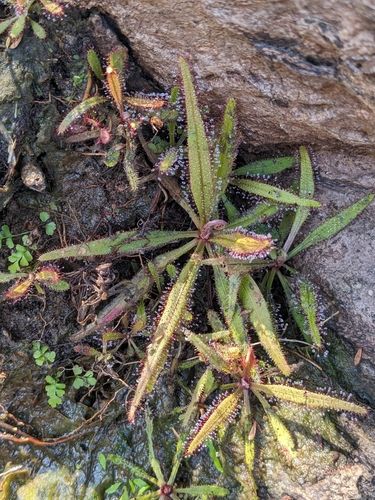
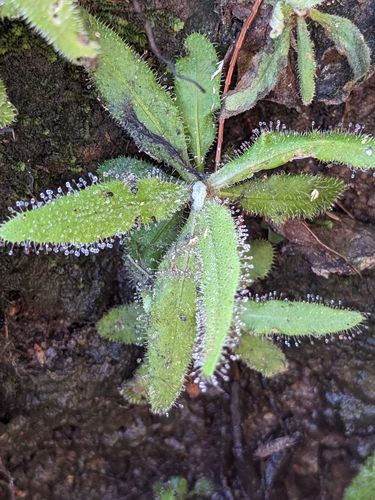
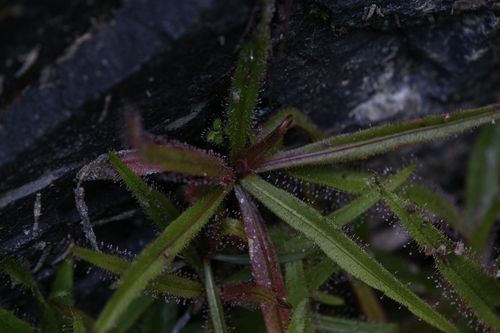
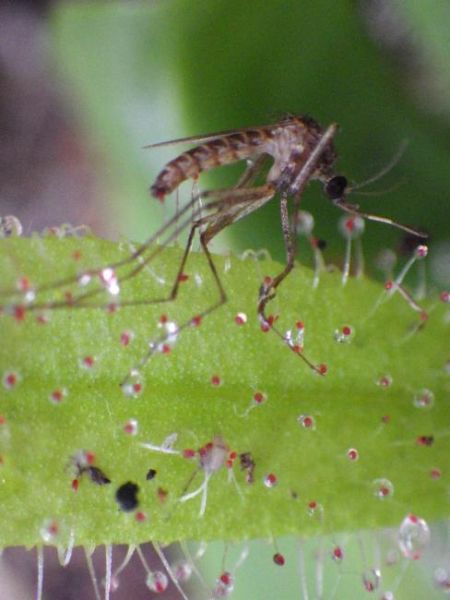
Etymology
- Drosera: from the Greek droserós, “covered with dew”, for the glistening droplets on its leaves.
- adelae: “of Adele”. The name is thought to honour a person called Adele (identity uncertain: Mueller did not specify it in the available sources).
History of the description
The great German-Australian botanist Ferdinand von Mueller describes it in 1864, in volume 4 of his Fragmenta phytographiae Australiae. In 1909, Ludwig Diels names a variety latior, which is now assigned to another species, D. schizandra.
Description (how to recognise it)
- Habit: tropical perennial plant, forming a rosette.
- Leaves: long, narrow and sword-shaped, 10 to 25 cm long by 7 to 10 mm wide, almost without a petiole. Green in shade, they become shorter and bronze in full light.
- Almost motionless tentacles: its sticky hairs move so slowly that it is “barely perceptible”.
- Flowers: in one-sided racemes up to 35 cm long, from June to November. They are small (about 3 mm), red, orange-red or cream, and their five petals form a perfect pentagon.
- Chromosomes: 2n = 30 (a cultivated plant with 2n = 28 may correspond to another form of the species).
Distribution
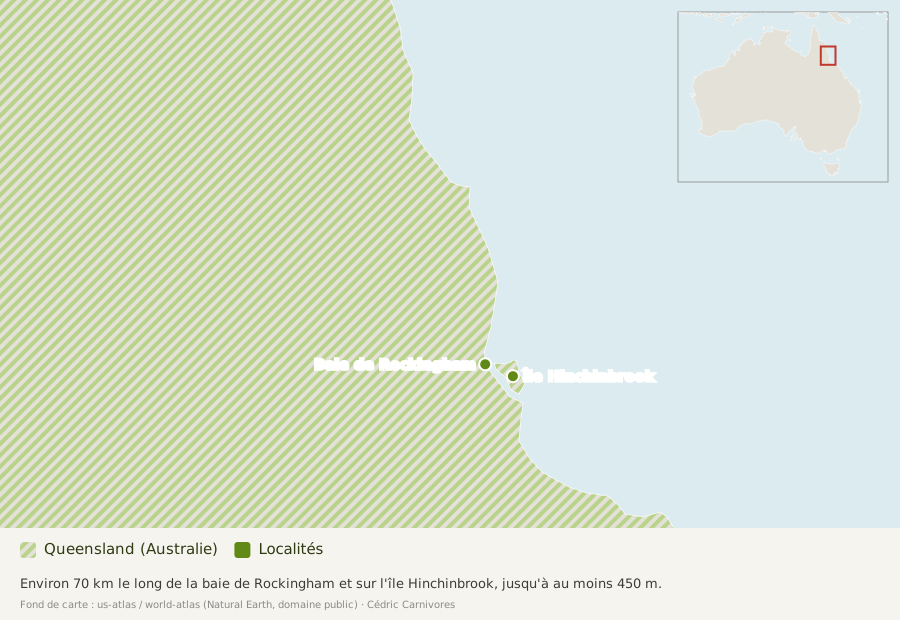
Endemic to Queensland, in Australia: over about 70 km, along Rockingham Bay and on Hinchinbrook Island, from sea level up to at least 450 m.
Habitat
- Deeply shaded edges of the tropical rainforests of north-eastern Australia;
- sandy soils beside streams;
- damp rocks near waterfalls.
Ecology
- It multiplies on its own: new plants grow from its spreading roots. As a result it often forms large clumps.
- It tolerates light frosts and can regrow from its roots after a short spell below 0 °C.
The “three sisters of Queensland”
D. adelae shares the rainforests of north-eastern Queensland with two close relatives, D. schizandra and D. prolifera. They are nicknamed the “three sisters of Queensland”. Each one lives in an area of its own:
- D. adelae in the south, around Rockingham Bay;
- D. schizandra about 100 km further north, on Mount Bartle Frere;
- D. prolifera another 140 km further north, on Thornton Peak.
Threats and protection
Listed as “rare” under the Queensland Nature Conservation Act (1992).
Did you know?
- Its tiny flowers form a perfect pentagon.
- Of the three sisters, it is the easiest to live with: it copes better with light, dry air and cool conditions.
Sources
- Wikipedia (English), Drosera adelae: Mueller 1864, Diels 1909, description, flowering, chromosomes, range, habitat, multiplication, status.
- International Carnivorous Plant Society, “The sisters of Queensland”: 70 km along Rockingham Bay, altitude, ranges of the three sisters.