Drosera arcturi Hook.
Species sheet, updated on 29/10/2026.
At a glance
| Scientific name | Drosera arcturi William Jackson Hooker, 1834 |
| Synonyms | D. atra, D. ligulata, D. polyneura, D. ruahinensis |
| Family | Droseraceae |
| Distribution | Mountains of south-eastern Australia, Tasmania, New Zealand |
| Habitat | Bogs, mountain lakes and seeps, mainly at altitude |
Photos in the wild
Etymology
- Drosera: see the genus sheet.
- arcturi: from the Latin, “of Arthur”, for Mount Arthur, in north-eastern Tasmania, its type locality.
Description (how to recognise it)
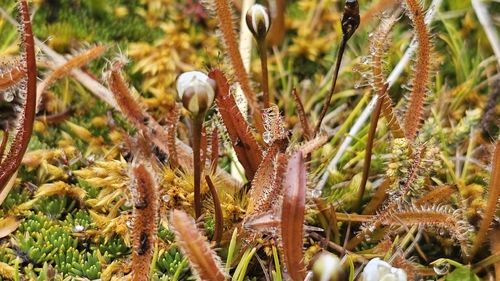
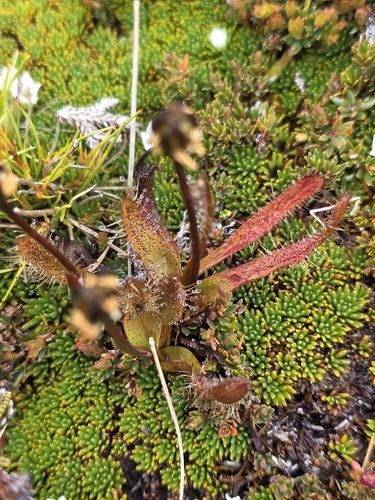
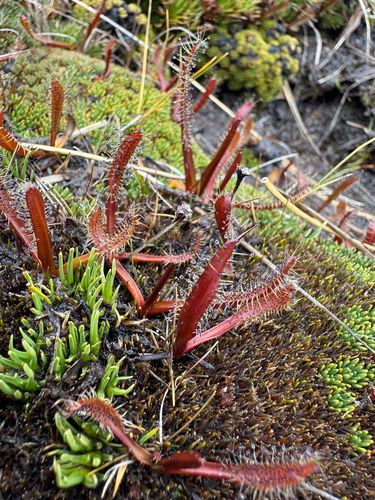
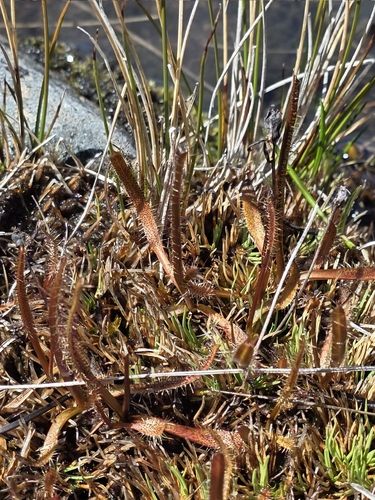
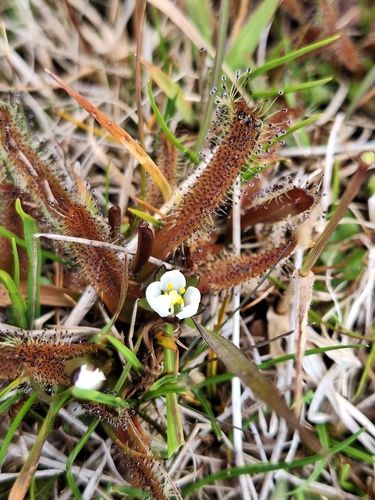
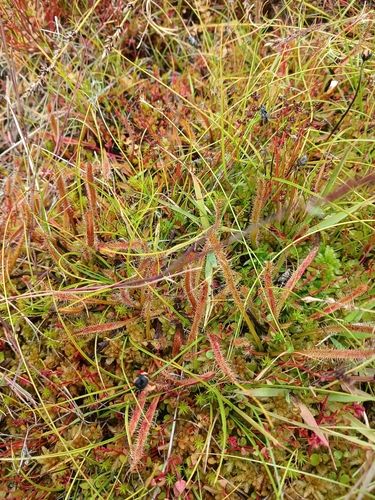
- Linear leaves 1 to 5 cm long, from pale green to muddy brown, turning burgundy in full sun; red glandular hairs.
- Young leaves are folded and open like a book.
- Flowers from November to February: the typical form bears a single white flower about 13 mm across; a giant lowland form bears 1 to 5 on a scape up to 25 cm tall.
Distribution
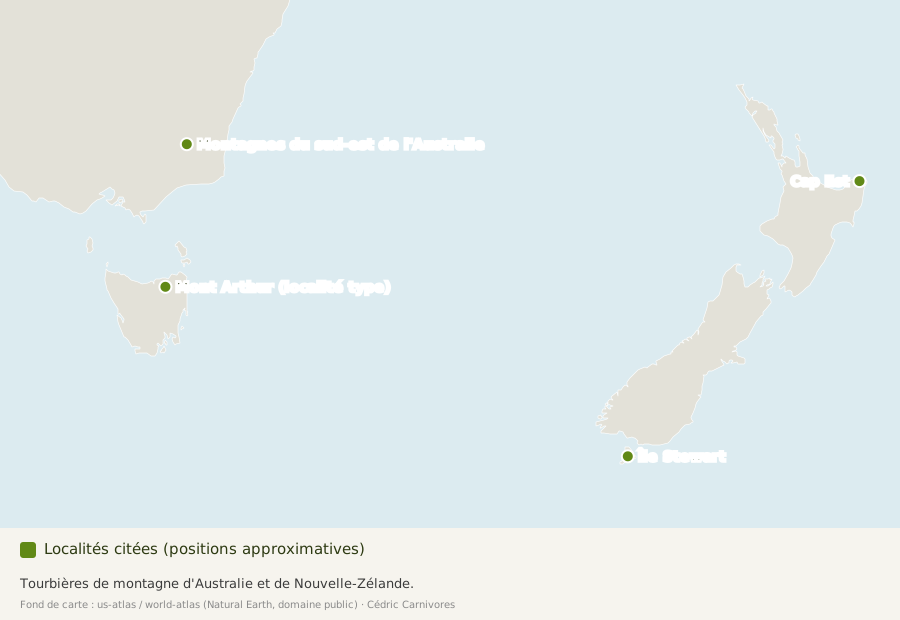
- New Zealand: from East Cape (North Island) to Stewart Island; above 1,500 m in the North Island, near sea level in the South Island.
- Australia: mountains of the south-east and Tasmania, sometimes near the sea in western Tasmania.
Habitat
Bogs, small mountain lakes, seeps and sphagnum bogs, mainly in the montane and alpine zones. In New Zealand, it often grows with Utricularia dichotoma.
Ecology: a snow sundew
After flowering, its leaves die back to a horn-shaped hibernaculum, buried in the soil or moss, often under snow for months. It is one of the two alpine sundews of New Zealand, together with D. stenopetala.
Sources
- Wikipedia (English), Drosera arcturi: Hooker, etymology, synonyms, description, flowers, range, altitudes, habitat, hibernaculum.
- Genus list: year 1834.