Drosera capensis L.
Species sheet, updated on 29/10/2026.
At a glance
| Scientific name | Drosera capensis Linnaeus, Species Plantarum, 1753 |
| Family | Droseraceae |
| Common names | Cape sundew; in French droséra du Cap |
| Distribution | Cape region of South Africa, from the south coast of the Western Cape to Port Elizabeth |
| Habitat | Permanently moist, nutrient-poor places: seepages, stream banks, coastal wetlands, from sea level to 1,800 m |
| Status | Least concern (South African Red List); invasive in New Zealand |
Photos in the wild
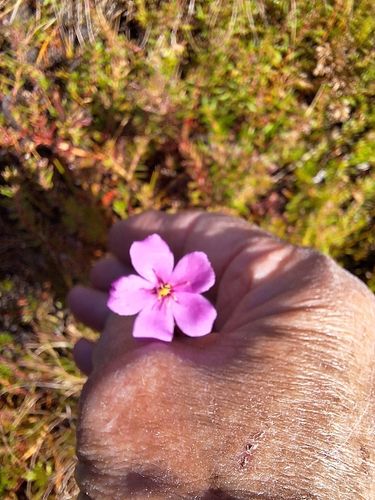
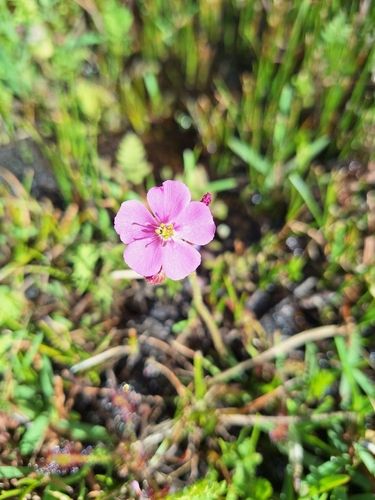
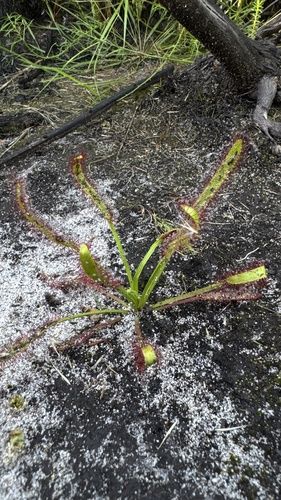
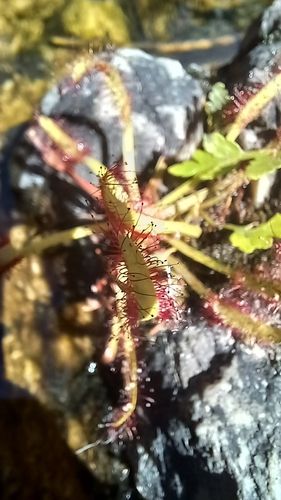
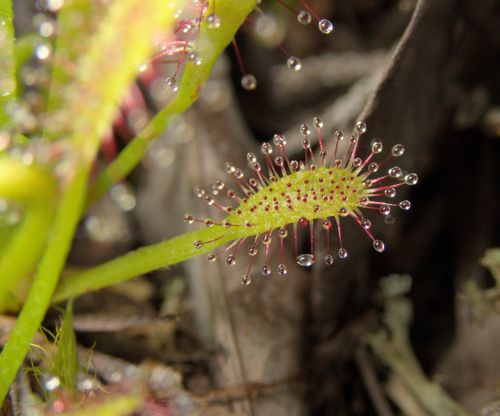
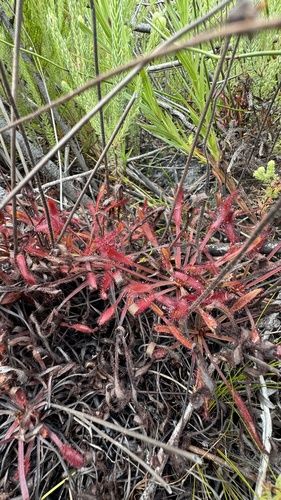
Etymology
- Drosera: from the Greek droserós, “covered in dew”, for the shining droplets on its leaves.
- capensis: “from the Cape”, the Cape of Good Hope region, in South Africa.
History of the description
It is one of the sundews known for the longest time: Linnaeus described it in 1753 in his Species Plantarum, citing three older descriptions.
Description (how to recognise it)
- Habit: a perennial rosette 10 to 15 cm in diameter, sometimes up to 30 cm.
- Leaves: narrow and elongated, half upright, with a clearly distinct petiole. They are covered with tentacles that secrete a sticky glue.
- Flowers: 1 to 3 scapes 15 to 25 cm tall, each bearing from 15 to more than 30 flowers, usually pale mauve, sometimes darker or white.
- Seeds: dark brown and shiny, 0.7 to 1 mm.
- Chromosomes: 2n = 40 (a tetraploid plant, with four sets of chromosomes).
Forms
The species is very variable. The specialist Richard Gibson distinguished nine forms in 2020, including:
- a broad-leaved form, known from Silvermine, Vogelgat and the former Bergvliet farm;
- a red-leaved form;
- a white-flowered form;
- dwarf and giant forms, and three spoon-leaved forms, one of them from Bainskloof Pass.
In cultivation, two cultivars are registered: 'Albino' (white flowers, no red colour at all) and 'Narrow Leaf' (narrow leaves).
Distribution
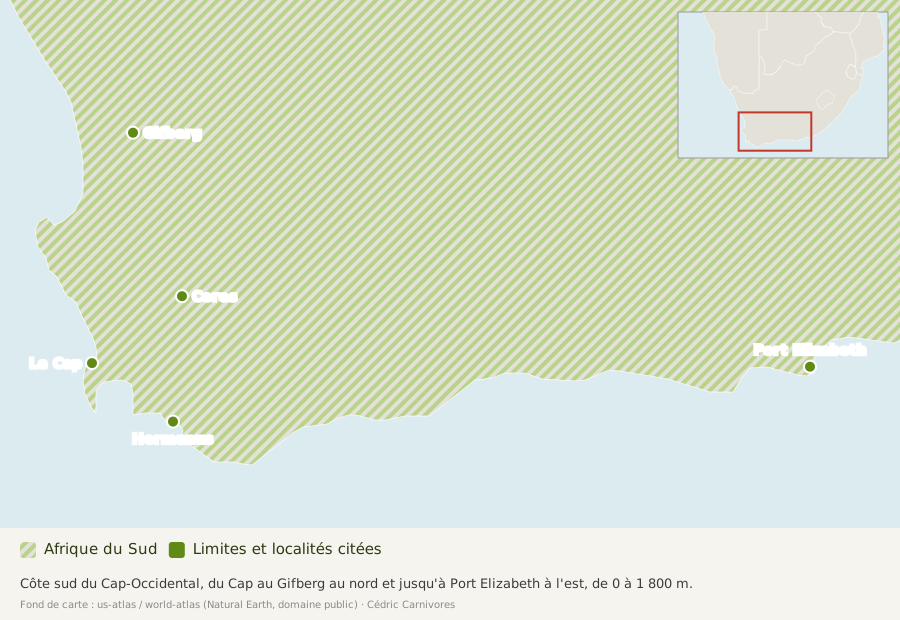
Cape region, in South Africa:
- the south coast of the Western Cape;
- northwards, from Cape Town to the Gifberg;
- eastwards, as far as Port Elizabeth, in the Eastern Cape.
Localities cited: Bredasdorp, Ceres, Hermanus, Paarl, Franschhoek, Jonkershoek, Tradouw Pass, Table Mountain National Park, Bainskloof.
Habitat
- Permanently moist, nutrient-poor places: seepages, stream banks, coastal wetlands, sheltered cliff bases;
- peaty or sandy soils, mossy rocks, quartzite scree, sphagnum mats;
- from sea level to 1,800 m.
It is often uncommon or local, but can become very abundant when competing vegetation disappears, for example after a fire.
Ecology
- A trap that curls up: when prey gets stuck, the tentacles at the edge bend towards it, and those nearby surround it. The whole leaf can then fold by more than 180° and curl around the insect. It folds further if the prey is near the tip of the leaf.
- A hormone at work: experiments have shown that this movement comes from growth triggered by a plant hormone, auxin.
- It fertilises itself: its flowers self-pollinate and produce many seeds.
A laboratory plant
The red-leaved form is the first sundew, and the first carnivorous plant in its group (the Caryophyllales), to have had its entire genome sequenced. It measures 264 million base pairs.
A conqueror
Very easy to grow, it has escaped from gardens in several parts of the world:
- New Zealand: listed on the national pest plant list, its sale and propagation are banned there. It is established in the Waitākere Ranges and is the subject of ongoing control near Auckland;
- Australia: one site in Royal National Park, with at least 100 adult plants;
- United States: dense stands in the Albion bog, in California, where it competes with the local sundew (D. rotundifolia) and has proved impossible to eradicate;
- also in Japan, Brazil and the Azores.
Threats and protection
- “Least concern” on the Red List of South African plants, and in a 2020 assessment using IUCN criteria.
Did you know?
- Its leaf can curl right around a fly.
- So easy to grow that it becomes invasive: in New Zealand, selling it is banned.
Sources
- Wikipedia (English), Drosera capensis: Linnaeus 1753, description, forms (Slack 1986, D'Amato 1998, Gibson 2020), range, localities, habitat, altitude, curling and auxin, self-pollination, chromosomes, genome, invasive species, statuses; references: Gibson 2020, Carnivorous Plant Newsletter 49(4): 173-180; Robinson et al. 2017, Drosera of the World vol. 3.