Drosera dichrosepala Turcz.
Species sheet, updated on 29/10/2026.
At a glance
| Scientific name | Drosera dichrosepala Nikolai Turczaninow |
| Former name | Drosera scorpioides var. brevipes (synonym) |
| Family | Droseraceae; subgenus Bryastrum, section Lamprolepis (pygmy sundews) |
| Common names | Rusty sundew; in French droséra rouillée |
| Distribution | Western Australia |
| Habitat | Laterite, around depressions and seeps that are wet in winter |
| Flowering | Mid-spring in the southern hemisphere; dormant in summer |
| Status | Endangered (IUCN, 2020 assessment) |
Photos in the wild
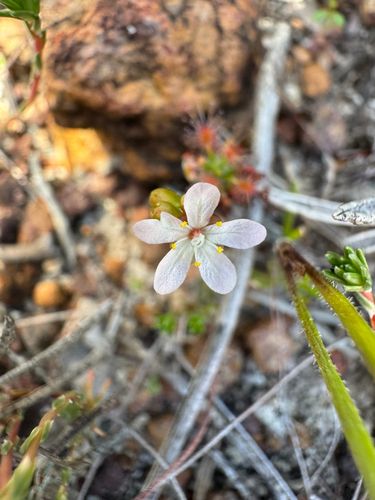
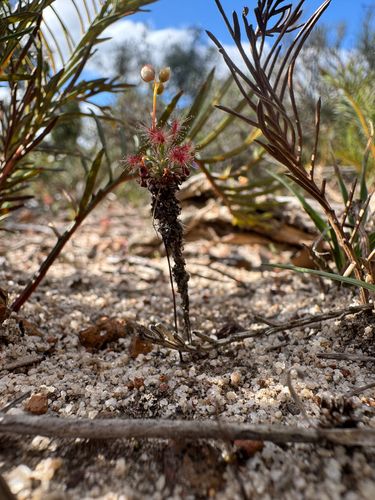
Etymology
- Drosera: from the Greek droserós, “covered in dew”.
- dichrosepala: from the Greek dis, “twice”, and chroia, “colour”, with the Latin sepalum, “sepal”: “with two-coloured sepals”. Its sepals have two colours.
History of the description
It was described by the Russian botanist Nikolai Turczaninow, who in the 19th century described a great many Australian plants from herbarium collections sent to Europe (year not confirmed). It has also been treated as a variety of D. scorpioides.
Subspecies
Two subspecies are often cited: subsp. dichrosepala and subsp. enodes. But Kew Gardens now treats enodes as a separate species, D. enodes. The classification of this group remains difficult.
Distribution
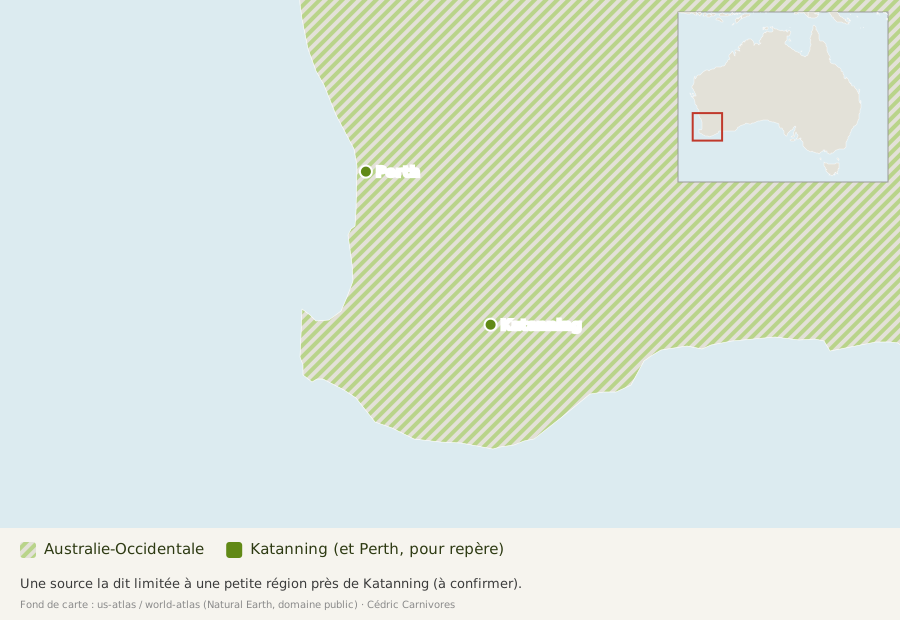
Western Australia. One source says it is restricted to a small area near Katanning (not confirmed).
Habitat
- Laterite-rich soils;
- around depressions and seeps that are wet in winter.
Threats and protection
Endangered on the IUCN Red List (assessment by A. Cross, 2020).
Did you know?
- Its English name, rusty sundew, refers to its colour.
Sources
- Wikipedia (English), Drosera dichrosepala: author, English name, etymology, synonym, subspecies, classification, IUCN status.
- Plants of the World Online (Kew), D. dichrosepala subsp. enodes: status of enodes.
- Fierce Flora, Drosera dichrosepala and Carlton Carnivores (summary of search results): Katanning, laterite, flowering.