Drosera falconeri Tsang ex K. Kondo
Species sheet, updated on 29/10/2026.
At a glance
| Scientific name | Drosera falconeri Tsang ex Katsuhiko Kondo, 1984 |
| Family | Droseraceae; subgenus Lasiocephala, D. petiolaris complex |
| Distribution | Northern part of the Northern Territory (Australia): Finniss River, Palmerston, Berry Springs, Melville Island |
| Habitat | Grey silty clays and alkaline calcareous sands |
| Flowering | November–December |
Etymology
- Drosera: from the Greek droserós, “covered in dew”.
- falconeri: in honour of Mr Falconer, who collected the first specimens along the Finniss River while gathering plants and tropical fish for Peter Tsang.
History of the description
- 1980: Peter Tsang announces the species. He thinks it belongs to the D. petiolaris group, because of the resemblance of its resting buds and roots.
- 1984: the Japanese botanist Katsuhiko Kondo publishes its formal description.
Description (how to recognise it)
- A perennial tropical rosette, with kidney-shaped leaves pressed flat on the ground, about 1.5 cm long by 2 cm wide, up to 3 cm on old plants.
- Like a Venus flytrap: the sticky glands carried on small stalks along the leaf margins are a little reminiscent of the bristles of the Venus flytrap.
- Flowers: white or pink, about a dozen per scape, opening one by one, in November–December.
- Chromosomes: 2n = 12.
Distribution
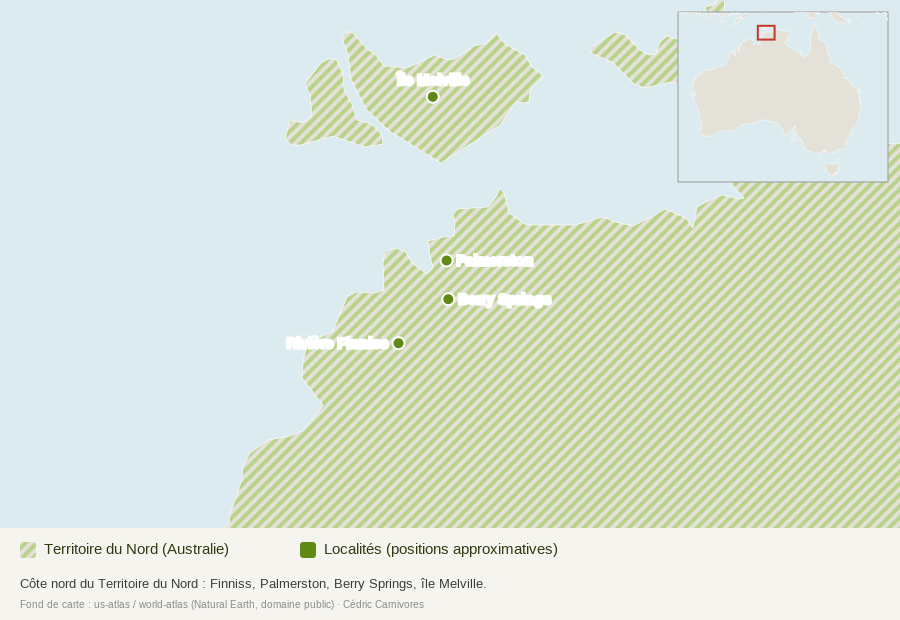
Endemic to the Northern Territory, in Australia, common on the north coast. Localities cited: Finniss River, Palmerston (where the plant sold in the shop comes from), Berry Springs and Melville Island.
Habitat
- Grey silty clays;
- alkaline calcareous sands with a high pH, which is very unusual for a carnivorous plant: the soil at the first site had a pH of about 8.
Ecology
- A cycle timed to the monsoon: during the dry season, its leaves die and the plant survives as a small bulb of leaf bases, just below the soil surface. It starts growing again with the first rains of the wet season.
- It hybridises easily with the other species of its group, such as D. dilatatopetiolaris.
Did you know?
- It likes calcareous soils, whereas almost all carnivorous plants live on acidic soils.
Sources
- Wikipedia (English), Drosera falconeri: Tsang 1980, Kondo 1984, etymology, petiolaris complex, description, flowering, chromosomes, localities, alkaline soils, dry-season dormancy, hybrids.