Drosera filiformis Raf.
Species sheet, 29/10/2026, based on the Flora of North America. Points marked “(not confirmed)” rest on a single, unreliable source.
At a glance
| Scientific name | Drosera filiformis Constantine Samuel Rafinesque, Medical Repository, hexade 2, 5: 360, 1808 |
| Family | Droseraceae |
| Common names | Threadleaf sundew, dew-threads; in French droséra filiforme |
| Distribution | Outer Atlantic Coastal Plain, in scattered patches, from Nova Scotia to northwest Florida |
| Habitat | Pond shores, seepage bogs, interdune hollows, coastal bogs, from 0 to 40 m |
| Flowering | Late May to September |
| Status | Least concern (IUCN); endangered in Canada |
Etymology
- Drosera: from the Greek droserós, “covered in dew”.
- filiformis: from the Latin filum, “thread”, and forma, “shape”: “thread-shaped”, for its very fine leaves. Its English name dew-threads means “threads of dew”.
History of the description
Constantine Samuel Rafinesque, the naturalist who also named Sarracenia leucophylla, described it in 1808 in a New York medical journal, the Medical Repository.
Description (how to recognise it)
- Habit: a rosette barely 1 cm across, from which thread-like upright leaves rise.
- A small bulb-like base: the base of the stem forms a small bulb (a “corm”) of 1 to 2 cm, made of the widened leaf bases. The stipules, fused to the leaves and fringed along the edges, give it a woolly look.
- Leaves: thread-like, 8 to 25 cm long (up to 30 cm), barely 1 mm wide. They are covered in red to purplish-red glandular hairs, which turn brown as they dry. There is no distinct petiole.
- They unroll like fern fiddleheads, a trait that is rare among sundews.
- Flowers: 4 to 12 (up to 24) flowers of 10 to 20 mm, with pink to purplish-mauve petals, on scapes of 6 to 26 cm, from late May to September.
- Seeds: black, ellipsoid, pointed at both ends, 0.5 to 0.8 mm, covered in small craters arranged in rows.
- Chromosomes: 2n = 20.
- Winter: it overwinters as resting buds (hibernacula).
Distribution
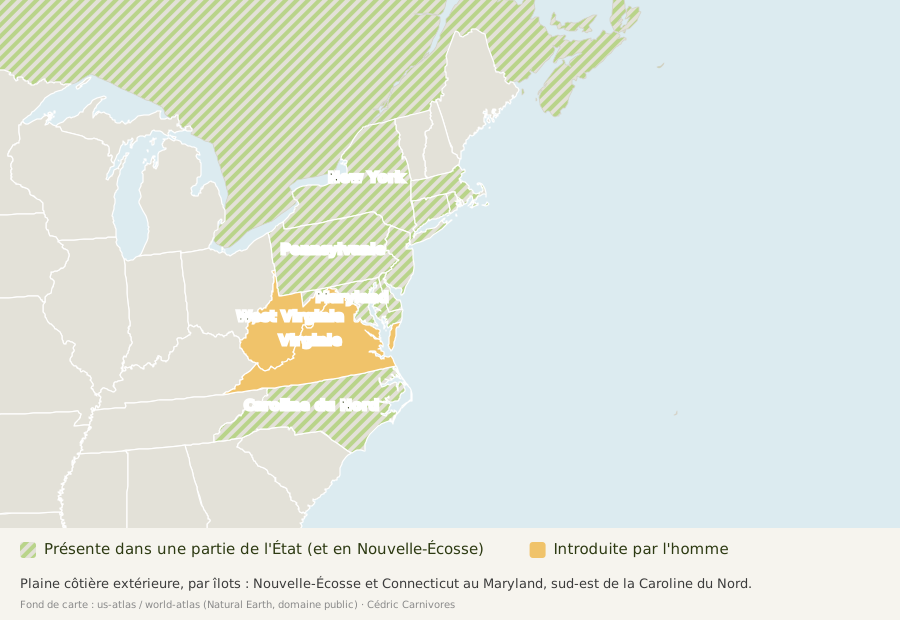
In scattered patches on the outer Atlantic Coastal Plain:
- from Nova Scotia (Canada) and Connecticut to Maryland;
- then in southeastern North Carolina.
States and provinces: Nova Scotia, Connecticut, Delaware, Maryland, Massachusetts, New Jersey, New York, North Carolina, Pennsylvania and Rhode Island.
What about Florida? The Flora of North America also cites populations in Bay and Washington counties, Florida. But since August 2026, these red plants have formed a separate species, Drosera floridana (see its sheet). It has been reported from South Carolina, but no specimen has been seen.
Introduced in Caroline County (Virginia) and Preston County (West Virginia), perhaps elsewhere too at the edge of its range. At some of these sites, it does not persist for long.
Why such a patchy range? Its isolated presence in Nova Scotia may be explained by a former land connection between Nova Scotia and Cape Cod, now under the sea (according to Wikipedia).
Habitat
- Exposed shores of freshwater ponds;
- seepage bogs and fens along streams;
- wet hollows between dunes;
- coastal bogs;
- roadside depressions and old wet quarries.
Altitude: from sea level to 40 m.
Its two Florida cousins
- The large Gulf Coast form, with green leaves of 30 to 50 cm, is a distinct species, Drosera tracyi: the botanist B. A. Sorrie gave the evidence for this in 1998. It is probably the plant the shop sells under the name “Florida giant” (not confirmed).
- The red form of Bay and Washington counties, long called “red filiformis” and then D. filiformis var. floridana (2017), became a separate species in August 2026, Drosera floridana. This is the plant the shop sells under the name “Drosera filiformis var. floridana”.
Hybrids
- The cross with Drosera intermedia gives the sterile wild hybrid D. × hybrida Macfarlane, known from New Jersey, and sold in the shop.
- Crossed artificially with D. tracyi, it gives the sterile cultivar 'California Sunset'.
Threats and protection
- “Least concern” for the IUCN.
- In Canada, it is listed as an endangered species on Schedule 1 of the Species at Risk Act.
- Threats: urban development, peat extraction, encroachment by shrubs.
Did you know?
- Its thread-fine leaves unroll like fern fiddleheads.
- A small population lives in isolation in Nova Scotia, hundreds of kilometres from the others.
Sources
- Flora of North America, vol. 6, p. 423, Drosera filiformis (T. L. Mellichamp), floranorthamerica.org/Drosera_filiformis: 1808 publication, names, full description, flowering, habitats, altitude, range and counties, introductions, D. tracyi as distinct (Sorrie 1998).
- Wikipedia (English), Drosera filiformis: varieties, fiddleheads, Nova Scotia–Cape Cod connection, statuses, threats.