Drosera floridana (B. Rice) Juve & Fleischm.
Species sheet, updated on 29/10/2026.
At a glance
| Scientific name | Drosera floridana (B. Rice) Noah Juve & Andreas Fleischmann, Carnivorous Plant Newsletter 55(4): 132-151, 2026 |
| First name | Drosera filiformis var. floridana B. Rice, 2017 |
| Family | Droseraceae |
| Common names | Florida threadleaf sundew; in French droséra filiforme de Floride; among growers, the “red filiformis” |
| Distribution | Only two counties: Bay and Washington, in the Florida Panhandle |
| Habitat | Seeps on quartz sand, on the shores of a few very nutrient-poor lakes |
| Distinctive feature | The sundew with the smallest range in North America |
Etymology
- Drosera: from the Greek droserós, “covered in dew”.
- floridana: “from Florida”, the only state where it lives.
History: from variety to species
- Its Florida populations were long placed in the threadleaf sundew, D. filiformis. Growers called it the “red filiformis”.
- 2017: Barry Rice, with Alastair Robinson and Andreas Fleischmann, made it a variety, D. filiformis var. floridana. It stands out by its red to orange leaves, its shorter scapes and petioles, and its range limited to Bay and Washington counties.
- August 2026: Noah Juve, now a student at the University of Florida, and the botanist Andreas Fleischmann raised it to the rank of a full species, based on its form, its ecology and its timing of growth and flowering. Smithsonian magazine then presented it as “the world's newest carnivorous plant”.
Description (how to recognise it)
- A sundew with thread-fine leaves, from the same group of forms as D. filiformis and D. tracyi.
- Red to orange leaves.
- Shorter scapes and petioles than in D. filiformis.
- A “death hug”: like its relatives, it slowly wraps its prey in its leaves. The insects die a slow, silent death.
Distribution
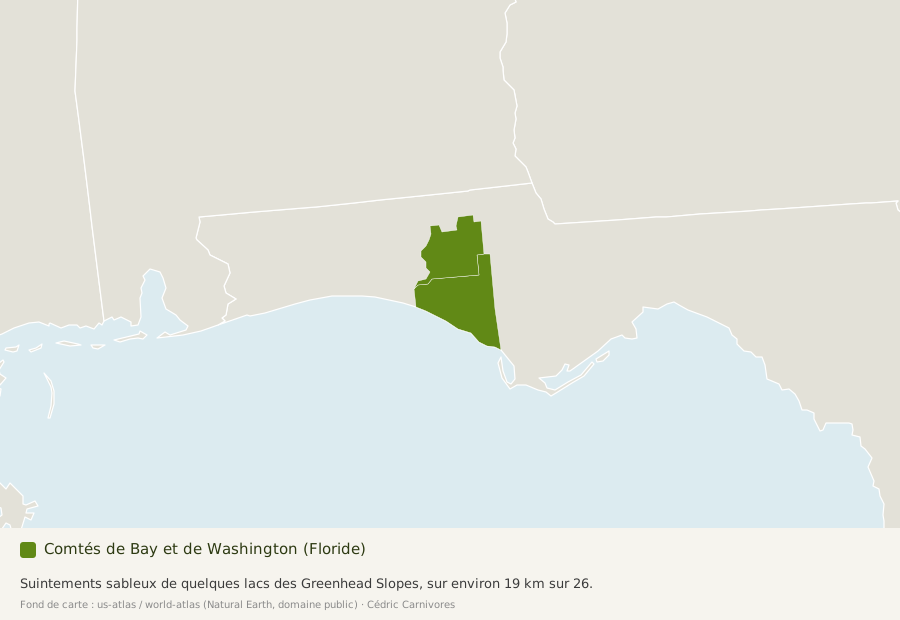
Endemic to the “Greenhead Slopes” lake region, in the Florida Panhandle: an area of about 19 km by 26 (12 miles by 16), straddling Bay and Washington counties. It is the smallest range of all North American sundews.
Habitat
- Seepage areas on quartz sand, on lake shores;
- a habitat found only at a few oligotrophic lakes, that is, very poor in nutrients, in Bay and Washington counties.
A hybrid turned species
Where it grows alongside D. tracyi, it forms a natural hybrid. The same authors raised it to species rank in 2026: Drosera × arenaria, from the Latin arena, “sand”.
Threats and protection
Its survival depends on a rare and disappearing habitat, the sandy seeps of a few Florida lakes.
Did you know?
- It is one of the most recently described carnivorous plants in the world, in August 2026.
- The whole species fits within a square about twenty kilometres on each side.
Sources
- Juve & Fleischmann 2026, Carnivorous Plant Newsletter 55(4): 132-151 (summary of search results): raising to species rank, criteria, range, habitat, D. × arenaria.
- Smithsonian Magazine, August 2026 (summary of search results): Noah Juve, “newest carnivorous plant”, “death hug”, 12-by-16-mile area, threatened habitat.
- Flora of the Southeastern US (FSUS), D. filiformis var. floridana: 2017 variety (Rice, Robinson & Fleischmann), characters, counties.
- Florida Plant Atlas, genus Drosera: already lists the species under the name D. floridana.