The genus Drosera
Genus sheet, updated on 29/10/2026.
At a glance
| Genus | Drosera Linné, Species Plantarum, 1753 |
| Common names | Sundews, “dew of the sun”; in French droséras, “rossolis” |
| Family | Droseraceae, together with the Venus flytrap (Dionaea) and the waterwheel plant (Aldrovanda) |
| Number of species | At least 194 according to Wikipedia; about 260 in our list, including recent descriptions |
| Distribution | Every continent except Antarctica; nearly half of the species in Australia |
| Habitat | Mostly wet, acidic, sunny places; some in forest, desert or shade |
Etymology
- Drosera: from the Greek drosos, “dew”, for the shining droplets of mucilage at the tips of the hairs.
- Sundew and the French rossolis both come from the Latin ros solis, “dew of the sun”: these droplets do not dry up in the sun.
History
- 1753: Linné publishes the genus in the Species Plantarum.
- 1875: Charles Darwin publishes Insectivorous Plants, largely based on his experiments with D. rotundifolia. He proves that these plants digest their prey. He even wrote that at the time he cared “more about Drosera” than about the origin of species.
Distribution
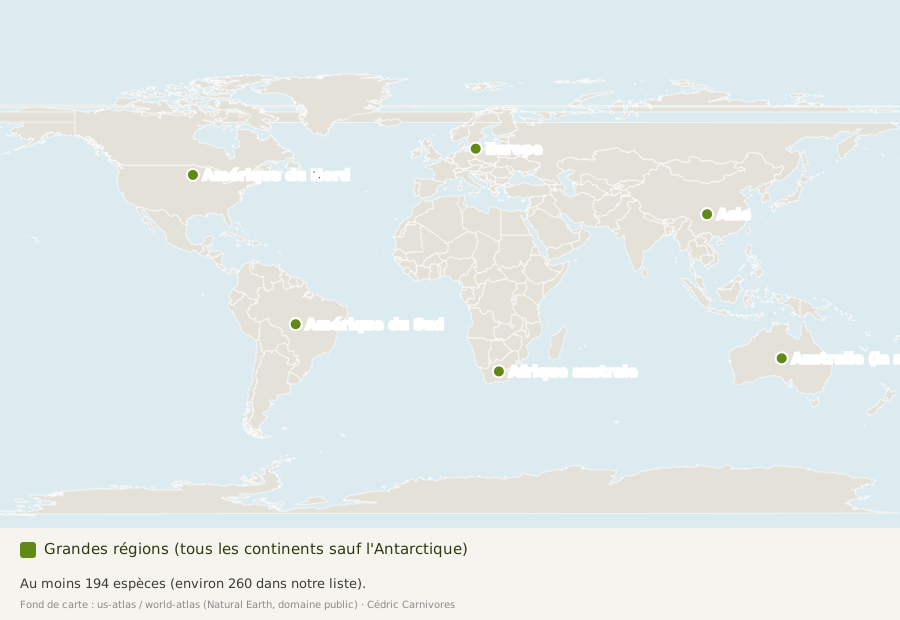
On every continent except Antarctica. Australia has about half of the species; South America and southern Africa each have more than twenty.
Habitat
Usually places that are wet for part of the year, acidic and sunny: peat bogs, marshes, wet meadows, Australian wallum heathlands. A few species live in tropical forest, in the desert or in deep shade.
The main life forms
| Form | Features | Examples |
|---|---|---|
| Temperate | spend the winter as a hibernaculum, a tight bud of leaves; all the species of Europe, northern Asia and North America | rotundifolia, anglica, intermedia, filiformis |
| Subtropical | grow all year round | capensis, spatulata, aliciae |
| Pygmy | some forty tiny Australian species that multiply by gemmae | see the pygmy sundews sheet |
| Tuberous | some fifty Australian species that spend the dry summer as a tuber | peltata, gigantea, erythrorhiza, macrantha |
| Petiolaris complex | 14 species from tropical Australia with hairy petioles | paradoxa, falconeri |
| Queensland sundews | 3 species of the tropical rainforest understorey | adelae, prolifera, schizandra |
How they trap
- Stalked glands (the “tentacles”) carry a drop of sweet, sticky mucilage that attracts and holds insects.
- Enzymes (esterases, peroxidases, phosphatases, proteases) digest the prey; sessile glands absorb the nutrients. The prey usually dies within a quarter of an hour.
- They move: the tentacles bend towards the prey, thanks to electrical signals and rapid growth. D. glanduligera folds in its “snap-tentacles” in a few tenths of a second; D. capensis wraps its whole leaf around the prey in half an hour.
Flowers and propagation
- The flowers, with five petals, are held high above the traps: this may prevent the pollinators from being caught. They open one by one, often only in sunshine.
- Many self-pollinate as they close. The seeds are tiny and black.
- They also multiply by gemmae (pygmies), stolons, plantlets on the roots or tubers.
- Some species live up to 50 years; D. erythrogyne climbs up to 3 m.
Uses
- Medicine: used in Europe since at least the 12th century, mainly against coughs. In Madagascar, the Zafimaniry treat dysentery and fever with D. madagascariensis.
- Drink: a liqueur is made from the leaves of D. capensis, D. spatulata and D. rotundifolia (the Italian rosolio, not confirmed).
- Dye: the tubers of some Australian species were used for dyeing; in the Scottish Highlands, D. rotundifolia gave a purple or yellow dye.
- Food: Aboriginal Australians ate the tubers of the tuberous species.
Threats and protection
- Many species are protected in Europe and Australia.
- Threats: drainage of wetlands, development, illegal collecting, climate change.
- In Madagascar, millions of D. madagascariensis are harvested every year for the pharmaceutical trade.
Relationships
Together with the Venus flytrap and the waterwheel plant, the sundews form the family Droseraceae. Drosophyllum and the Byblis, which look like them, belong to other families.
Sources
- Wikipedia (English), Drosera: etymology, number of species, Linné, Darwin, range, habitat, life forms, trap, enzymes, movements, flowers, propagation, lifespan, uses, threats.
- Genus list: about 260 species.
- (“Rossolis” in French and the Italian liqueur: general knowledge; not confirmed)