Drosera hilaris Cham. & Schltdl.
Species sheet, updated on 29/10/2026.
At a glance
| Scientific name | Drosera hilaris Adelbert von Chamisso & Diederich von Schlechtendal |
| Family | Droseraceae |
| Distribution | Southwestern tip of the Western Cape: mountains of the Cape Peninsula to Paarl and Caledon |
| Habitat | Lower slopes of sheltered, well-drained mountainsides, on sandstone |
| Status | Not threatened in 2005 (SANBI Red List, according to a secondary source) |
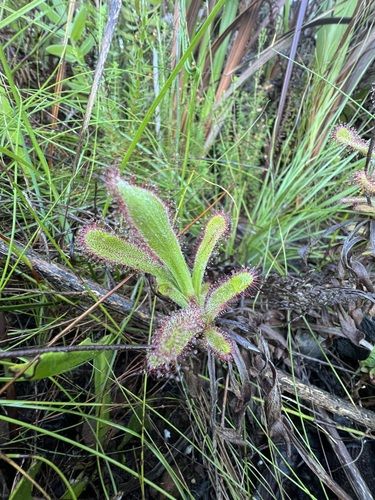
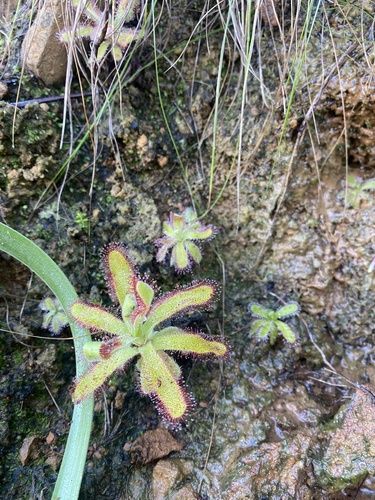
Photos in the wild
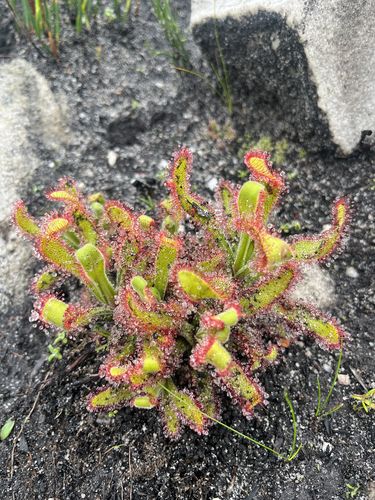
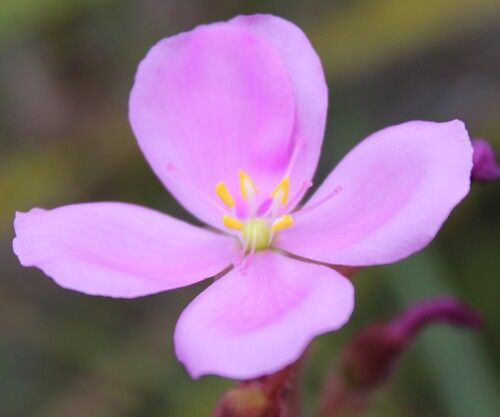
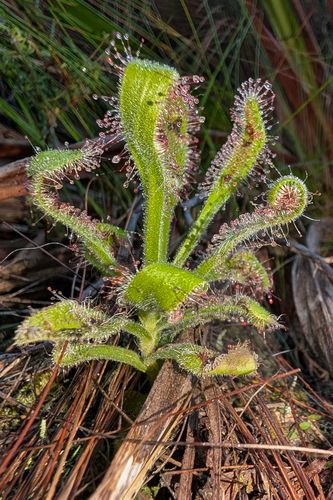
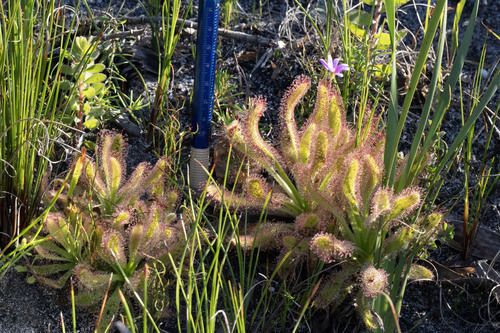
Etymology
- Drosera: see the genus sheet.
- hilaris: from the Latin, “cheerful, merry” (probable meaning, not confirmed).
Description (how to recognise it)
- According to Diels (1906): a robust plant; elongated stem covered with the remains of old leaves; widened petiole 0.5 to 3 cm long, with dense reddish-brown hairs; blade very narrow, elliptic to lanceolate, 4 to 6 cm by 0.7 to 1.1 cm, covered with reddish-brown hairs on both sides.
- Scape usually single, 20 to 30 cm tall, bearing 4 to 8 flowers; large dark purple petals 15 to 20 mm long.
Distribution
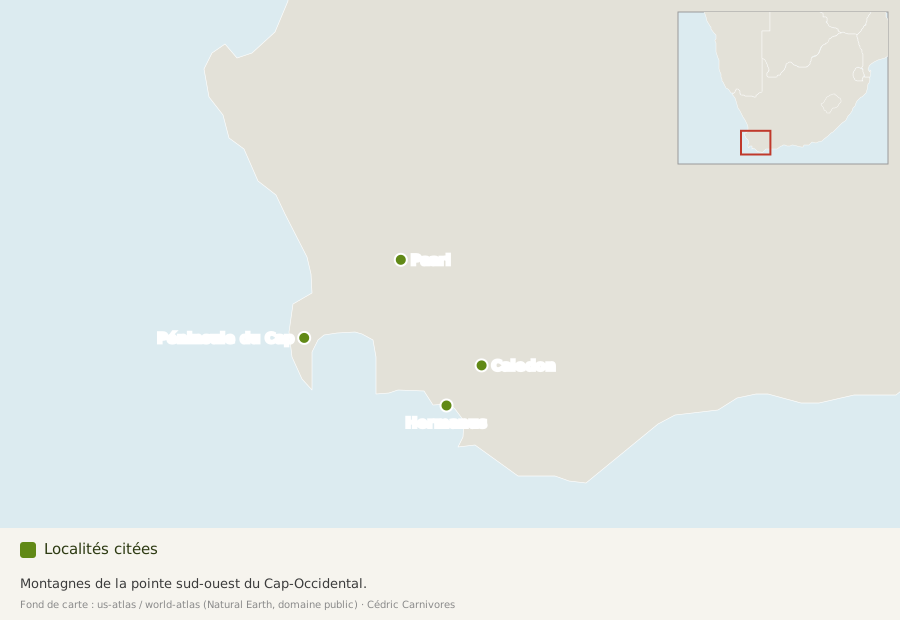
Restricted to the southwestern tip of the Western Cape, on the mountains of the Cape Peninsula as far as Paarl and Caledon; another source describes it along the coastal mountains from the Cape to Hermanus. According to Kew's world plant list (WCVP), it is native to this single region only: Cape Provinces.
Habitat
Sheltered spots on the lower slopes of mountains, on sandstone, well drained and not necessarily wet. Diels (1906) calls it fairly rare, in damp places on mountain slopes of the Cape Peninsula; one collection records it in heathland near Table Mountain, on black peaty soil, another on shady slopes of the Zwarteberg near Caledon. In flower from August to October.
Sources
- Fernkloof Nature Reserve, Drosera hilaris and Operation Wildflower (found through a search): range, habitat, 2005 status.
- World Flora DB: authors.
- GBIF, Drosera hilaris: author, original publication, countries and localities of herbarium specimens and observations.
- Kew, World Checklist of Vascular Plants (via GBIF): natural distribution.
- Diels, Das Pflanzenreich IV.112: Droseraceae, 1906 (archive.org): description, localities and habitats of the specimens (translated from Latin and German).