Drosera intermedia Hayne
Species sheet, 29/10/2026, based on the Flora of North America. Parent species of the hybrid D. × hybrida (D. filiformis × D. intermedia) sold in the shop.
At a glance
| Scientific name | Drosera intermedia Friedrich Gottlob Hayne, in Dreves & Hayne, Botanisches Bilderbuch 3: 18, plate 3B, 1798 |
| Former name | Drosera americana Willdenow (synonym) |
| Family | Droseraceae |
| Common names | Spoon-leaved sundew, spatulate-leaved sundew, oblong-leaved sundew, water sundew; in French droséra intermédiaire |
| Distribution | Very wide: eastern North America, the West Indies, Central and South America, Europe and Asia |
| Habitat | The wettest places, often under several centimetres of water, from 0 to 500 m |
| Flowering | June to August |
Photos in the wild
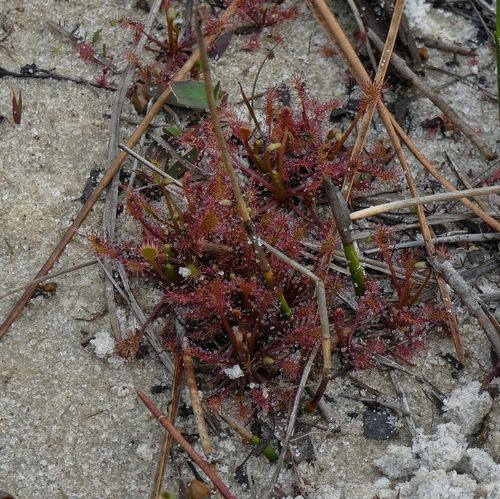
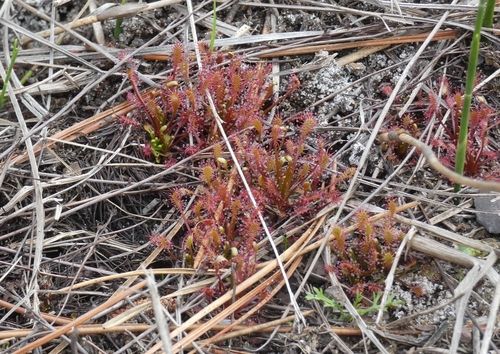
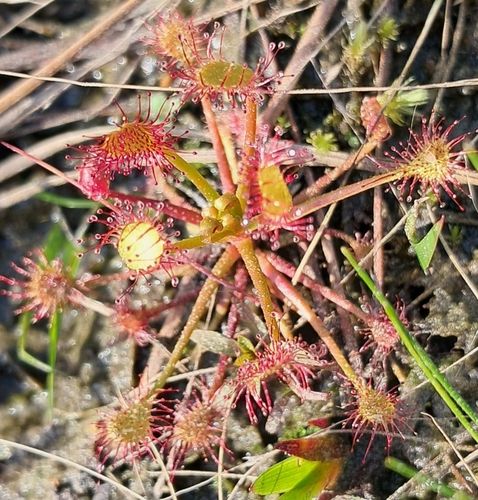
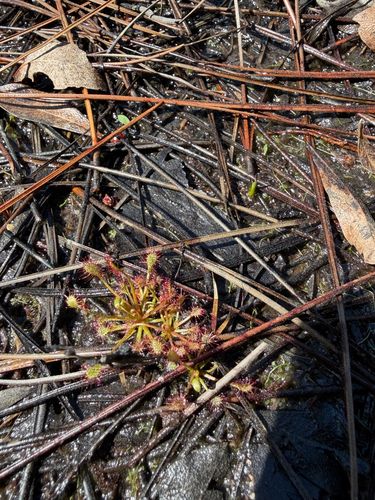
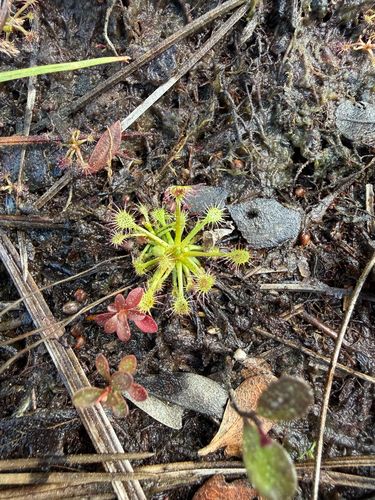
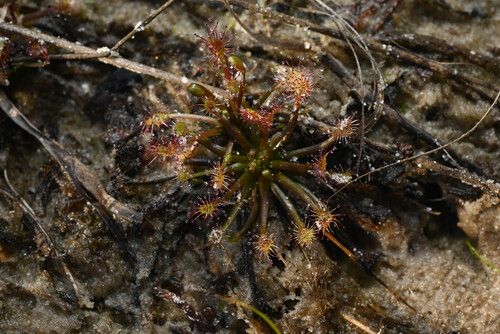
Etymology
- Drosera: from the Greek droserós, “covered with dew”.
- intermedia: a Latin word meaning “intermediate”. It was seen as intermediate between two other European sundews, the round-leaved sundew (D. rotundifolia) and the long-leaved sundew (D. anglica) (reason for the name, not confirmed).
History of the description
The German botanist Friedrich Gottlob Hayne described it in 1798, in an illustrated botany book, Dreves and Hayne's Botanisches Bilderbuch. It also bears the name D. americana, given by Willdenow, which is no longer accepted.
Description (how to recognise it)
- The only sundew with a true stem: it is the only species in the genus with a distinct stem, with leaves spaced along the stem, and an arching flower scape. The stem is 1 to 8 cm long, up to 20 cm.
- Rosettes: 3 to 6 cm, only in young plants.
- Leaves: erect to spreading, spoon-shaped; they first spread out at the base, then turn upwards.
- Flowers: 7 to 12 mm, with white petals, sometimes tinged with pink, on scapes 5 to 20 cm tall, from June to August.
- Seeds: reddish-brown, 0.7 to 1 mm, covered with small papillae.
- Chromosomes: 2n = 20.
A water plant
- It loves water: it grows in the wettest places, often in standing water. The deeper the water, the longer its stem grows: up to 20 cm in the south of its range.
- Winter: it forms resting buds at the tips of its erect stems. They drop to the ground and start growing again the following spring.
- Babies instead of flowers: it can multiply by producing small plants in place of flowers.
Forms
The botanist M. L. Fernald (1950) distinguished two forms:
- forma corymbosa: flowers grouped in a corymb (a flat-topped cluster) instead of a raceme;
- forma natans: with floating stems up to 20 cm long.
Distribution
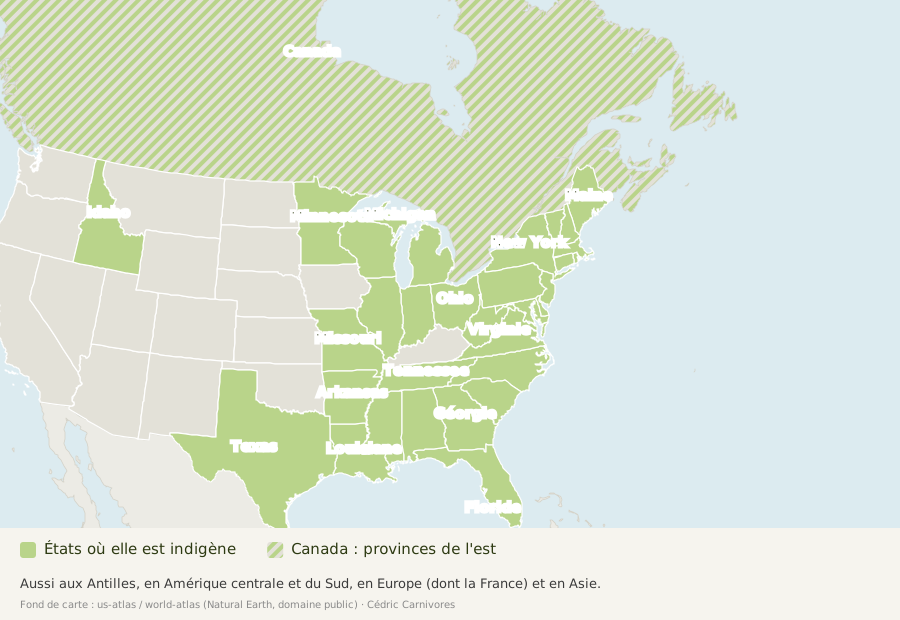
- Canada: New Brunswick, Newfoundland and Labrador, Nova Scotia, Nunavut, Ontario, Prince Edward Island, Quebec; and Saint Pierre and Miquelon (France).
- United States: Alabama, Arkansas, Connecticut, Delaware, District of Columbia, Florida, Georgia, Idaho, Illinois, Indiana, Louisiana, Maine, Maryland, Massachusetts, Michigan, Minnesota, Mississippi, Missouri, New Hampshire, New Jersey, New York, North Carolina, Ohio, Pennsylvania, Rhode Island, South Carolina, Tennessee, Texas, Vermont, Virginia, West Virginia and Wisconsin.
- Also in the West Indies, Central America, South America, and Europe and Asia: it also grows in France, in peat bogs.
Habitat
- In the north: bogs, beaver ponds, edges of wetlands, often on wet logs.
- In the south: soggy edges of streams, ponds, “bays” and ditches.
Altitude: from sea level to 500 m.
Natural hybrids
| Hybrid | Other parent | Where |
|---|---|---|
| D. × hybrida | D. filiformis | New Jersey |
| D. × beleziana | D. rotundifolia | Nova Scotia, Michigan |
| unnamed | D. capillaris | Pender County, North Carolina |
Did you know?
- It is the only sundew with a true, leafy stem.
- It is also found in France, and even in Saint Pierre and Miquelon.
In Florida
Based on the Atlas of Florida Plants and the specimens of the University of South Florida Herbarium.
- Status: Threatened on the State of Florida list.
- Herbarium: the University of South Florida Herbarium holds 24 collections made between 1961 and 2017 in 15 counties of Florida: Bay, Calhoun, Escambia, Gulf, Highlands, Lafayette, Lake, Okaloosa, Orange, Osceola, Pasco, Polk, Putnam, Santa Rosa and Walton.
- Habitats noted on the labels: hummocks at the edge of marshes, seepage bogs on organic muck, floating peat mats at the edge of lakes and of streams fed by cold springs, rain-fed bogs, edges of interdunal lakes, cypress swamps. The Atlas classes it among the “obligate wetland” plants.
- Flowering in Florida: from June to September.
Sources
- Flora of North America, vol. 6, p. 423, Drosera intermedia (T. L. Mellichamp), floranorthamerica.org/Drosera_intermedia: 1798 publication, synonym, names, full description, flowering, habitats, altitude, range, winter buds, small plants, Fernald's forms (1950).
- Flora of North America, Drosera tracyi: wild hybrids.
- Atlas of Florida Plants (University of South Florida), Drosera intermedia, and its herbarium specimens: status in Florida, counties, habitats, flowering.