Drosera linearis Goldie
Species sheet, 29/10/2026, based on the Flora of North America. Species not currently sold in the shop.
At a glance
| Scientific name | Drosera linearis John Goldie, Edinburgh Philosophical Journal 6: 325, 1822 |
| Family | Droseraceae |
| Common names | Linear-leaved sundew; in French droséra à feuilles linéaires |
| Distribution | Canada and the northern United States (Great Lakes, Maine, Montana) |
| Habitat | Marl fens, waterlogged limestone shores, often under a centimetre of water, from 10 to 400 m |
| Flowering | June to August |
Photos in the wild
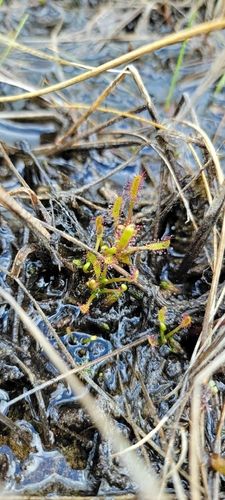
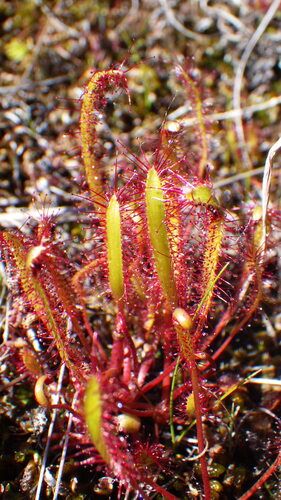
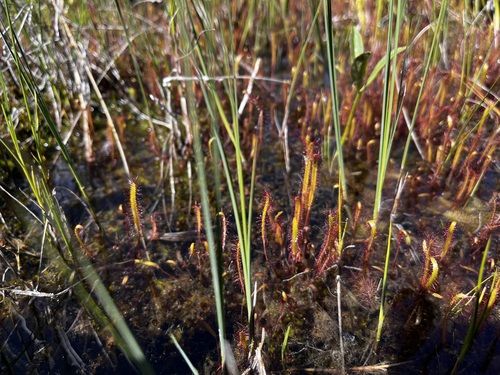
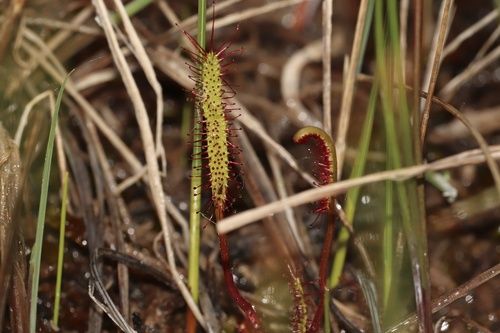
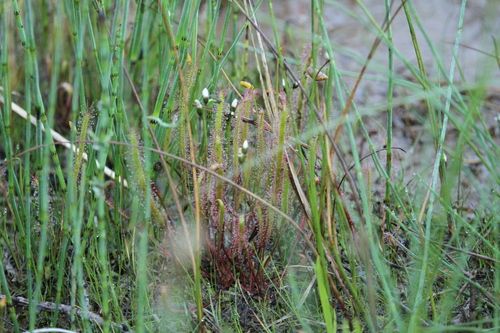
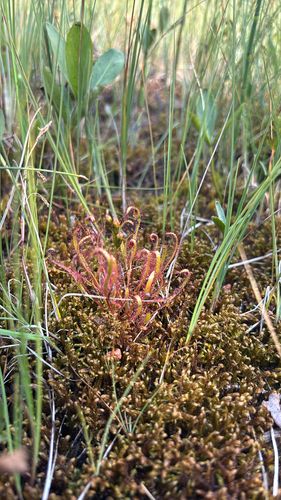
Etymology
- Drosera: from the Greek droserós, “covered in dew”.
- linearis: from the Latin linea, “line”: “linear”, for its narrow, straight leaves.
History of the description
It was described in 1822 by the Scottish botanist John Goldie, an explorer of the flora of Canada, in the Edinburgh Philosophical Journal.
Description (how to recognise it)
- Habit: a rosette 6 to 15 cm across, without a bulb-like base.
- Leaves: upright, with a flattened petiole 3 to 7 cm long, followed by a linear blade 1 to 6 cm long and 1.5 to 3 mm wide.
- Flowers: 1 to 8 small white flowers 6 to 8 mm across, on scapes 2 to 15 cm tall, from June to August.
- Seeds: black, 0.5 to 0.8 mm.
- Chromosomes: 2n = 20.
- Winter: it spends the winter as resting buds.
Distribution
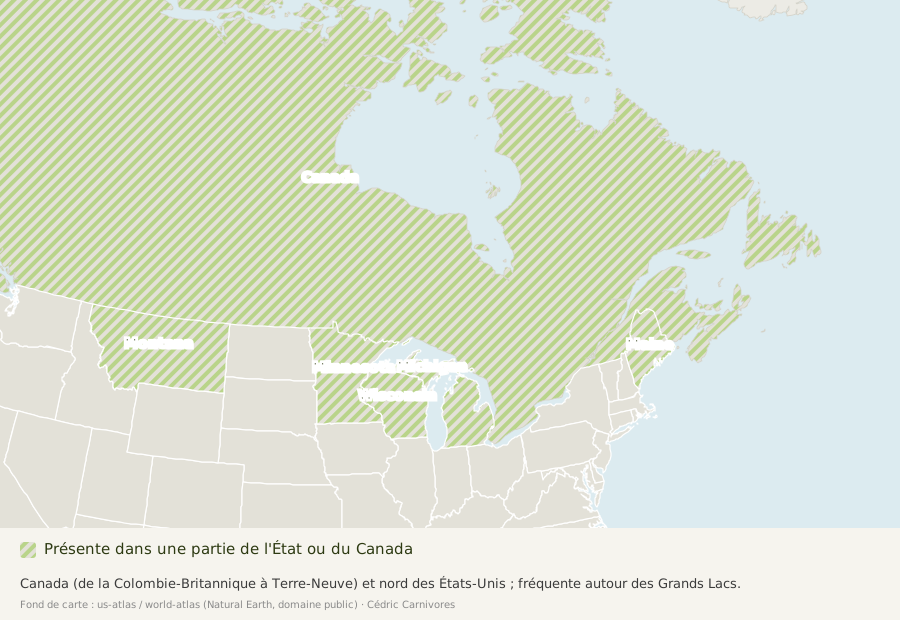
- Canada: Alberta, British Columbia, Manitoba, Newfoundland, Northwest Territories, Ontario, Quebec and Saskatchewan.
- United States: Maine, Michigan, Minnesota, Montana and Wisconsin.
- It is particularly common on the shores and marl fens of the western Great Lakes, in Michigan.
Habitat
- Marl fens (marl is a limy deposit);
- waterlogged limestone shores, often under a centimetre of water.
Altitude: from 10 to 400 m.
Ecology: three sundews, three niches
In Michigan, it often grows with two other sundews, and each has its own place:
- D. linearis on bare marl;
- D. rotundifolia on sphagnum hummocks;
- D. anglica rather at the foot of the hummocks and along the edges of the fens.
Hybrids
- D. × linglica: with D. anglica (Quebec).
- D. × woodii: with D. rotundifolia (Quebec).
Did you know?
- It may be the most difficult sundew to grow, especially in a warm climate.
- It likes limestone, like D. falconeri in Australia, which is rare among carnivorous plants.
Sources
- Flora of North America, vol. 6, p. 424, Drosera linearis (T. L. Mellichamp), floranorthamerica.org/Drosera_linearis: publication, names, description, flowering, habitat, altitude, range, coexistence of the three sundews (Schnell 2002), difficulty in cultivation.
- Flora of North America, Drosera tracyi: hybrids D. × linglica and D. × woodii.