Drosera magnifica Rivadavia & Gonella
Species sheet, updated on 29/10/2026.
At a glance
| Scientific name | Drosera magnifica Rivadavia & Gonella, Phytotaxa, 2015 |
| Family | Droseraceae |
| Distribution | Pico do Padre Ângelo, eastern Minas Gerais (Brazil) |
| Habitat | Sandstone outcrops in grassy and shrubby vegetation, 1 500-1 530 m |
| Status | Critically endangered (IUCN) |
Etymology
- Drosera: see the genus sheet.
- magnifica: from the Latin, “magnificent”.
History: discovered on Facebook
- 2012: an orchid grower, Reginaldo Vasconcelos, posts a photo on Facebook.
- A year later, the researcher Paulo Gonella sees it and realises it is a new species. The team sets off to collect it on the mountain.
- 2015: description by Fleischmann, Rivadavia and Gonella.
- It is the first plant species discovered thanks to photos posted on a social network.
Description (how to recognise it)
- The largest sundew in the New World: a stem up to about 1.20 m long, more than 1.50 m including the leaves.
- A candelabra-shaped inflorescence.
- Despite producing many seeds, no seedlings have been seen in the wild; young shoots arise from the stems or roots of old plants.
Distribution
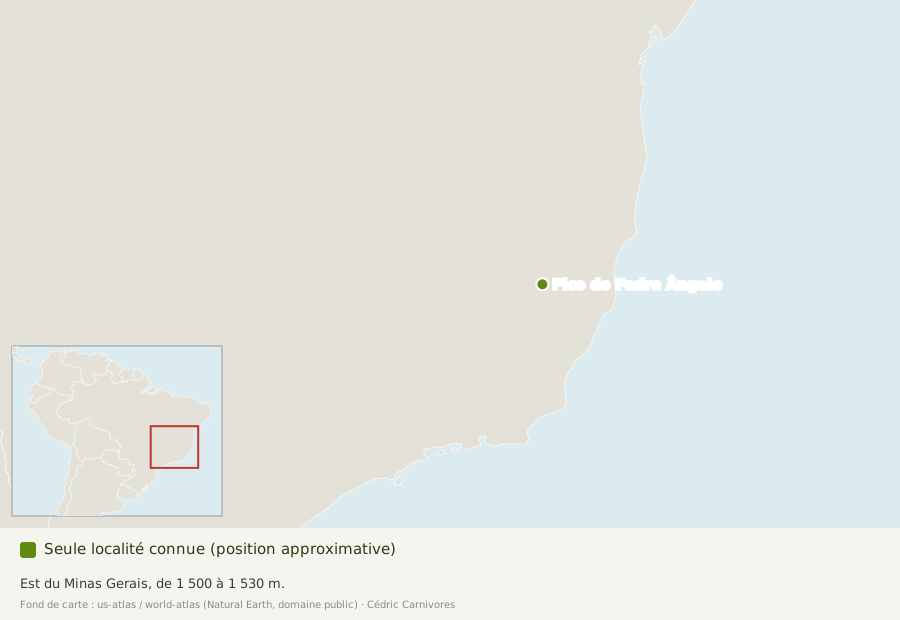
Endemic to Pico do Padre Ângelo, in eastern Minas Gerais (Brazil), from 1 500 to 1 530 m.
Habitat
Sandstone outcrops, in grassy and shrubby vegetation.
Relationships
Close to D. graminifolia and D. spiralis. Together with D. regia and D. gigantea, it is one of the three largest sundews.
Threats and protection
“Critically endangered” according to the IUCN: a single mountain.
Sources
- Wikipedia (English), Drosera magnifica: 2015 description, discovery on Facebook, size, inflorescence, propagation, range, altitude, habitat, relationships, status.