Drosera meristocaulis Maguire & Wurdack
Species sheet, updated on 29/10/2026.
At a glance
| Scientific name | Drosera meristocaulis Bassett Maguire & John Julius Wurdack, 1957 |
| Family | Droseraceae (only species of subgenus Meristocaulis) |
| Distribution | Northern slope of Pico da Neblina (Brazil-Venezuela border) |
| Habitat | Bogs and open savannas, marshes, stream banks, from 1 900 to 2 200 m |
Etymology
- Drosera: see the genus sheet.
- meristocaulis: from the Greek, “with a divided stem” (probable meaning, for its branched stem, not confirmed).
History
- 1953-1954: discovered during a New York Botanical Garden expedition to the Neblina.
- 1957: description by Maguire and Wurdack.
- 1985: only the second collection. Very few specimens of it exist.
- 1996: Jan Schlauer places it in a subgenus of its own, because of its ancient features.
Description (how to recognise it)
- Clumps of rosettes on a short, branched stem, up to about 15 cm tall.
- Red, spoon-shaped leaves 5 to 12 mm long.
- Pink flowers in December, with undivided styles, a unique feature among related sundews.
Distribution
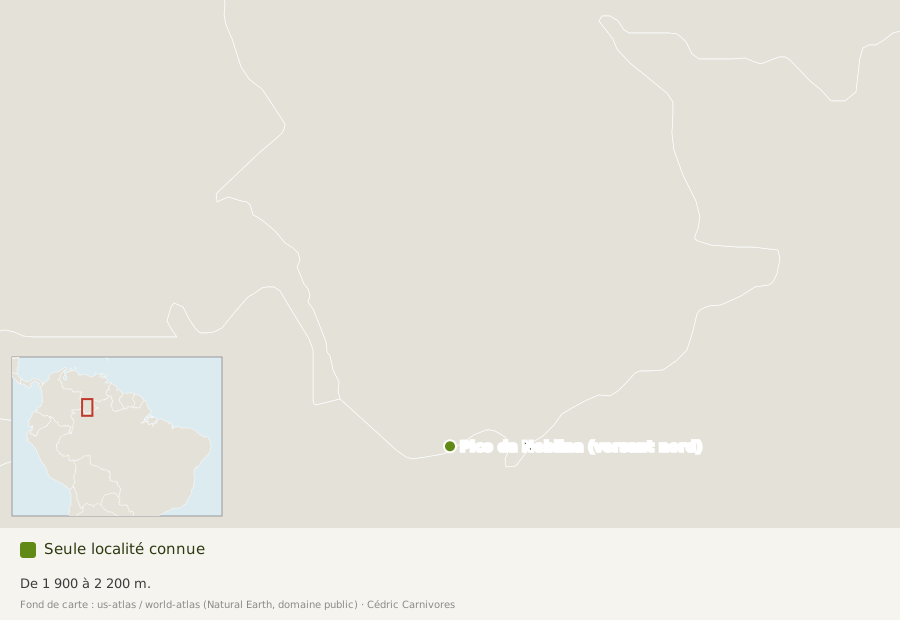
Endemic to Pico da Neblina, on the border between Brazil and Venezuela: a few valleys on the northern slope.
Habitat
Open bogs and savannas, marshes with Heliamphora neblinae, stream banks with Euterpe palms.
A puzzle: a cousin of the Australian pygmy sundews
DNA analyses place it closer to the pygmy sundews of Australia than to the other South American sundews. It may have reached America through long-distance dispersal by the wind.
Sources
- Wikipedia (English), Drosera meristocaulis: Maguire & Wurdack 1957, 1953-1954 expedition, 1985 collection, subgenus, description, range, altitude, habitat, relationships.