Drosera paleacea DC. (and D. roseana)
Species sheet, updated on 29/10/2026.
At a glance
| Scientific name | Drosera paleacea Augustin Pyramus de Candolle, Prodromus 1: 318, 1824 |
| Family | Droseraceae; subgenus Bryastrum, section Lamprolepis (pygmy sundews) |
| Common names | In English dwarf sundew |
| Distribution | South-west of Western Australia (Albany region) |
| Habitat | White sand and sandy clay |
| Flowering | September to December, sometimes January |
Etymology
- Drosera: from the Greek droserós, “covered with dew”.
- paleacea: from the Latin palea, “chaff, small flake”. The name may refer to flake-like scales on the plant (reason for the name, not confirmed).
History of the description
It was described in 1824 by the great Geneva botanist Augustin Pyramus de Candolle, in the first volume of his Prodromus, a vast flora of the whole world.
Description (how to recognise it)
- A tiny perennial rosette, up to 3 cm tall and 1.5 cm wide, on fibrous roots.
- Flowers: white to cream, from September to December or January.
And roseana?
- The plant sold under the name D. paleacea subsp. roseana is now considered a separate species, Drosera roseana N. G. Marchant & Lowrie, described in the Kew Bulletin in 1992 (47: 327).
- According to FloraBase, the official flora of Western Australia, it is not threatened.
- As its name suggests, its flowers are said to be pink (not confirmed).
Distribution
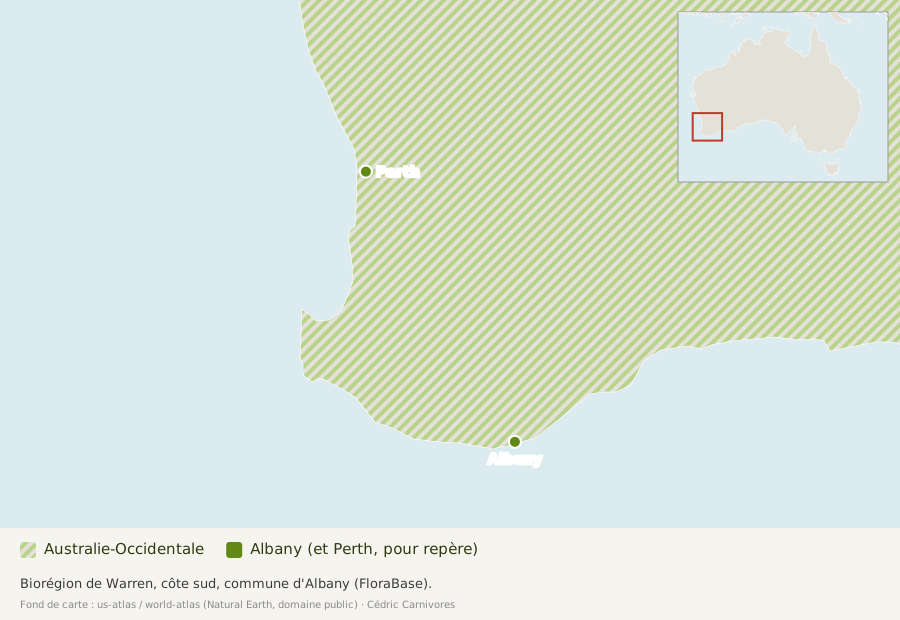
FloraBase places D. paleacea in the Warren bioregion, on the south coast of Western Australia, in the municipality of Albany.
Habitat
- White sand and sandy clay.
Threats and protection
FloraBase ranks D. paleacea as “Priority 1”, a poorly known species that needs monitoring. The list may not be up to date.
Sources
- FloraBase (Western Australia), Drosera paleacea: 1824 publication, description, flowering, soils, range, Priority 1.
- Wikipedia (English), Drosera paleacea: classification.
- FloraBase, Drosera roseana N. G. Marchant & Lowrie (summary of search results): 1992 publication, not threatened.