Drosera paradoxa Lowrie
Species sheet, updated on 29/10/2026.
At a glance
| Scientific name | Drosera paradoxa Allen Lowrie, Nuytsia 11(3): 347-351, 1997 |
| Family | Droseraceae; D. petiolaris complex |
| Distribution | Kimberley (Western Australia) and Northern Territory, as far as Arnhem Land and Kakadu park |
| Habitat | Shallow sands over sandstone, banks of seasonal creeks, sandstone crevices |
| Flowering | July to September |
| Status | Considered common and not threatened in 1997 |
Etymology
- Drosera: from the Greek droserós, “covered with dew”.
- paradoxa: “paradoxical”, “puzzling”. At first, botanists did not understand what they were seeing: depending on the population, it looked like an annual plant, a herbaceous plant, or a large adult plant. Repeated expeditions from 1993 to 1997 showed that these were the stages of a single life cycle, that of a perennial plant.
History of the description
The Australian botanist Allen Lowrie described it in 1997 in Nuytsia, the journal of the Western Australian Herbarium. The reference specimen was collected on 1 August 1996, near Wren Creek, on the Pantijan road (Western Australia).
Description (how to recognise it)
- A sundew on a stem: a perennial plant with a woody stem, up to 30 cm tall, topped by a single rosette.
- Leaves: tiny and almost round (2 to 3 mm), at the end of thin petioles 20 to 35 mm long.
- Flowers: pink or white, very numerous (50 to 70 per raceme), on scapes 20 to 40 cm tall, from July to September.
- Its close relative: D. petiolaris. The main difference: D. paradoxa has a tall woody stem, whereas D. petiolaris forms clumps of rosettes at ground level.
Distribution
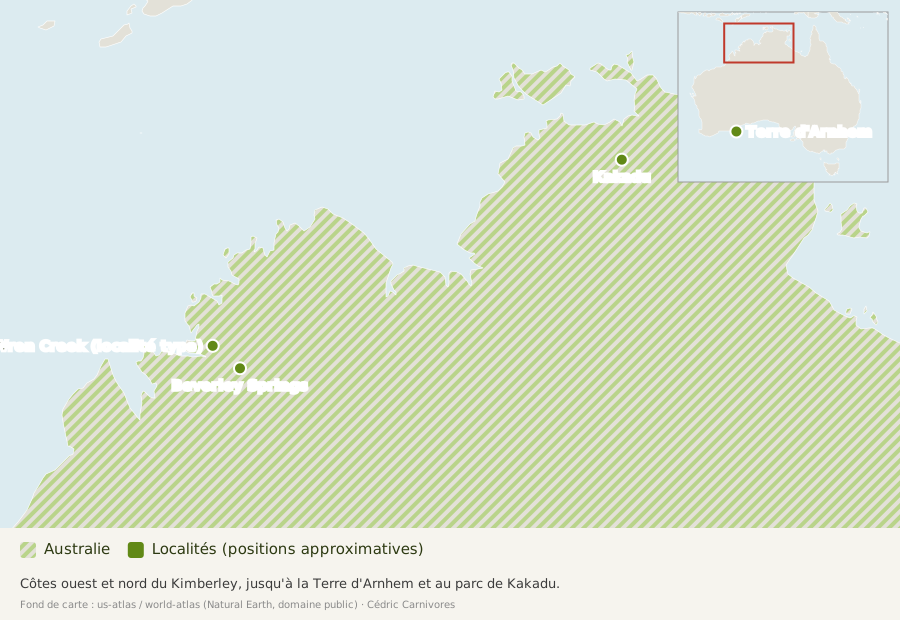
- Western Australia: along the west and north coasts of the Kimberley, and inland as far as Beverley Springs.
- Northern Territory: eastwards, as far as Arnhem Land and Kakadu National Park.
Habitat
- Shallow sands over sandstone;
- banks of creeks that are dry for part of the year;
- sandstone crevices.
During the rainy season (March-April), these places are swept by fast-flowing water.
Did you know?
- It took four years of expeditions to understand that plants looking so different belonged to a single species.
Sources
- Wikipedia (English), Drosera paradoxa: Lowrie 1997, etymology, reference specimen, description, flowering, range, habitat, relationship with D. petiolaris, status.