Drosera peltata Thunb.
Species sheet, updated on 29/10/2026.
At a glance
| Scientific name | Drosera peltata Carl Peter Thunberg, 1797 |
| Common names | Shield sundew, pale sundew; in French droséra bouclier, droséra pâle |
| Family | Droseraceae |
| Distribution | Eastern and western Australia, Tasmania, northern New Zealand, India, South-East Asia |
| Habitat | Open, frost-free flat ground, wet in winter and dry in summer |
Etymology
- Drosera: see the genus sheet.
- peltata: from the Latin, “shield-shaped”, for its stem leaves.
Description (how to recognise it)
- A tuberous sundew, erect, climbing or scrambling, 5 to 50 cm tall, with a simple or branched stem bearing small shield-shaped leaves.
- A tuber buried 4-6 cm deep.
- White or pale pink flowers; the colour of the plant is very variable.
Subspecies
| Subspecies | Distinctive feature |
|---|---|
| subsp. peltata | type form |
| subsp. auriculata (often treated as the species D. auriculata) | different seeds and sepal hairs |
Some authors also separate D. foliosa and D. gracilis. It may be a complex of several species.
Distribution
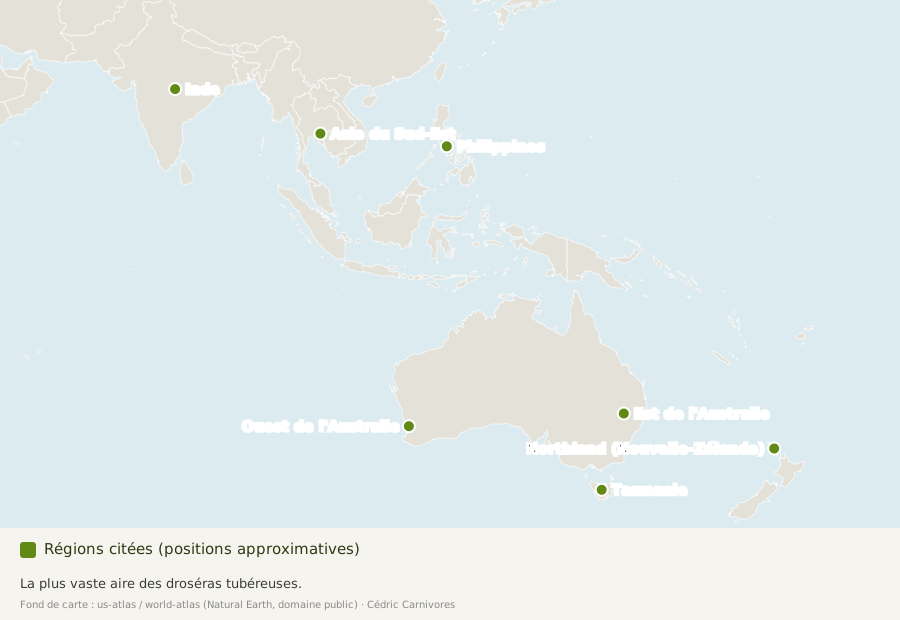
The largest range of all tuberous sundews: eastern and western Australia, Tasmania, northern New Zealand (Northland), India and a large part of South-East Asia, including the Philippines.
Habitat
Open, frost-free flat ground, open scrub, regenerating forests, grassy roadsides and banks; clay, peaty or sandy soils, wet in winter and dry in summer.
Ecology
It survives the summer drought as a dormant tuber, then regrows with the winter rains.
Sources
- Wikipedia (English), Drosera peltata: Thunberg 1797, names, etymology, description, tuber, subspecies, complex, range, habitat, dormancy.