Drosera prolifera C. T. White
Species sheet, updated on 29/10/2026.
At a glance
| Scientific name | Drosera prolifera Cyril Tenison White, 1940 |
| Family | Droseraceae, section Prolifera (with D. adelae and D. schizandra) |
| Common names | Trailing sundew, hen and chicks sundew |
| Distribution | Thornton Peak massif, near Cape Tribulation, in the Daintree region (Queensland, Australia) |
| Habitat | Streams in tropical rainforest and cloud forest, from sea level to 1 300 m |
| Status | “Vulnerable” under Queensland law (according to Wikipedia); another source says it is not threatened (not confirmed) |
Etymology
- Drosera: from the Greek droserós, “covered with dew”.
- prolifera: from the Latin, “producing offshoots”. Its flower scapes produce many small plantlets, which is also the origin of its English name hen and chicks.
History of the description
It was described in 1940 by the Queensland Government Botanist Cyril Tenison White.
Description (how to recognise it)
- Habit: a small rosette 5 to 8 cm across, sometimes more than 14 cm.
- Leaves: a rounded, kidney-shaped blade at the end of a long, thin petiole.
- Walking scapes: its flower scape lies down and acts as a stolon. All along its length it regularly produces new small plants, often in place of flowers. The plant thus gradually “spreads out”, hence its English name trailing sundew.
Distribution
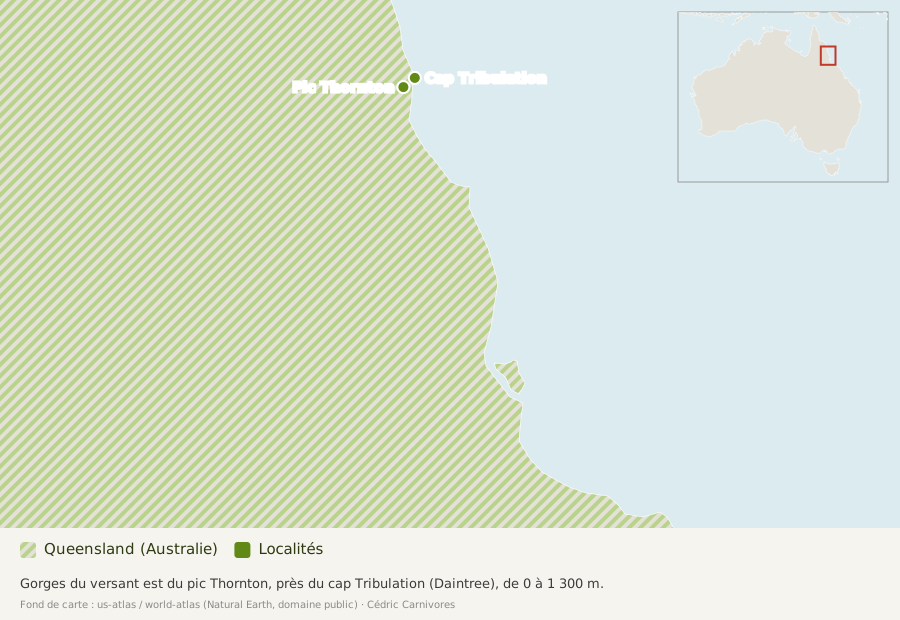
Endemic to the Thornton Peak massif, in the Daintree region, in the far north of Queensland. It lives only in the gorges on the eastern slope of Thornton Peak, near Cape Tribulation, from sea level up to 1 300 m.
Habitat
- Streams in tropical rainforest and cloud forest;
- seeps and running water;
- for example, sheltered, mossy seeps above flood level.
The “three sisters of Queensland”
See the sheet on D. adelae: D. prolifera is the northernmost of the three, 140 km north of D. schizandra.
Threats and protection
According to Wikipedia, it is listed as “vulnerable” under the Queensland Nature Conservation Act (1992). Another source (Rainforest Rescue), on the contrary, says it is not threatened (current status, not confirmed).
Did you know?
- Its flowers often turn into baby plants: the flower scape becomes a creeping stem that “walks” across the forest floor.
Sources
- Wikipedia (English), Drosera prolifera: White 1940, section Prolifera, status.
- International Carnivorous Plant Society, “The sisters of Queensland”: Thornton Peak, Cape Tribulation, 0 to 1 300 m.
- Fierce Flora, Drosera prolifera: Daintree, cloud forest, mossy seeps, leaf shape, small plants on the scape.
- Rainforest Rescue, trailing sundew: status.