Drosera regia Stephens
Species sheet, updated on 29/10/2026.
At a glance
| Scientific name | Drosera regia Edith Layard Stephens, 1926 |
| Family | Droseraceae |
| Common names | King sundew; in French droséra royale |
| Distribution | Only two sites, in the Bainskloof Mountains, near Wellington (Western Cape, South Africa) |
| Habitat | Marshy fynbos, peaty quartzite sand that is always wet, at 500 and 900 m altitude |
| Flowering | January-February (southern summer) |
| Status | Not assessed by the IUCN; considered at risk by the International Carnivorous Plant Society; among the most threatened sundews in the world |
Photos in the wild
Etymology
- Drosera: from the Greek droserós, “covered in dew”.
- regia: a Latin word meaning “royal”, for its spectacular appearance and huge leaves.
History of the discovery
- 1923: a certain J. Rennie finds a few plants beside a stream in the upper Baviaans Kloof and informs the South African botanist Edith Layard Stephens.
- More plants are later found on a plateau between South Ridge Peak and Observation Point.
- 1926: a second population is discovered about 6.5 km away, near the source of the Witte River. The same year, Stephens describes the species.
Description (how to recognise it)
- Giant leaves: up to 70 cm long and 2 cm wide, covered in tentacles along almost their whole length. They have no petiole and unroll like a crozier, as ferns do.
- A woody rhizome: it grows from horizontal, woody underground stems, a feature shared only with D. arcturi in the whole genus.
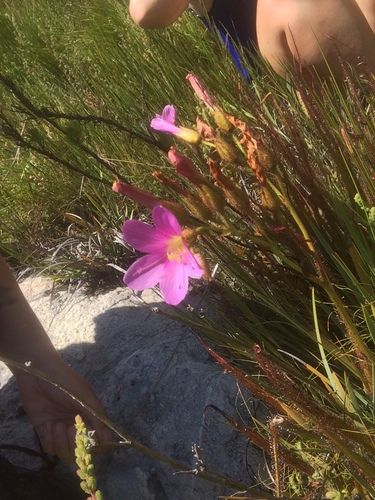
- Flowers: 5 to 20 (up to 30) pink, unscented flowers, with petals 2 to 3 cm long, on scapes up to 40 cm tall, in January-February. The style is not divided.
- Chromosomes: 2n = 34, an unusual number in the genus.
- Dormancy: it goes dormant during the cool season.
Distribution
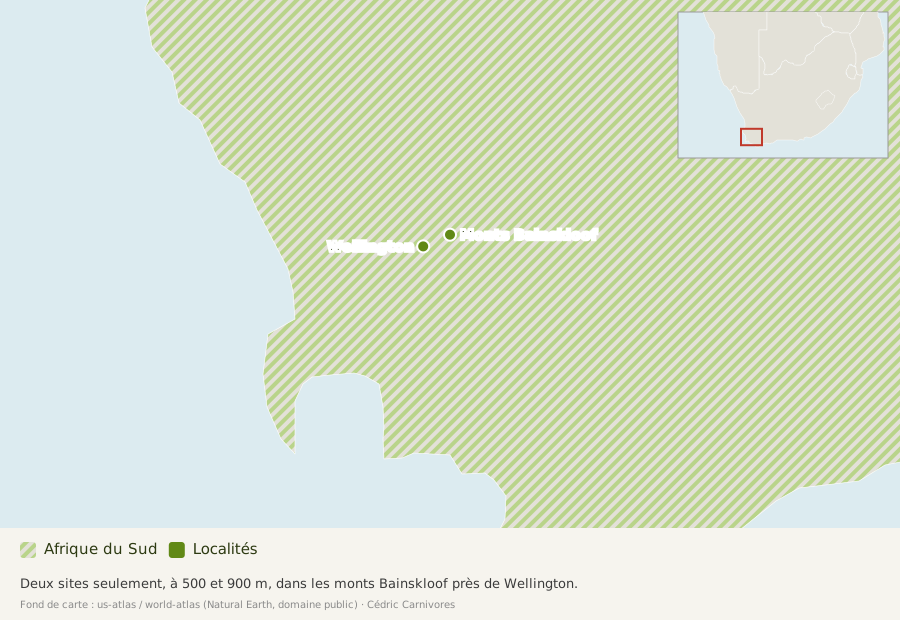
Endemic to South Africa, known from only two sites, at 500 and 900 m altitude, in the Bainskloof Mountains near Wellington (Western Cape). It has never been found in the neighbouring valleys, despite long searches. Each population covers only a few hundred square metres.
Habitat
- Fynbos (the shrubby vegetation of the Cape), among dense marsh grasses;
- at the lower site, a peaty quartzite sand, always wet, on a gravel bank in an old stream bed;
- neighbouring plants: Leucadendron, and plants of the sedge (Cyperaceae), iris (Iridaceae) and Restionaceae families;
- frosts are rare there.
Ecology
- Large prey: it catches beetles, moths and butterflies. Its leaves fold over and curl around the prey, which is held by the glue.
- Fire: it needs regular fires, which stop large plants from smothering it. Its intact roots regrow after a fire.
- Propagation: after flowering, it multiplies through its rhizome and roots.
- No seeds without a partner: its pollen cannot fertilise the flowers of the same clone. An isolated plant therefore produces no seeds.
A living fossil
D. regia is considered the oldest of the living sundews, at the base of the genus's family tree. It is close to the Venus flytrap and to Aldrovanda. Its sticky trap, which folds over the prey, may be a model of how the Venus flytrap's snap trap could have arisen.
Threats and protection
- In 2006, the botanist Andreas Fleischmann finds the upper site overgrown with vegetation and sees no plants there any more. The lower site has only about fifty adult plants. It is then one of the most threatened sundews in the world.
- In 2015, a fire changes everything: staff from the Stellenbosch botanical garden discover new plants at the lower site and find the species again at the upper site.
Did you know?
- Its leaves reach 70 cm: a record among sundews (not confirmed).
- It may resemble the ancestor of the Venus flytrap.
- A fire saved it in 2015.
Sources
- Wikipedia (English), Drosera regia: Stephens 1926, discovery in 1923 (J. Rennie), description, two sites, altitudes, habitat, prey, fire, pollination, phylogeny, decline (Fleischmann 2006), rediscovery after the 2015 fire, cultivar 'Big Easy'.