Drosera rotundifolia L.
Species sheet, updated on 29/10/2026.
At a glance
| Scientific name | Drosera rotundifolia Linné, 1753 |
| Common names | Round-leaved sundew; in French droséra à feuilles rondes, rossolis |
| Family | Droseraceae |
| Distribution | Circumboreal: Europe, Siberia, North America, Korea, Japan, eastern China, as far as the Philippines and New Guinea |
| Habitat | Bogs, marshes and fens, often among sphagnum |
| Status | Least concern (IUCN); protected in several countries and states |
Photos in the wild
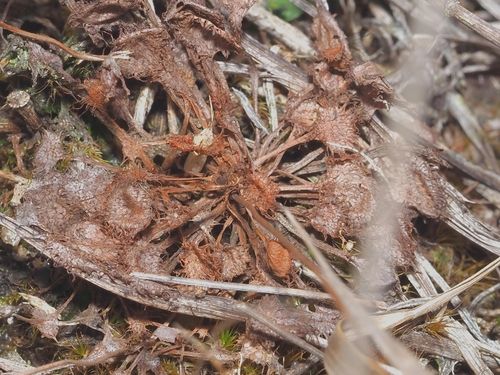
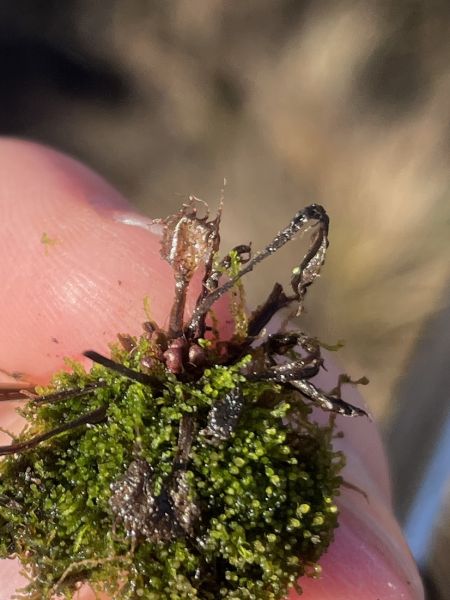
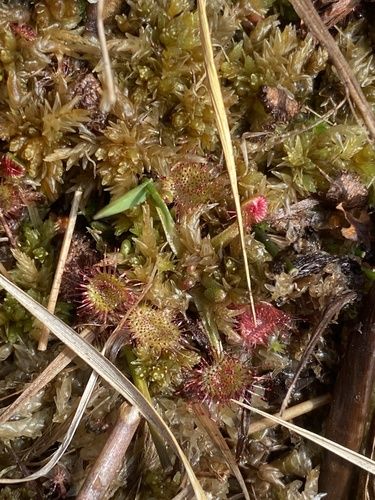
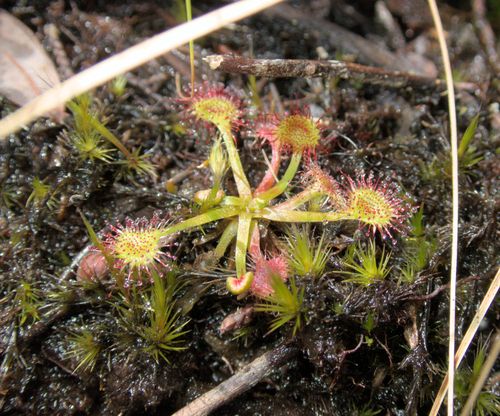
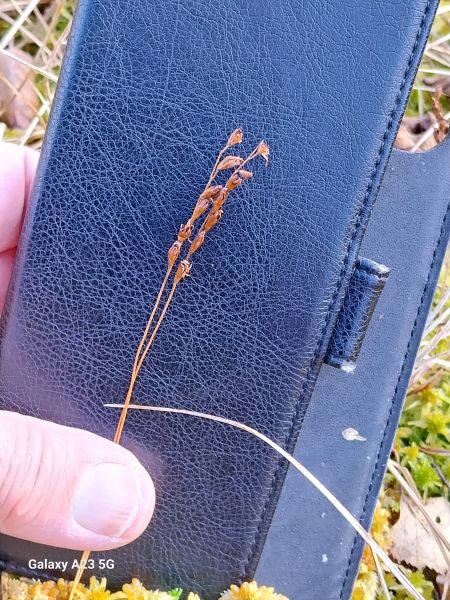
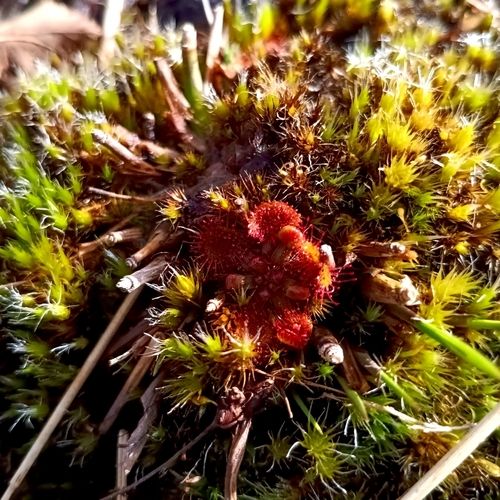
Etymology
- Drosera: see the genus sheet.
- rotundifolia: from the Latin, “with round leaves”.
History
- 1753: Linnaeus describes it.
- 19th century: it is on this plant that Charles Darwin carries out most of the experiments in his book Insectivorous Plants (1875), which prove that plants can be carnivorous.
Description (how to recognise it)
- A rosette 3 to 5 cm across, with round leaves 4 to 10 mm wide, borne on hairy petioles 1.3 to 5 cm long.
- Red hairs covered in mucilage on the upper side of the leaves.
- White or pink flowers, with five petals, on a slender scape 5 to 25 cm tall.
- In winter, it shrinks to a hibernaculum, a bud of tightly packed leaves at ground level.
Distribution
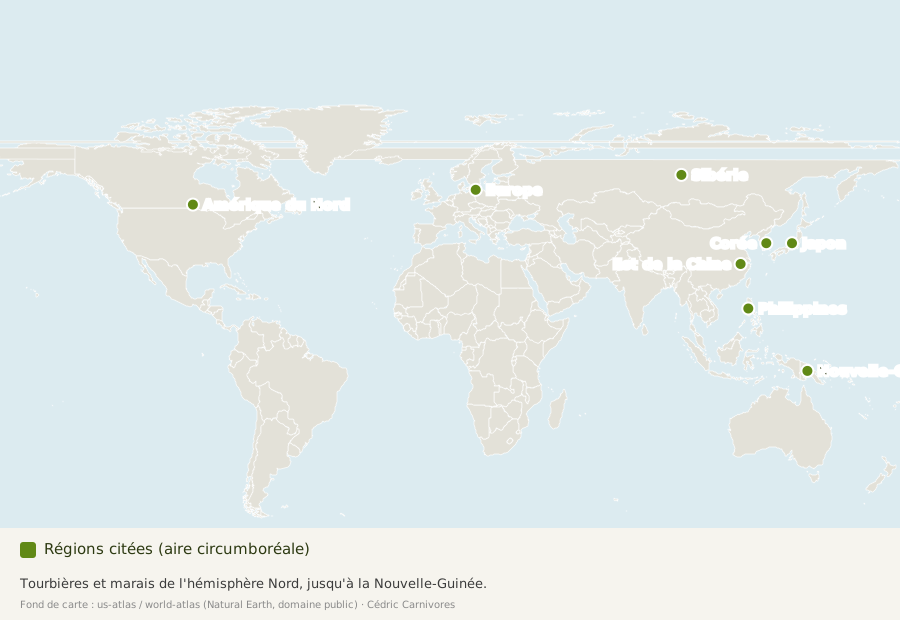
Circumboreal: a large part of Europe (including France), Siberia, part of North America, Korea, Japan, eastern China, and as far as the Philippines and New Guinea.
Habitat
Bogs, marshes and fens, including wet black spruce forests and sphagnum bogs, in open places, sunny or in half-shade.
Ecology
Insects are attracted by the sweet mucilage and get stuck. The plant digests them with its enzymes and absorbs the ammonia and other nutrients: an adaptation to poor, very acidic soils.
Natural hybrids
With D. anglica (D. × obovata) and D. intermedia (not confirmed; and to be completed, not confirmed). D. anglica itself arose from a cross between D. rotundifolia and D. linearis.
Uses
- It is credited with anti-inflammatory and antispasmodic effects, attributed to flavonoids (hyperoside, quercetin). It was long used against coughs.
- In the Scottish Highlands, it was used to make a purple or yellow dye.
Threats and protection
“Least concern” for the IUCN, but endangered in Illinois and Iowa, threatened in Tennessee, and protected in several European countries.
Did you know?
- It is the county flower of Shropshire, in England, Darwin's home region.
Sources
- Wikipedia (English), Drosera rotundifolia: Linnaeus 1753, names, description, hibernaculum, carnivory, range, habitat, chemistry, statuses, Shropshire.
- Wikipedia (English), Drosera: Darwin, Scottish dye.
- Wikipedia (English), Drosera anglica: origin of D. anglica.
- (D. × obovata and hybrid with D. intermedia: general knowledge; Shropshire “Darwin's home region”: biographical reminder, not confirmed)