Drosera tracyi (Diels) Macfarl.
Species sheet, 29/10/2026, based on the Flora of North America. The “Drosera filiformis, Florida giant” sold in the shop probably corresponds to this species *(not confirmed); the “var. floridana” is now Drosera floridana (see its sheet).*
At a glance
| Scientific name | Drosera tracyi (Diels) John Muirhead Macfarlane, in L. H. Bailey, Standard Cyclopedia of Horticulture 2: 1077, 1914 |
| First name | Drosera filiformis var. tracyi Diels, 1906 |
| Family | Droseraceae |
| Common names | Tracy's sundew, Gulf Coast threadleaf sundew; in French droséra de Tracy |
| Distribution | Gulf Coastal Plain, from south-west Georgia to south-east Louisiana |
| Habitat | Seepage bogs, edges of pine savannas, ditches, shores of sinkhole ponds, from 0 to 70 m |
| Flowering | Late May–June |
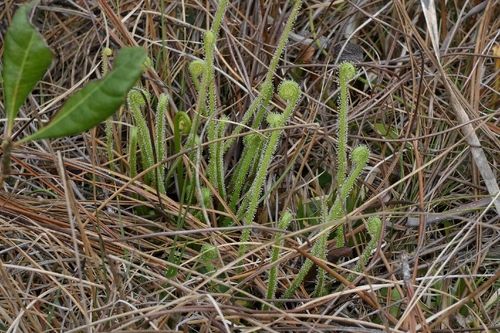
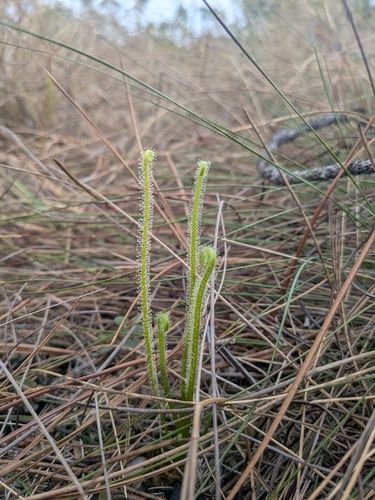
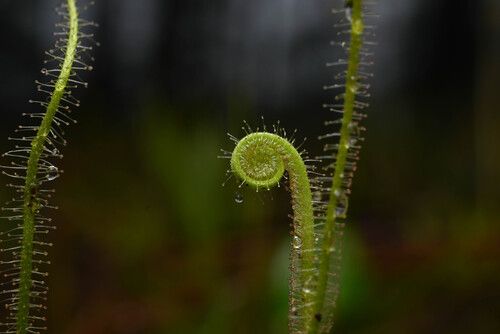
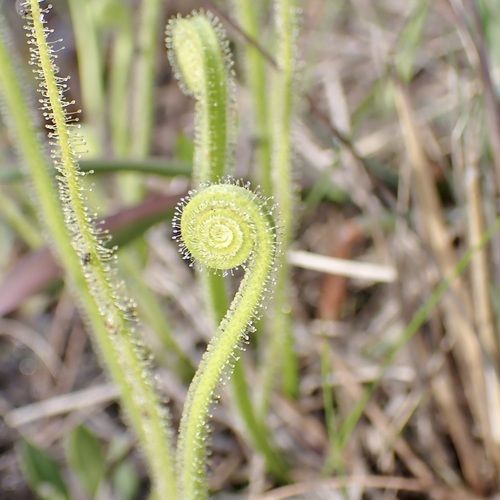
Photos in the wild
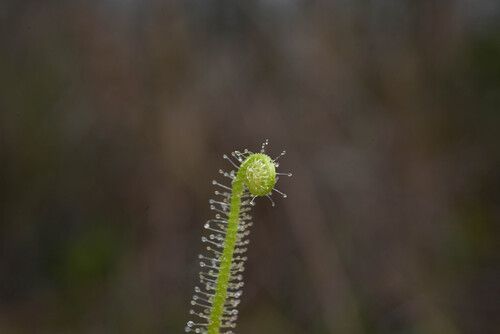
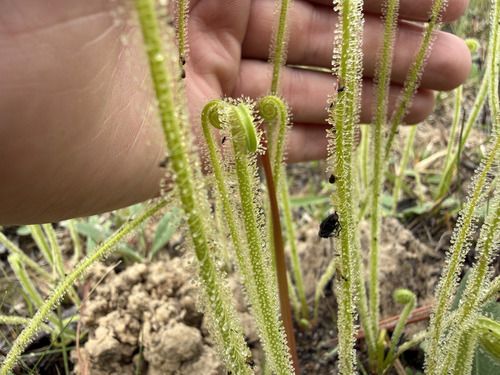
Etymology
- Drosera: from the Greek droserós, “covered in dew”.
- tracyi: named after a person called Tracy, probably the American botanist Samuel Mills Tracy, who explored the flora of the Gulf Coast (not confirmed).
History of the description
- 1906: the German botanist Ludwig Diels, a leading sundew specialist, describes it as a variety of the thread-leaved sundew: D. filiformis var. tracyi.
- 1914: John Muirhead Macfarlane raises it to species rank, in an encyclopedia of horticulture.
- 1998: the botanist B. A. Sorrie provides evidence, drawn from its form and ecology, that it really is a species distinct from D. filiformis.
Description (how to recognise it)
- Like a giant thread-leaved sundew: a small rosette of 1 cm, on a base forming a small woolly bulb 1 to 2 cm across.
- Leaves: thread-like, 30 to 50 cm long, 1 to 2 mm wide. Their glandular hairs are pale green, turning greenish brown as they dry. In D. filiformis, they are red and the leaves measure 8 to 25 cm.
- Flowers: 4 to 12 (up to 24) flowers 15 to 30 mm across, with bright pink petals, rarely white, on scapes 25 to 60 cm tall.
- Seeds: black, 0.5 to 0.8 mm, covered in small pits arranged in rows.
- Chromosomes: 2n = 20.
- In winter: it overwinters as resting buds.
Distribution
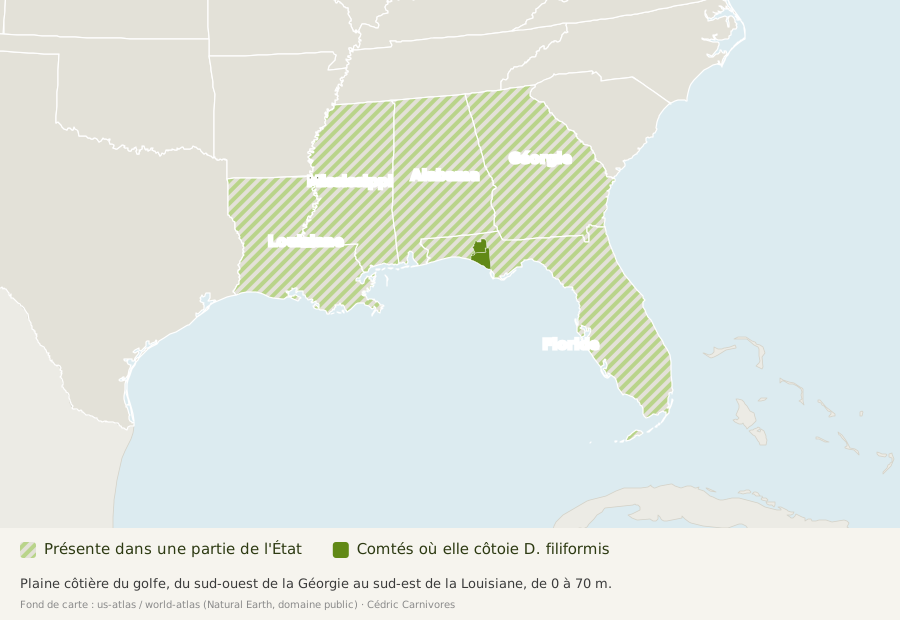
Coastal plain of the Gulf of Mexico, from south-west Georgia to south-east Louisiana: Alabama, Florida, Georgia, Louisiana and Mississippi. It has been reported from South Carolina, but no specimen has been seen.
A meeting in Bay and Washington counties (Florida): the Flora of North America reports D. tracyi there alongside D. filiformis, with no apparent hybrids, according to Sorrie. Since 2026, these Florida “filiformis” plants form the species D. floridana; their natural hybrid with D. tracyi has been named D. × arenaria (Juve & Fleischmann, 2026).
Habitat
- Seepage bogs on slopes;
- edges between pine savannas and wooded wetlands of swamp magnolias, gum trees and cypresses;
- wet roadside ditches and old quarries;
- shores of sinkhole ponds, the hollows formed when limestone ground collapses.
Altitude: from sea level to 70 m.
Notable forms
A form without red pigment, with white flowers, is known.
Hybrids
- Crossed artificially with D. filiformis, it gives a sterile hybrid, which has become the cultivar 'California Sunset'.
- The wild sundew hybrids of North America recorded by the Flora of North America (all sterile):
| Hybrid | Parents | Where |
|---|---|---|
| D. × beleziana | D. intermedia × D. rotundifolia | Nova Scotia, Michigan |
| D. × hybrida | D. filiformis × D. intermedia | New Jersey |
| D. × linglica | D. linearis × D. anglica | Quebec |
| D. × obovata | D. anglica × D. rotundifolia | British Columbia, south-east Canada, Newfoundland, Quebec, Great Lakes, northern California, Oregon, Washington State, New England |
| D. × woodii | D. linearis × D. rotundifolia | Quebec |
| unnamed | D. capillaris × D. intermedia | Pender County, North Carolina |
Did you know?
- Its leaves, as fine as threads, reach half a metre.
- It grows alongside the thread-leaved sundew without ever crossing with it.
In Florida
Based on the Atlas of Florida Plants and the specimens of the University of South Florida herbarium.
- Herbarium: the University of South Florida herbarium holds 27 collections made between 1921 and 2015 in 12 counties of Florida: Bay, Calhoun, Escambia, Franklin, Gulf, Jackson, Leon, Liberty, Okaloosa, Santa Rosa, Wakulla and Walton.
- Habitats noted on the labels: grassy seepages and hillside bogs, peaty hollows in slash pine woods, sphagnum patches, pine savannas with pitcher plants, roadside ditches, sometimes burned. The Atlas classes it among the “obligate wetland” plants.
- Flowering in Florida: in April and May.
Sources
- Flora of North America, vol. 6, p. 425, Drosera tracyi (T. L. Mellichamp), floranorthamerica.org/Drosera_tracyi: publication, first name (Diels 1906), names, full description, flowering, habitats, altitude, range, presence with D. filiformis, white form, 'California Sunset', wild hybrids, Sorrie 1998.
- Atlas of Florida Plants (University of South Florida), Drosera tracyi, and its herbarium specimens: status in Florida, counties, habitats, flowering.