The genus Heliamphora
Genus sheet, updated on 29/10/2026.
At a glance
| Genus | Heliamphora Bentham, 1840 |
| Common names | Sun pitchers (an incorrect name) or marsh pitcher plants; in French sarracénies des tepuys, héliamphoras |
| Family | Sarraceniaceae, with Sarracenia and Darlingtonia |
| Number of species | 24 recognised (23 in our list) |
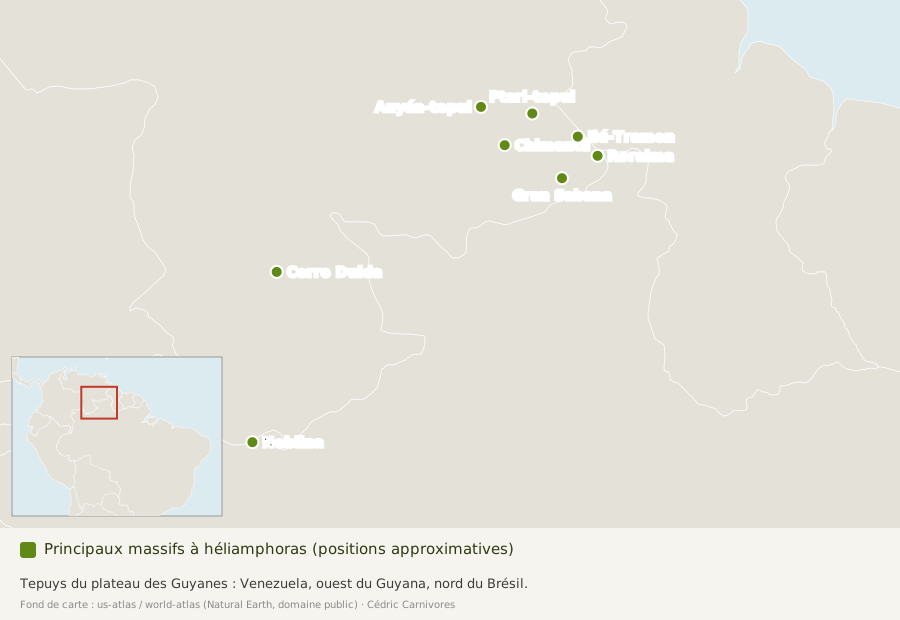
| Distribution | Guiana Shield: mainly Venezuela, also western Guyana and northern Brazil |
| Habitat | Summits and slopes of the tepuis, and wet savannas at their foot, from about 860 m to over 3 000 m |
Etymology: sun or marsh?
The name comes from the Greek helos, “marsh”, and amphoreus, “amphora”: the “marsh pitcher”. The common English name sun pitcher comes from a confusion with the Greek helios, “sun”. The correct translation is therefore “marsh pitcher”.
History of the discovery
- 1839: the brothers Robert and Richard Schomburgk, explorers in the service of Great Britain, see the first species on Mount Roraima.
- 1840: George Bentham describes H. nutans, which will remain the only known species for 90 years.
- 1881: David Burke collects it in British Guiana and introduces it to England.
- 1931: Henry Allan Gleason describes H. tatei and H. macdonaldae, then H. minor in 1939.
- Since 2000, expeditions by Andreas Wistuba, Joachim Nerz, Andreas Fleischmann, Stewart McPherson and others have brought the genus to more than twenty species.
Distribution
The world of the tepuis
The tepuis are sandstone table mountains with vertical walls, rising above the savanna of the Guiana Shield. Their summits, often shrouded in cloud, are very wet, cool and nutrient-poor. Isolated from one another like islands, they are home to many endemic species: each Heliamphora often lives on only one or a few tepuis.
- Summit species: H. nutans, H. ionasi, H. tatei…
- Species of the lower slopes and savannas: H. ciliata (at about 900 m) and H. heterodoxa, in warmer wet grasslands.
Description (how to recognise them)
- Perennial plants with no visible stem, forming rosettes that grow from underground stems. A few species (H. tatei, H. macdonaldae, H. neblinae, H. parva) form true stems.
- Pitchers: each pitcher is a rolled leaf with fused edges, from a few centimetres (H. minor, H. pulchella) to more than 50 cm (H. ionasi, H. tatei, H. neblinae).
- No true lid: instead, a “nectar spoon”, a small appendage at the top of the pitcher that secretes nectar to attract insects.
- An overflow: a hole or a slit at the front lets rainwater drain out, so that the pitcher does not overflow.
- Downward-pointing hairs line the inside and guide insects towards the bottom.
Ecology: how they trap
- Prey: mainly ants, attracted by visual and chemical signals; the pitchers are pitfall traps.
- Aquaplaning: in H. nutans, the inner hairs become much more slippery when wet; insects slide off, as in many Nepenthes.
- Outsourced digestion: most species do not produce digestive enzymes and let bacteria break down the prey. The exception is H. tatei, which produces its own enzymes and wax scales, and catches more flying insects.
- Carnivorous when it pays off: in low light, carnivory seems to be abandoned; it would mainly serve to obtain nitrogen and phosphorus during rapid growth.
Evolution
Closely related species often live on neighbouring tepuis. The main groups are thought to have arisen in the Miocene, through isolation and dispersal; the recent diversification is linked to the glacial cycles of the Pleistocene. The shape of the pitchers evolved in similar ways several times: an adaptive radiation on the tepuis.
Natural hybrids
At least eleven known natural hybrids, without names of their own (see the list of the genus), and complex hybrids on the Neblina massif. Four cultivars are registered.
Species by massif
| Massif or region | Species |
|---|---|
| Roraima, Kukenán and neighbours (Venezuela-Brazil-Guyana border) | H. nutans, H. glabra |
| Auyán-tepui | H. minor |
| Chimantá massif and neighbours | H. chimantensis, H. pulchella, H. huberi, H. exappendiculata, H. uncinata |
| Ilú-Tramen massif | H. ionasi, H. elongata, H. arenicola |
| Ptari-tepui and Sororopán | H. sarracenioides, H. purpurascens, H. heterodoxa, H. collina |
| Los Testigos (Aparaman group) | H. folliculata, H. collina |
| Gran Sabana (savannas) | H. ciliata, H. heterodoxa |
| Cerro Duida, Marahuaca, Huachamacari | H. tatei, H. macdonaldae |
| Neblina massif (Venezuela-Brazil) | H. neblinae, H. hispida, H. parva, H. ceracea |
Sources
- Wikipedia (English), Heliamphora: etymology, discovery, number of species, family, range, altitudes, morphology, carnivory, enzymes of H. tatei, evolution, hybrids.
- Wikipedia (English), Heliamphora nutans: Schomburgk 1839, Burke 1881, aquaplaning.
- Wikipedia pages of the species: distribution by massif.
- (General description of the tepuis: general geographical knowledge.)