Heliamphora heterodoxa Steyerm.
Species sheet, updated on 29/10/2026.
At a glance
| Scientific name | Heliamphora heterodoxa Julian A. Steyermark, 1951 |
| Family | Sarraceniaceae |
| Distribution | Gran Sabana (Venezuela) and neighbouring Guyana |
| Habitat | High-altitude wetlands and lower slopes of the tepuis, from about 1,200 to 1,500 m |
Etymology
- Heliamphora: see the genus sheet.
- heterodoxa: from the Greek heteros, “other”, and doxa, “opinion”. Steyermark gave it this name because of the great variability he observed in it.
History of the discovery
1944: the American botanist Julian Steyermark discovered it on the slopes linking Ptari-tepui and Sororopán-tepui (Venezuela). He described it in 1951; it is one of the four heliamphoras he described.
Description (how to recognise it)
- A vigorous plant.
- A large nectar spoon that overhangs the pitcher.
Distribution
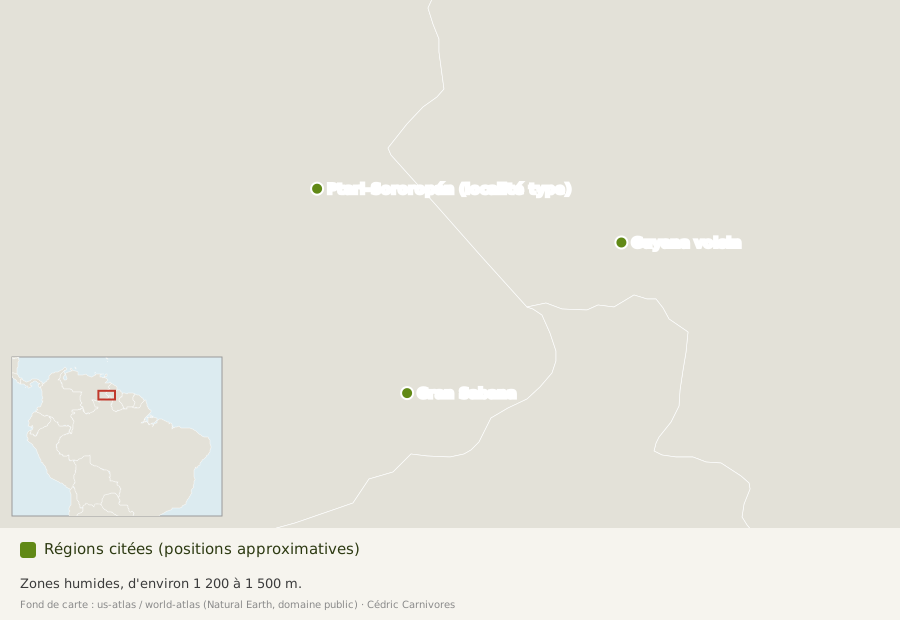
Gran Sabana (Venezuela) and neighbouring Guyana, from about 1,200 to 1,500 m.
Habitat
High-altitude wetlands and lower habitats of the Pantepui. It tolerates slightly warmer temperatures than the other heliamphoras.
Relationships
Close to H. glabra, and long treated as one of its forms. Some former varieties are now H. exappendiculata, H. minor and H. glabra.
Did you know?
- In 2018, an expedition to its type locality found H. collina there and a hybrid swarm of H. collina × H. purpurascens.
Sources
- Wikipedia (English), Heliamphora heterodoxa: Steyermark 1944/1951, etymology, description, range, altitude, habitat, relationships, 2018 expedition.