Heliamphora hispida Nerz & Wistuba
Species sheet, updated on 29/10/2026.
At a glance
| Scientific name | Heliamphora hispida Joachim Nerz & Andreas Wistuba, 2000 |
| Family | Sarraceniaceae |
| Distribution | Cerro Neblina, Brazil-Venezuela border |
| Habitat | 1,800-3,014 m |
Etymology
- Heliamphora: see the genus sheet.
- hispida: from the Latin hispidus, “bristling with stiff hairs”.
History of the description
Nerz and Wistuba described it in 2000 as a new species from Cerro Neblina.
Description (how to recognise it)
- Its name comes from the Latin hispidus, “bristly”, for the stiff, ciliate hairs that line the inside of the pitchers in some plants (Nerz and Wistuba, 2000).
- Although it grows on the southern tepuis, it resembles the species with squat pitchers from the eastern tepuis (H. nutans, H. minor…), which called into question the idea of a clear split between “western” species with long pitchers and “eastern” species (Nerz and Wistuba, 2000).
Distribution
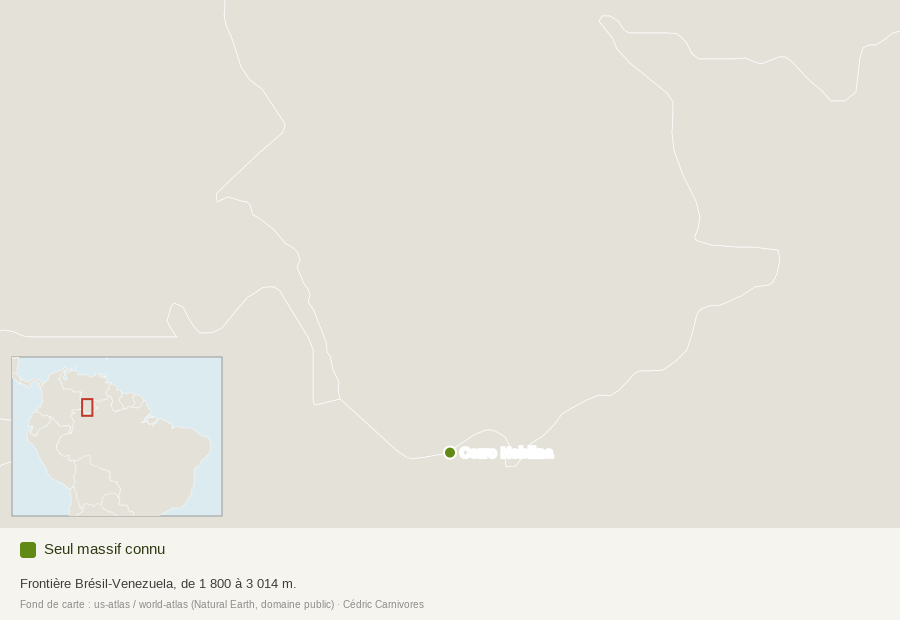
Endemic to Cerro Neblina, the southernmost tepui of the Guiana Shield, on the border between Brazil and Venezuela. Up to 3,014 m: the highest altitude in the genus. According to the Kew world list of plants (WCVP), it is native to the following regions: northern Brazil and Venezuela. According to the Flora do Brasil (the official list of the plants of Brazil), it grows in Brazil in this state: Amazonas. Major biomes: Amazonia.
Habitat
According to the Flora do Brasil: terrestrial plant, in rock outcrop vegetation. Nerz and Wistuba (2000) knew it only from the south-eastern end of Cerro Neblina, where it is dominant: high-altitude bogs and meadows below Pico Phelps and up to its summit (3,014 m), often in shade in shrubby bogs, and often half submerged, with the water level in the pitchers matching that of the ground; they saw a 1.80 m pile of debris completely covered with its plants.
Natural hybrids
With H. ceracea, and presumed complex hybrids on the Neblina with H. neblinae and H. parva.
Sources
- Wikipedia (English), Heliamphora hispida: Nerz & Wistuba 2000, etymology, range.
- Genus list: altitude, hybrids.
- Kew, World Checklist of Vascular Plants (via GBIF): natural distribution.
- Flora e Funga do Brasil, official list (via GBIF): states, biomes, endemism, life form and vegetation types in Brazil.
- Nerz and Wistuba, Carnivorous Plant Newsletter 29, 2000 (archive.org): original description, habitat, etymology.