Heliamphora ionasi Maguire
Species sheet, updated on 29/10/2026.
At a glance
| Scientific name | Heliamphora ionasi Bassett Maguire, 1978 (often wrongly spelled ionasii) |
| Family | Sarraceniaceae |
| Distribution | Plateau between Ilú-tepui and Tramen-tepui (Venezuela) |
| Habitat | 1,800-2,600 m |
Etymology
- Heliamphora: see the genus sheet.
- ionasi: in honour of Jonah Boyan, a member of Maguire's team, after the Latin form of his first name (Ionas). The original spelling is ionasi; “ionasii”, which is very widespread, is an error.
History of the discovery
- 1952: the reference specimens were collected during the William H. Phelps Jr. expedition to Ilú-tepui, by a team led by Bassett Maguire, with Jonah Boyan.
- 1978: Maguire described it.
- September 1979: a photo of Boyan holding a plant made the cover of the Carnivorous Plant Newsletter.
Description (how to recognise it)
It bears the largest pitchers in the genus, up to 50 cm tall. Its pitchers also collect plant debris, like those of H. exappendiculata.
Distribution
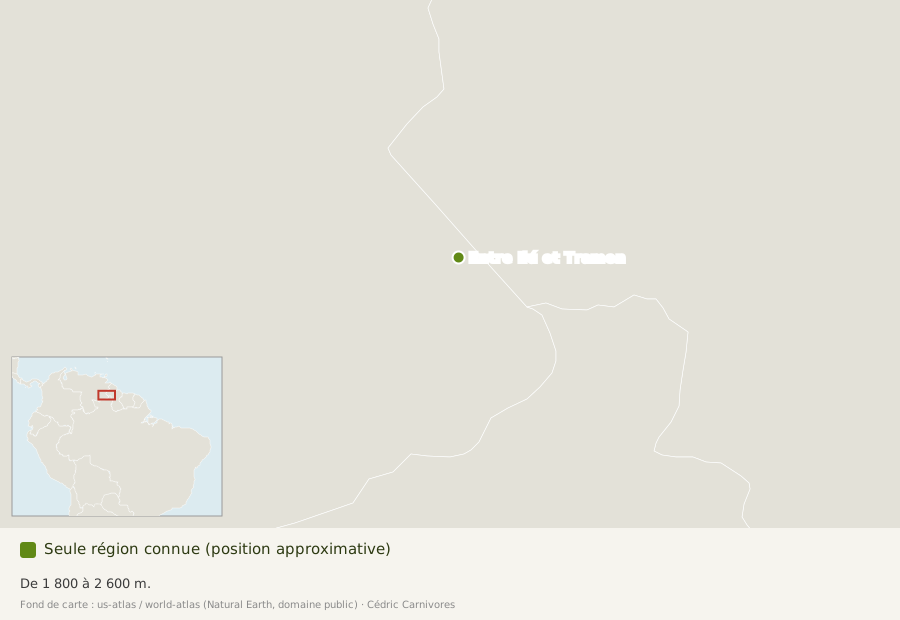
It is believed to be endemic to a plateau in Venezuela lying between the foot of Ilú-tepui and that of Tramen-tepui.
Natural hybrids
With H. arenicola and H. elongata.
Sources
- Wikipedia (English), Heliamphora ionasi: Maguire 1978, 1952 Phelps expedition, Jonah Boyan, spelling, size, range, CPN cover.
- Wikipedia (English), Heliamphora exappendiculata: debris-collecting pitchers.
- Genus list: altitude, hybrids.