Heliamphora tatei Gleason
Species sheet, updated on 29/10/2026.
At a glance
| Scientific name | Heliamphora tatei Henry Allan Gleason, 1931 |
| Synonym | H. tyleri Gleason (1931) |
| Family | Sarraceniaceae |
| Distribution | Cerro Duida, Cerro Huachamacari and Cerro Marahuaca (Venezuela) |
| Habitat | Wet tepui summits, 1,700-2,400 m |
Etymology
- Heliamphora: see the genus sheet.
- tatei: in honour of the naturalist George Henry Hamilton Tate, of the American Museum of Natural History (institution, not confirmed).
History of the description
Gleason described it in 1931, together with H. macdonaldae and H. tyleri (now a synonym): the first new species since H. nutans in 1840.
Description (how to recognise it)
- A stem-forming heliamphora: it forms true stems, like its close relatives H. macdonaldae, H. neblinae and H. parva, formerly treated as its varieties.
- Large pitchers, over 50 cm according to the genus sheet.
Distribution
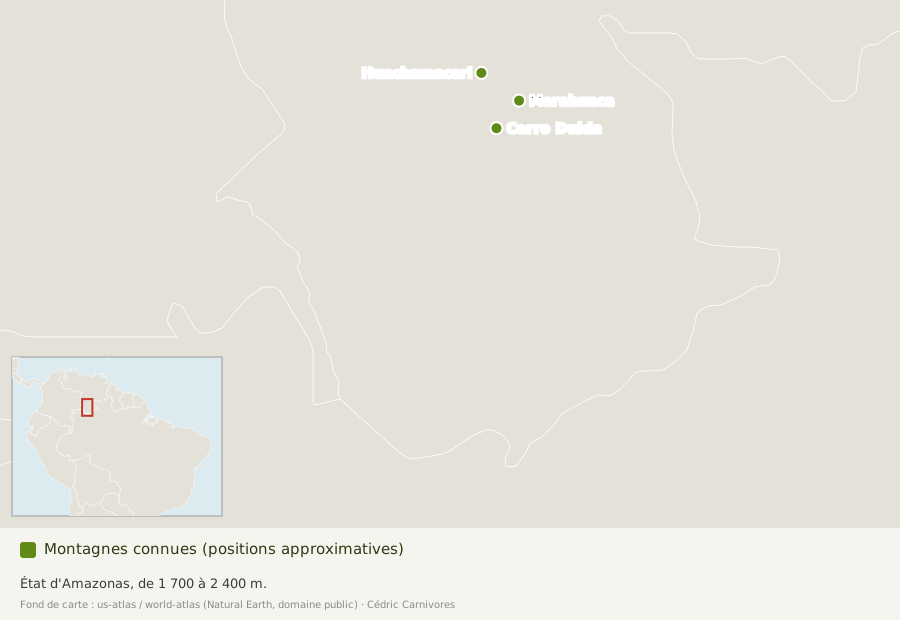
Endemic to Venezuela: Cerro Duida, Cerro Huachamacari and Cerro Marahuaca, in Amazonas State.
Ecology: the only one that digests on its own
Unlike the other heliamphoras, which let bacteria digest their prey, H. tatei produces its own digestive enzymes. It also bears wax scales and catches more flying insects.
Natural hybrids
With H. macdonaldae, presumed, in the south of Cerro Duida.
Sources
- Wikipedia (English), Heliamphora tatei: Gleason 1931, synonym, etymology, range, stem-forming habit, relationships, hybrids.
- Wikipedia (English), Heliamphora: enzymes and wax, pitcher size.
- Genus list: altitude.