Utricularia cornuta Michx.
Species sheet, updated on 30/10/2026.
At a glance
| Scientific name | Utricularia cornuta André Michaux, 1803 |
| Synonym | Stomoisia cornuta |
| Common name | Horned bladderwort; in French utriculaire cornue |
| Family | Lentibulariaceae (subgenus Bivalvaria, section Stomoisia) |
| Distribution | North America (Canada, United States), Bahamas, Cuba |
| Habitat | Marshes, swamps and shallow pools, at low altitude |
Photos in the wild
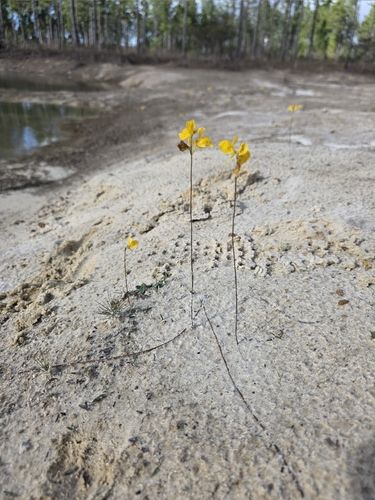
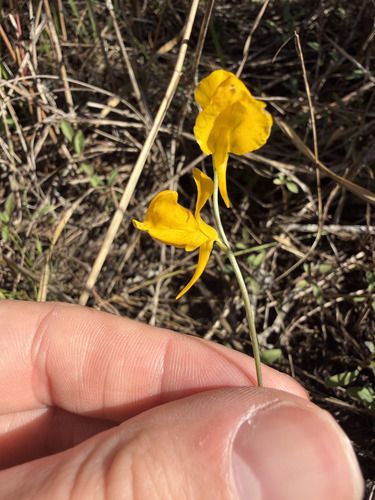
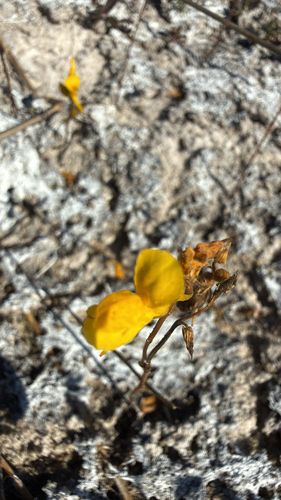
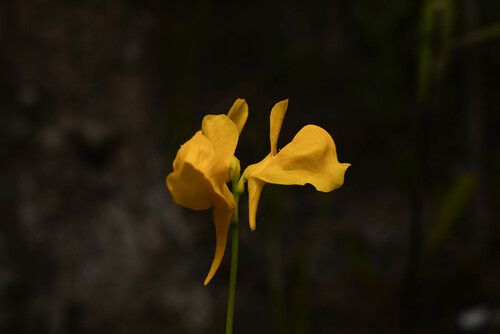
Etymology
- Utricularia: see the genus sheet.
- cornuta: from the Latin, “horned”, probably for the long spur of its flower (not confirmed).
Description (how to recognise it)
- A small to medium-sized bladderwort, probably perennial.
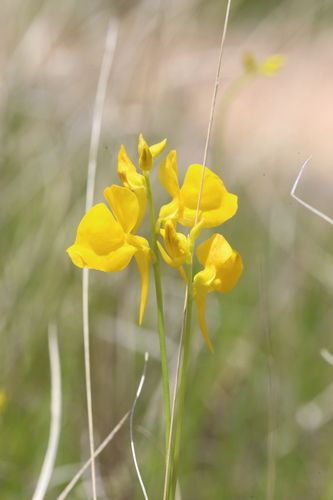
- According to Britton and Brown (1913), who place it in the genus Stomoisia: stiff, brownish scape up to 30 cm, with 1 to 5 flowers clustered near the top; yellow corolla, lower lip 13 to 17 mm around a helmet-shaped palate; awl-shaped, hanging spur, 7 to 13 mm (hence its English name horned bladderwort, in French “utriculaire cornue”).
Distribution
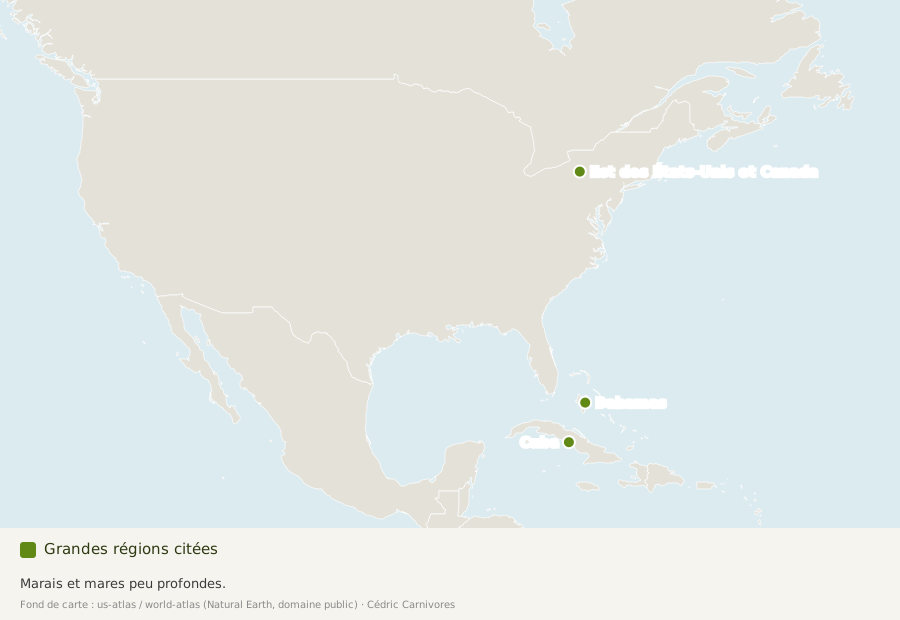
Canada, United States, Bahamas and Cuba. According to Kew's world checklist of plants (WCVP), it is native to 43 regions of the world (see the map and the Kew source). According to the Flora do Brasil (the official list of Brazilian plants), it grows in these Brazilian states: Ceará, Maranhão and Rio Grande do Norte. Major biomes: Caatinga and Atlantic Forest.
Habitat
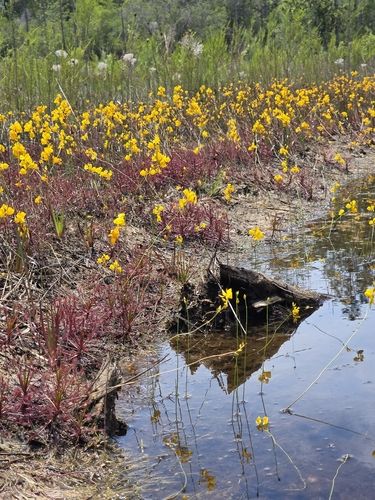
On the ground or half-submerged in marshes, swamps and shallow pools, mainly at low altitude. According to the Flora do Brasil: a terrestrial plant, in restinga (coastal sand vegetation) and aquatic vegetation. Britton and Brown (1913) give it on wet pond margins or in bogs, from Newfoundland to Minnesota and as far as Florida and Texas, as well as in the Bahamas and Cuba; flowering in July–August.
In Florida
According to the Atlas of Florida Plants and the specimens of the University of South Florida herbarium.
- Herbarium: the University of South Florida herbarium holds 93 collections made between 1919 and 2023 in 35 Florida counties: Bay, Brevard, Broward, Calhoun, Charlotte, Citrus, Clay, Collier, DeSoto, Flagler, Gulf, Hendry, Hernando, Highlands, Hillsborough, Jackson, Lake, Lee, Levy, Liberty, Marion, Martin, Miami-Dade, Monroe, Okaloosa, Okeechobee, Orange, Osceola, Palm Beach, Pasco, Polk, Sarasota, Volusia, Wakulla and Walton.
- Habitats noted on the labels: edges of bogs and ponds (cypress or tupelo ponds), wet prairies and marl clearings, shallow water on lake shores with silty bottoms, sandy peat in ditches. The Atlas classes it among “obligate wetland” plants.
- Flowering in Florida: all year round, mainly from April to June.
Sources
- Wikipedia (English), Utricularia cornuta: Michaux 1803, synonym, classification, range, habitat.
- Kew, World Checklist of Vascular Plants (via GBIF): native distribution.
- Flora e Funga do Brasil, official list (via GBIF): states, biomes, endemism, life form and vegetation types in Brazil.
- Britton and Brown, An Illustrated Flora of the Northern United States III, 2nd ed., 1913 (archive.org): description, habitats and range (translated from English).
- Atlas of Florida Plants (University of South Florida), Utricularia cornuta, and its herbarium specimens: status in Florida, counties, habitats, flowering.