The genus Utricularia
Genus sheet, updated on 30/10/2026.
At a glance
| Genus | Utricularia Linné, 1753 |
| Common names | Bladderworts; in French utriculaires |
| Family | Lentibulariaceae, together with the butterworts (Pinguicula) and Genlisea |
| Number of species | About 215 to 233 depending on the classification (about 240 in our list) |
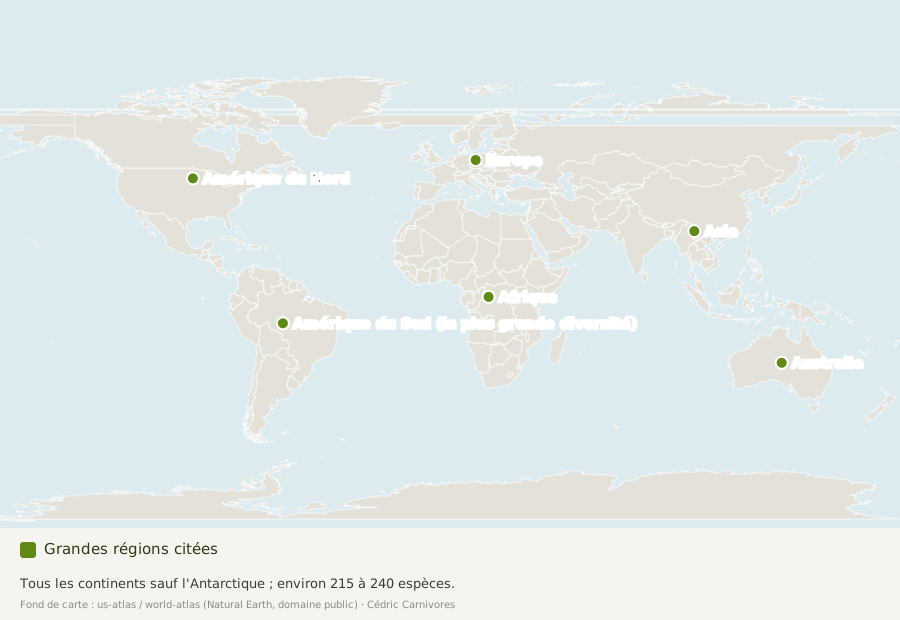
| Distribution | Every continent except Antarctica; the greatest diversity in South America, then in Australia |
| Habitat | Fresh water and waterlogged soils; also on wet bark, moss, in the rosettes of bromeliads, on damp rocks |
Etymology
Utricularia comes from the Latin utriculus, “small wineskin”, which referred to a wine flask, a leather bottle or a bagpipe: an allusion to the small bladders that serve as traps.
History
- 1753: Linné creates the genus.
- The first observers took the bladders of the aquatic species for floats.
- 1875: Darwin describes the traps in Les plantes insectivores.
- 1940s: Francis Ernest Lloyd demonstrates the mechanical workings of the trap.
- 1989: Peter Taylor's monograph, the standard reference work, reduces the number of species from 250 to 214.
Distribution
Plants without roots
Bladderworts have no roots. They bear stolons, thin stems often hidden in the soil or water, which carry the traps and the small green shoots. Their organs are not clearly divided into roots, stems and leaves.
Life forms
| Form | Share of species | Examples |
|---|---|---|
| Terrestrial | about 80% | waterlogged soils, mostly tropical: subulata, sandersonii, livida |
| Aquatic | about 20% | free-floating or anchored to the bottom: vulgaris, australis, minor, gibba; some in torrents and waterfalls |
| Epiphytic | a few species | on wet bark, moss or in the water of bromeliads: humboldtii, alpina, reniformis |
| On rocks and in rivers | a few species | damp rocks, shallow rivers |
The fastest trap in the plant world
- Each trap is a small hollow bladder, often bean-shaped, from 0.2 mm to 1.2 cm.
- The bladder pumps water outwards and creates a partial vacuum: the trap is then “set”.
- A flexible door stays shut thanks to trigger hairs. When a small animal touches them, the seal breaks: water and prey are sucked in within 10 to 15 milliseconds.
- The trap resets in 15 to 30 minutes. The mechanism is purely mechanical.
Prey and digestion
- Terrestrial traps: protozoa and rotifers.
- Aquatic traps: water fleas, nematodes, mosquito larvae, and even young tadpoles and small fish.
- Digestion takes a few hours; microbes living in the traps seem to help, especially with phosphorus.
Flowers
From 2 mm to 10 cm, two-lipped, similar to those of butterworts: those of aquatic species recall snapdragons, those of epiphytes orchids. Some plants have both open flowers pollinated by insects and closed flowers that self-fertilise.
Evolution
- The ancestor was terrestrial; the epiphytic way of life appeared three times and the aquatic way of life four times, independently.
- The genus is thought to have split from its sister genus about 30 million years ago.
- Three subgenera: Utricularia, Bivalvaria and Polypompholyx.
- Some bladderworts have among the smallest genomes known in flowering plants.
The bladderworts of France
U. vulgaris, U. australis, U. minor, U. intermedia, U. ochroleuca, U. stygia, U. bremii (list; with the French floras, not confirmed).
Sources
- Wikipedia (English), Utricularia: etymology, number of species, range, life forms, absence of roots, trap, speed, prey, flowers, evolution, subgenera, history (Darwin, Lloyd, Taylor), genomes.
- (List of the species of France: general knowledge, not confirmed)