Utricularia sandersonii Oliv.
Species sheet, updated on 30/10/2026.
At a glance
| Scientific name | Utricularia sandersonii Daniel Oliver, 1865 |
| Synonyms | U. treubii, U. sandersonii var. treubii |
| Common name | Sanderson's bladderwort; among hobbyists, “rabbit bladderwort” (in French “utriculaire lapin”) (not confirmed) |
| Family | Lentibulariaceae (section Calpidisca) |
| Distribution | Northern KwaZulu-Natal and Transkei (South Africa) |
| Habitat | Wet rock faces, often vertical, from 210 to 1 200 m |
| Status | Considered invasive in New Zealand |
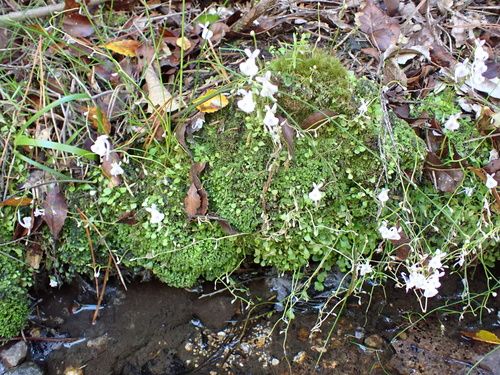
Photos in the wild
Etymology
- Utricularia: see the genus sheet.
- sandersonii: dedicated to a person named Sanderson (probably the naturalist John Sanderson, not confirmed).
Description (how to recognise it)
- Flowers like rabbit heads: white with pale blue markings, with long spurs curved forwards and double lobes that look like rabbit ears.
- A small plant up to 50 cm wide; the visible parts are not carnivorous: the traps are on the underground stems and catch micro-organisms in the waterlogged soil.
Distribution
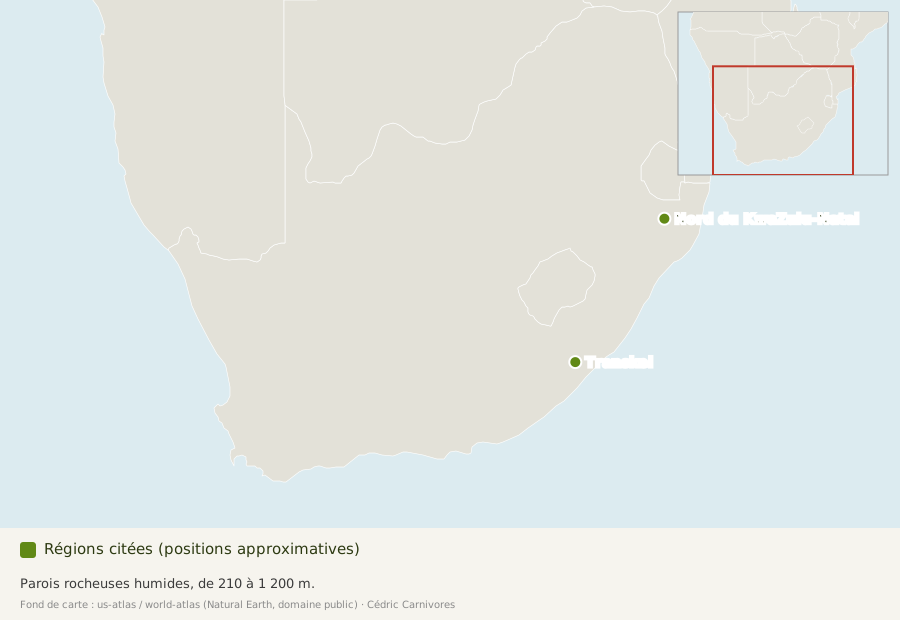
Endemic to South Africa: northern KwaZulu-Natal and Transkei.
Habitat
On rocks (lithophyte): wet rock faces, often vertical, from 210 to 1 200 m.
Did you know?
- Widely grown as a houseplant, it has received the Award of Garden Merit of the Royal Horticultural Society. It cannot self-pollinate but is easily propagated by division.
Sources
- Wikipedia (English), Utricularia sandersonii: Oliver 1865, section, description, flowers, range, habitat, altitude, cultivation, New Zealand status, synonyms.