Utricularia subulata L.
Species sheet, updated on 30/10/2026.
At a glance
| Scientific name | Utricularia subulata Linnaeus, 1753 |
| Common name | Zigzag bladderwort (in French “utriculaire en zigzag”) |
| Family | Lentibulariaceae (subgenus Bivalvaria) |
| Distribution | Almost the whole tropical world: the Americas, Africa, Australia; also Asia and Europe (naturalised) |
| Habitat | Damp soils (terrestrial) |
Photos in the wild
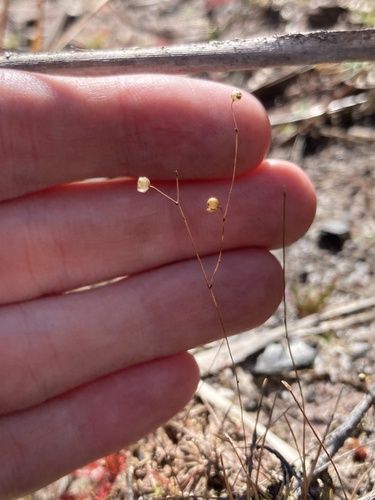
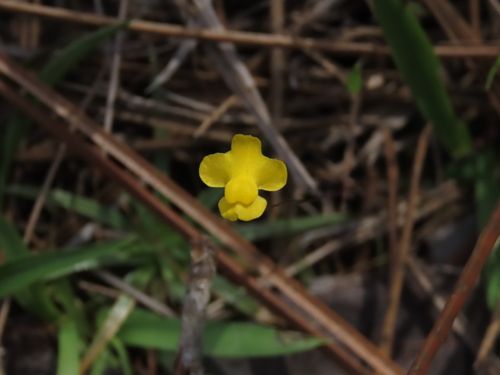
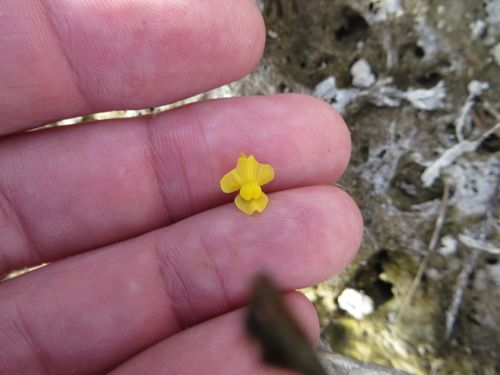
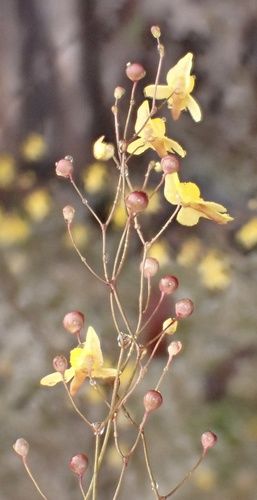
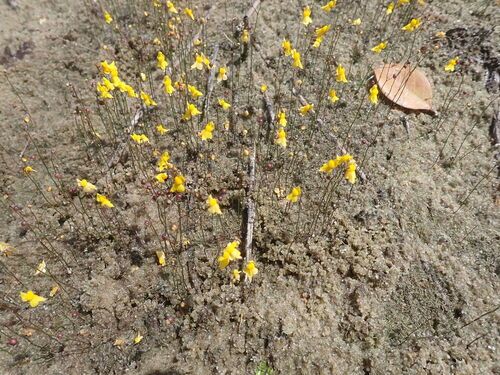
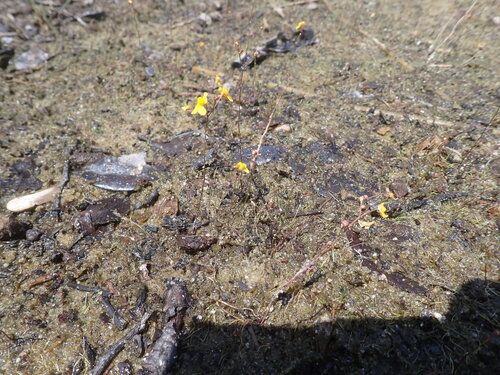
Etymology
- Utricularia: see the genus sheet.
- subulata: from the Latin, “awl-shaped”, for its thin, pointed leaves (probable meaning, not confirmed).
Description (how to recognise it)
- A small annual, terrestrial bladderwort.
- Terrestrial or growing at the water's edge, with linear, entire aerial leaves; peltate bracts, no bracteoles; yellow corolla, swollen palate, three-lobed lower lip; straight spur, entire or split into 2 or 4 points, as long as or longer than the lower lip; capsule opening by a ventral pore.
- It can be told apart from U. trichophylla by its entire leaves and clearly veined sepals, and from U. triloba by its sepals and its more deeply three-lobed lip.
Distribution
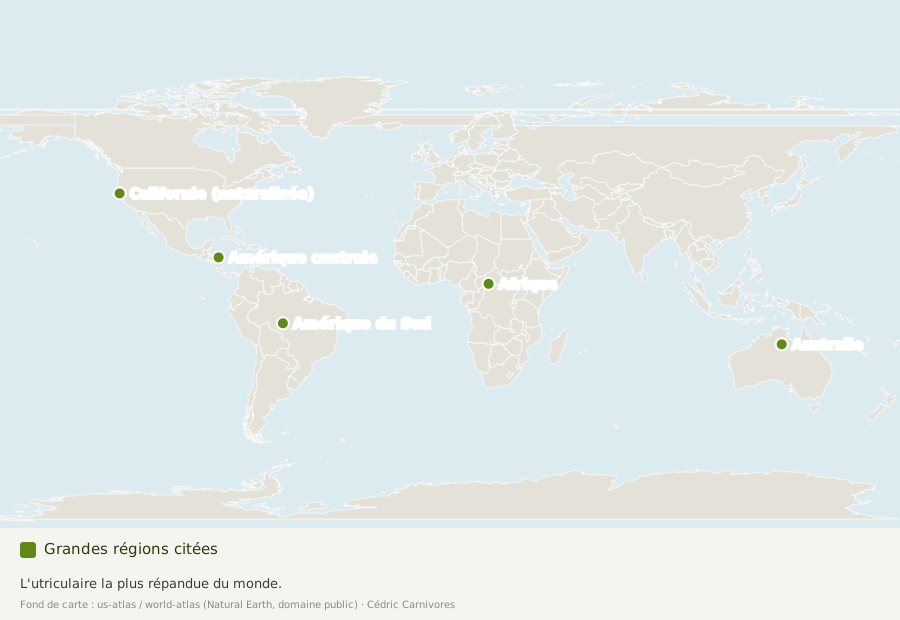
The most widespread species of the genus, almost pantropical: the Americas, Africa, Australia; it is also naturalised elsewhere, for example in Mendocino County, California. According to Kew's world plant list (WCVP), it is native in 95 regions of the world (see the map and the Kew source). According to the Flora do Brasil (official list of the plants of Brazil), it grows in these Brazilian states: Alagoas, Amazonas, Amapá, Bahia, Ceará, Federal District, Espírito Santo, Goiás, Maranhão, Minas Gerais, Mato Grosso do Sul, Mato Grosso, Pará, Paraíba, Pernambuco, Piauí, Paraná, Rio de Janeiro, Rio Grande do Norte, Rondônia, Roraima, Rio Grande do Sul, Santa Catarina, Sergipe, São Paulo and Tocantins. Major biomes: Amazonia, Caatinga, Cerrado, Atlantic Forest, Pampa and Pantanal.
Habitat
According to the Flora do Brasil: terrestrial plant, in human-modified habitats, campinarana (white-sand savanna of Amazonia), high-altitude grasslands, open grasslands, campos rupestres (rocky mountain grasslands), cerrado (savanna), gallery forests, seasonal deciduous forest, seasonal semi-deciduous forest, rainforest, palm groves, restinga (coastal sand vegetation), aquatic vegetation and vegetation on rock outcrops. In North Carolina, it is common in wet pine woods and pine savannas (Shaken Creek), flowering from March to July. In Bahia, it is widespread over a broad range of altitudes and in varied vegetation. In Portugal, its only sites in the Iberian Peninsula, it has not been collected since 1967: drainage of wetlands, eucalyptus, pines and crops have led to it being classed as “regionally extinct”.
In Florida
Based on the Atlas of Florida Plants and the specimens of the University of South Florida herbarium.
- Herbarium: the University of South Florida herbarium holds 84 collections made between 1934 and 2023 in 38 counties of Florida: Alachua, Brevard, Calhoun, Charlotte, Citrus, Clay, Collier, DeSoto, Duval, Franklin, Glades, Hamilton, Hardee, Hernando, Highlands, Hillsborough, Jefferson, Lake, Lee, Levy, Liberty, Manatee, Marion, Martin, Nassau, Okaloosa, Okeechobee, Orange, Palm Beach, Pasco, Pinellas, Polk, Sarasota, Sumter, Taylor, Volusia, Wakulla and Walton.
- Habitats noted on the labels: wet pine woods and edges of cypress swamps, seepage bogs at stream heads, bottomland forests and baygalls (peaty bay thickets), damp roadsides, even disturbed ground. The Atlas classes it among the “obligate wetland” plants.
- Flowering in Florida: almost all year round, especially in March, with a second flowering in autumn.
Sources
- Wikipedia (English), Utricularia subulata: Linnaeus 1753, name, habit, range, naturalised population in California.
- Kew, World Checklist of Vascular Plants (via GBIF): natural distribution.
- Flora e Funga do Brasil, official list (via GBIF): states, biomes, endemism, life form and vegetation types in Brazil.
- “Diversity and distribution of Lentibulariaceae in Bahia state, Brazil” (Plazi text, public domain, via GBIF): description, possible confusions, habitats in Bahia.
- Atlas of Florida Plants (University of South Florida), Utricularia subulata, and its herbarium specimens: status in Florida, counties, habitats, flowering.