Brocchinia reducta Baker
Species sheet, updated on 29/10/2026.
At a glance
| Scientific name | Brocchinia reducta John Gilbert Baker, 1882 |
| Family | Bromeliaceae, the pineapple family; subfamily Brocchinioideae |
| Genus | Brocchinia, about 20 species |
| Distribution | Guiana Shield: southern Venezuela, Guyana, Colombia, northern Brazil |
| Habitat | Wet sandy savannas and very poor soils, up onto the tepuis (Mount Roraima) |
| Special feature | The first bromeliad recognised as carnivorous (1984) |
Photos in the wild
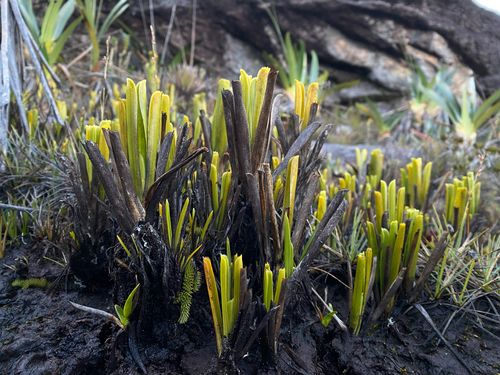
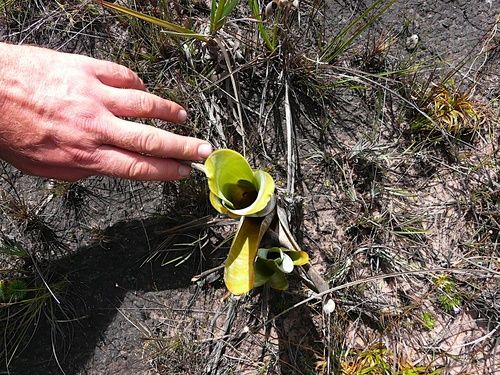
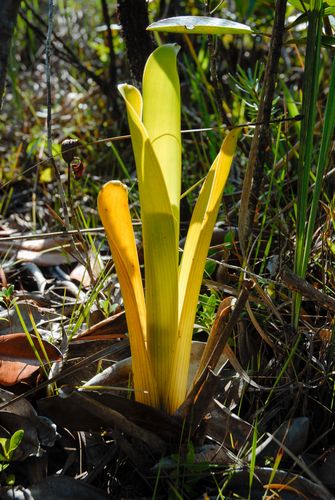
Etymology
- Brocchinia: the genus honours Giovanni Battista Brocchi (1772-1826), an Italian naturalist.
- reducta: a Latin word meaning “reduced” or “brought back” (reason for the name uncertain).
History
- 1882: the English botanist John Gilbert Baker, of Kew Gardens, describes it.
- 1984: the American botanist Thomas Givnish and his colleagues publish proof of its carnivory in The American Naturalist. It is the first known case of a carnivorous plant among the bromeliads. Their paper also puts forward a famous model explaining why carnivorous plants live mostly in sunny, wet and nutrient-poor places: that is where catching prey “pays” more than it “costs”.
- Some biologists still debate whether it truly deserves the title of carnivorous plant.
Description (how to recognise it)
- A tube of leaves: like other bromeliads, it forms a tank that holds rainwater. Its bright yellow-green leaves are almost vertical and tightly packed into a cylinder.
- A waxy powder: the leaves are covered with a thick powdery wax that strongly reflects ultraviolet light.
- A sweet smell: the water in the tank gives off a sweet scent.
- In cultivation, plants are often greener, shorter and with less tightly packed leaves than in the wild.
Distribution
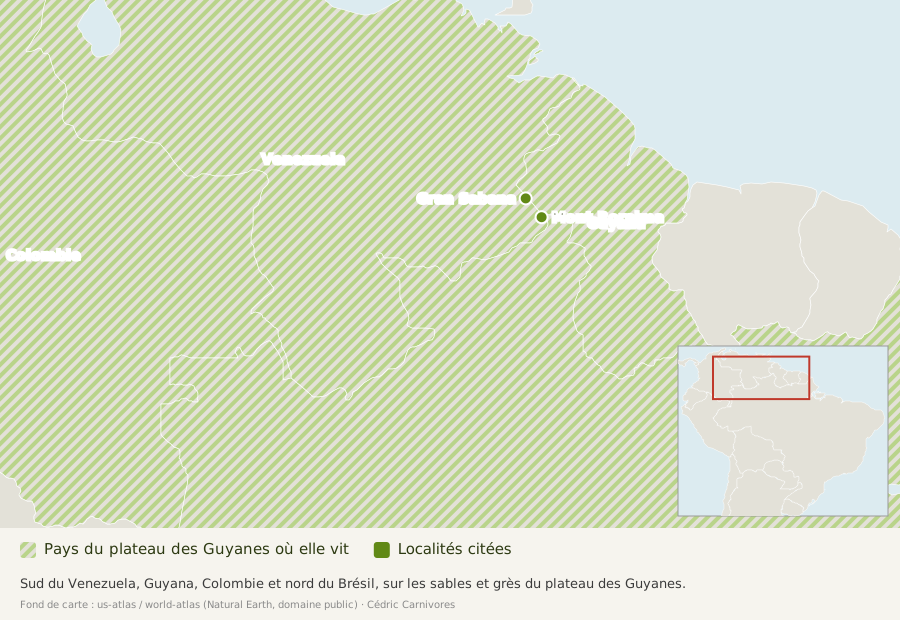
- Venezuela (south), Guyana, Colombia and Brazil (north): the Guiana Shield, one of the oldest rock formations on Earth.
- It is found for example in the Gran Sabana, in Bolívar State, in south-eastern Venezuela (near kilometre 148 of the road from El Dorado to Santa Elena), and on Mount Roraima, the famous tepui on the borders of Venezuela, Guyana and Brazil.
Habitat
- Wet sandy savannas;
- wet and very poor soils;
- like most Brocchinia, on the sands and sandstones of the Roraima formation, the rock of the tepuis.
Ecology
- The trap:
- insects, especially ants, are attracted by the sweet smell and probably by the ultraviolet reflections of the wax;
- the wax makes them slip into the tank, with its steep, smooth walls, where they drown;
- the water in the tank is very acidic (pH of about 3).
- Digestion: the plant secretes an enzyme, a phosphatase, into its tank. The hairs at the base of the leaves absorb the amino acids released as the prey decomposes. They can let through molecules up to 6.6 nanometres.
- A competitor: it shares its prey with another carnivorous plant of the tepuis, Heliamphora nutans (study by Gonzalez and colleagues, 1991).
The genus Brocchinia
- About 20 species, almost all from the Guiana Shield.
- Only one other species also seems to be carnivorous: B. hechtioides, whose tanks contain mostly bees and wasps.
- Others have found other ways to feed in these poor soils:
- B. acuminata hosts ants in the swollen base of its leaves; debris and dead ants fall into its tank and feed it;
- in B. tatei, cyanobacteria living in the tank may fix nitrogen from the air.
Threats and protection
No conservation status was found for this species (not confirmed).
Did you know?
- It is a cousin of the pineapple: a bromeliad that became carnivorous.
- Its wax shines in ultraviolet, a colour that insects can see and we cannot.
Sources
- Wikipedia (English), Brocchinia reducta: Baker 1882, description, ultraviolet wax, smell, trap, absorption by the hairs, distribution, competition with Heliamphora nutans (Gonzalez et al. 1991).
- Wikipedia (English), genus Brocchinia: etymology (Brocchi), 20 species, Guiana Shield, Roraima formation, pH 3, phosphatase, B. hechtioides, B. acuminata, B. tatei.
- Givnish et al. 1984, The American Naturalist 124: 479-497: first carnivorous bromeliad, ants, cost-benefit model.
- Benzing et al. 1985, Systematic Botany: Gran Sabana, wet and poor soils.