Byblis gigantea Lindl.
Species sheet, updated on 29/10/2026.
At a glance
| Scientific name | Byblis gigantea John Lindley, 1839 |
| Synonym | B. lindleyana Planch. (1848) |
| Family | Byblidaceae |
| Distribution | South-west of Western Australia, from Dandaragan to Boddington via Perth |
| Habitat | Marshes and seasonally wet places, on peaty sand |
| Status | Critically endangered (IUCN, 2000) |
Photos in the wild
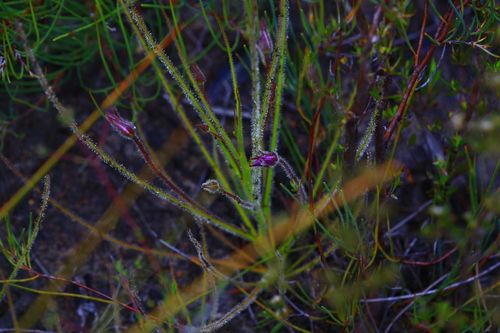
Etymology
- Byblis: see the genus sheet.
- gigantea: from the Latin giganteus, “giant”, because it is much larger than B. liniflora, the first species described.
History of the discovery
1839: the naturalist James Drummond collects the type specimen near the Swan River (Perth); Lindley describes it the same year.
Description (how to recognise it)
- A small perennial plant, herbaceous or somewhat woody, much branched, up to about 45 cm (up to 70 cm according to the genus sheet).
- Pink-purple and white flowers, from September to January.
Distribution
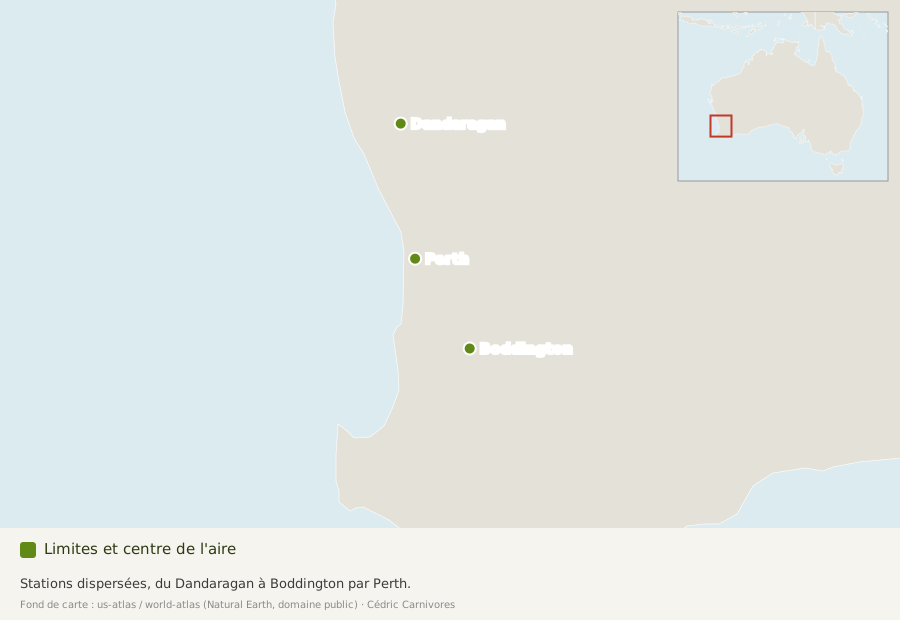
Endemic to Western Australia, in scattered sites: from the Dandaragan area in the north, through the suburbs of Perth and the Darling Range, to Boddington in the south.
Habitat
Marshes and places that are wet for part of the year, on sandy and peaty soils, usually in low thickets of Leptospermum and Restionaceae.
Ecology
- Fire: it resprouts from its underground stems after a fire. Seeds more than 22 years old have germinated after a fire treatment.
- Buzz pollination: its flowers only release their pollen when they sense the vibration of the wings of a pollinator (“sonication”, according to Adrian Slack).
Relationships
Very close to B. lamellata, from which it differs in the shape of its seeds.
Threats and protection
“Critically endangered” according to the IUCN (2000); “Priority Two” in Western Australia (2002). The urban growth of Perth has destroyed a large part of its range.
Sources
- Wikipedia (English), Byblis gigantea: Lindley 1839, Drummond, synonym, etymology, description, flowering, sonication, range, habitat, fire, status, relationships.