Byblis guehoi Lowrie & Conran
Species sheet, updated on 29/10/2026.
At a glance
| Scientific name | Byblis guehoi Allen Lowrie & John Godfrey Conran, Telopea, 2008 |
| Family | Byblidaceae |
| Distribution | Kimberley, Western Australia |
| Status | Vulnerable (IUCN, 2020) |
Etymology
- Byblis: see the genus sheet.
- guehoi: dedicated to a person named Guého.
History of the description
Described in 2008 in the journal Telopea as “a new species from the Kimberley”.
Description (how to recognise it)
- A compact and tetraploid species.
- According to Lowrie and Conran (2008), who described it: a compact, much-branched plant, covered with glands, anchored to the ground by a single root; each branch ends in a leafy, flowering head 6 to 8 cm long, and the whole plant spreads over 20 to 30 cm.
- Flowers mauve-pink above, whitish below, with toothed petals and purple filaments, 15 to 20 mm across when the soil is moist, three times smaller as the dry season approaches; pedicels longer than the leaves. Close to B. filifolia; 2n = 32 chromosomes.
Distribution
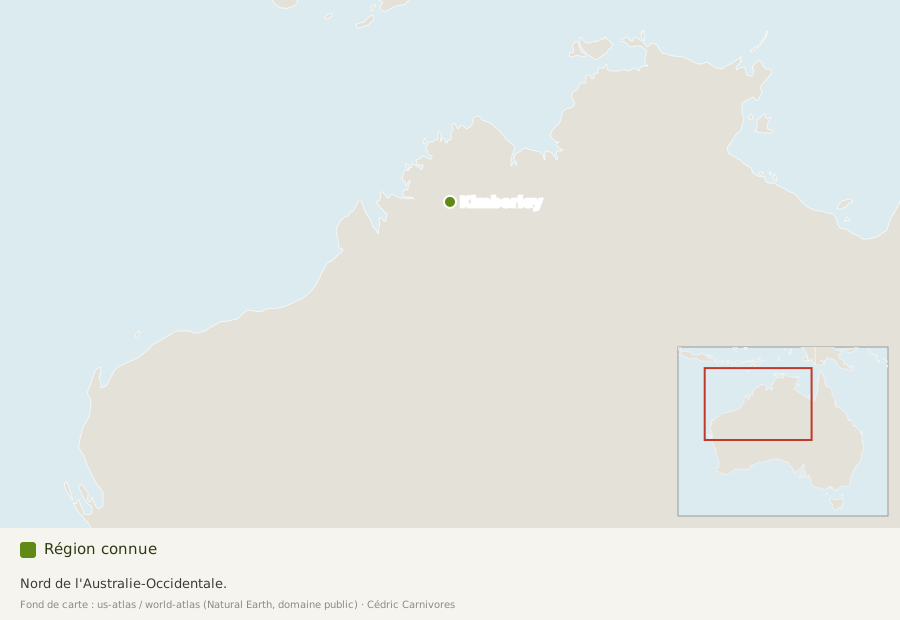
Endemic to the Kimberley, in the north of Western Australia.
Habitat
Lowrie and Conran (2008) know it from a single locality only, near the Beagle Bay mission (Dampier Peninsula, north-east of Broome), discovered by Russ Guého in 2004: an open woodland of acacias and eucalypts with low tufted grasses, where it grows on patches of sandy silt that is waterlogged in the rainy season but dries out quickly.
Threats and protection
“Vulnerable” according to the IUCN (2020).
Sources
- Wikipedia (English), Byblis guehoi: Lowrie & Conran 2008, range, description, status.
- Lowrie and Conran, Telopea 12(1), 2008 (archive.org): original description, habitat.