Cephalotus follicularis Labill.
Species sheet, updated on 29/10/2026.
At a glance
| Scientific name | Cephalotus follicularis Jacques-Julien Houtou de Labillardière, Novae Hollandiae plantarum specimen, 1806 |
| Family | Cephalotaceae: the only species in its family |
| Common names | Albany pitcher plant, Western Australian pitcher plant, fly-catcher plant; in French céphalote |
| Distribution | South-west of Western Australia, on a coastal strip about 400 km long |
| Habitat | Damp, acidic peaty sands: marshes, seeps, stream banks |
| Flowering | January-February (the southern summer) |
| Status | Vulnerable (IUCN); not threatened under Australian law; removed from CITES Appendix II |
Photos in the wild
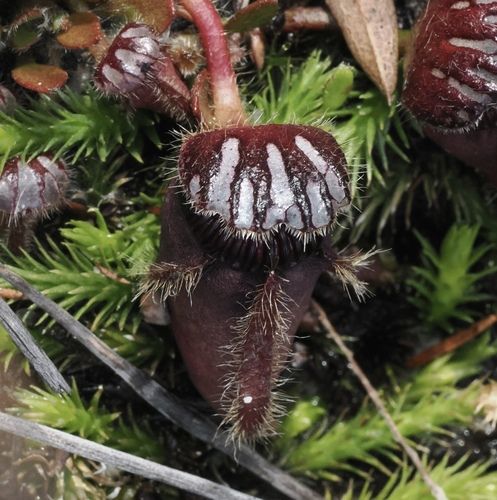
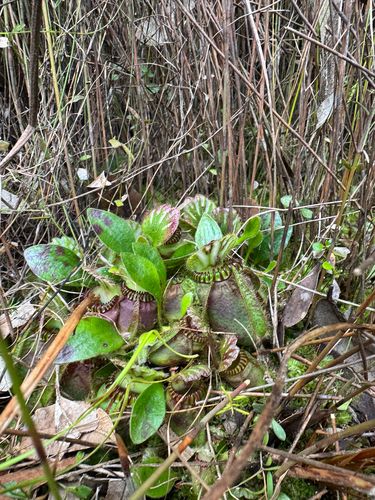
Etymology
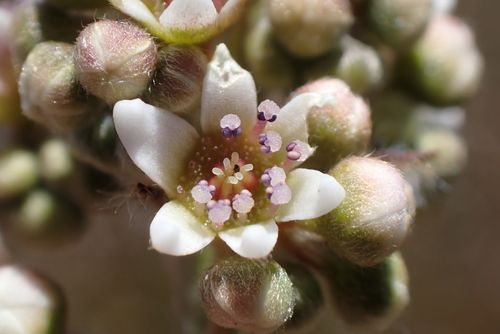
- Cephalotus: from the Greek kephalḗ, “head”, and oûs, ōtós, “ear”. The name describes the small head-shaped anthers of its flowers.
- follicularis: from the Latin folliculus, “little bag”. It refers to its pitchers shaped like small pouches.
- Its English name Albany pitcher plant comes from the town of Albany, at the heart of its range.
History of the discovery
- 1791: the Scottish surgeon and naturalist Archibald Menzies may have collected it during the Vancouver expedition (not confirmed).
- 1801-1802: the expedition of the botanist Robert Brown aboard HMS Investigator collects it at King George Sound, near Albany. The first discovery is generally credited to the painter Ferdinand Bauer and the artist William Westall, around 1 January 1802. Brown gives it a name that was never published.
- 1803: the French botanist Leschenault, of the Baudin expedition, collects further specimens.
- 1806: the Frenchman Labillardière describes it from Leschenault's collections. Because the fruit was poorly preserved, he first placed it, wrongly, in the rose family.
- Robert Brown later created a separate family for it, the Cephalotaceae, based on William Baxter's better-preserved specimens with fruit.
- 1823: Kew Gardens, in England, receives its first living plants.
Description (how to recognise it)
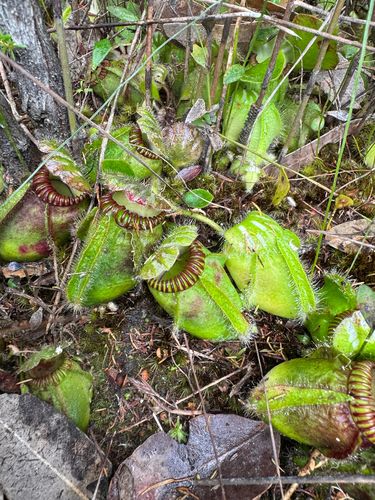
- Habit: small, evergreen perennial plant forming a rosette, about 10 to 20 cm tall, on a rhizome.
- Two kinds of leaves:
- flat, ordinary leaves, spoon-shaped and glossy, up to 15 cm long including the petiole. They catch nothing;
- pitchers, up to 5 cm long, sitting at ground level.
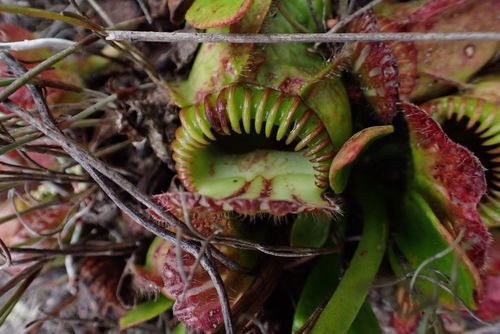
- The pitchers:
- a lid stops rain from getting in. It bears translucent patches, like windows, which disorient insects;
- the inner rim of the opening bristles with claw-like teeth, and the wall with downward-pointing hairs, which stop prey from climbing back out;
- they turn dark red in full sun and stay green in the shade.
- Flowers:
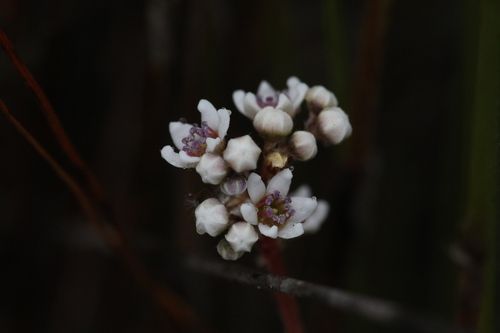
- borne on a scape up to 60 cm tall;
- small, white or cream, about 7 mm across, without petals, with 6 calyx lobes.
- Fruits: a hairy fruit containing one or two brown seeds, about 0.8 mm long.
- Chromosomes: 2n = 20.
Distribution
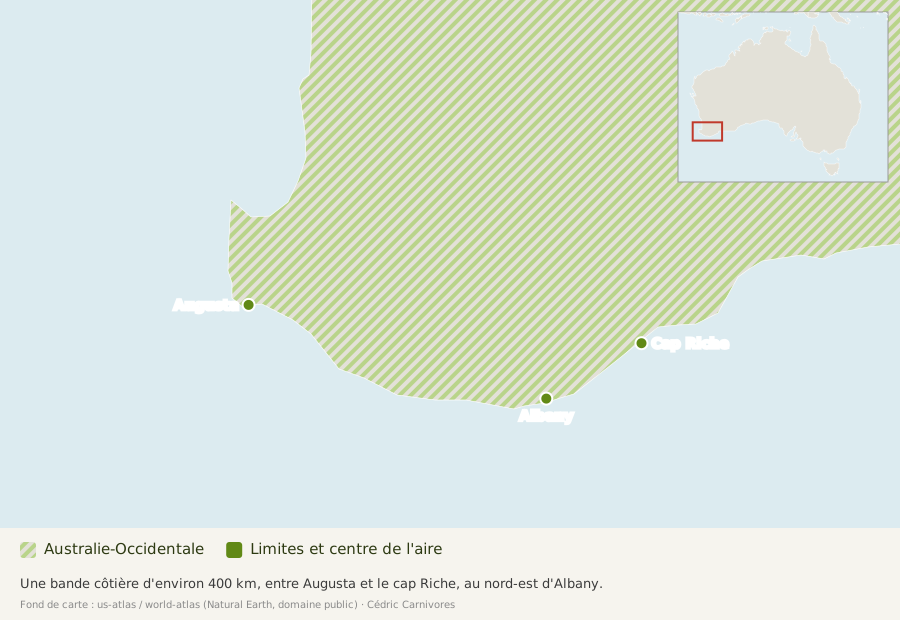
Endemic to the south-west of Western Australia, on a coastal strip about 400 km long, between Augusta in the west and Cape Riche, north-east of Albany.
Habitat
- Damp, acidic peaty sands;
- marshes, seeps and banks of streams or rivers;
- often among sphagnum moss and tufts of grasses.
Ecology
- Prey: mainly ants.
- Digestion: the pitcher fluid contains enzymes (esterases, phosphatases, proteases), and micro-organisms take part in digestion.
- Its inhabitants: the larvae of a wingless fly, Badisis ambulans, develop in the pitchers. This fly is known only from this plant. Larvae of midges of the genus Dasyhelea also live in the traps.
- After bushfires: it regrows from its rhizome.
Its place in classification
It looks like Nepenthes and pitcher plants, but it is not related to them at all. It belongs to the order Oxalidales, that of the wood sorrels (Oxalis), and its closest relatives are families of trees and shrubs (Brunelliaceae, Cunoniaceae, Elaeocarpaceae). Pitchers have therefore appeared several times, independently, in the history of plants.
In 2017, its genome was sequenced (journal Nature Ecology & Evolution). By comparing its ordinary leaves and its pitchers, researchers showed that carnivory evolved convergently in unrelated plants: the same “solutions” appeared again several times.
Threats and protection
- Listing: “vulnerable” for the IUCN, mainly because of the destruction of its habitats and over-collecting. Australian law (the EPBC Act and the Western Australian wildlife act) considers it not threatened. It has been removed from CITES Appendix II.
Did you know?
- A wingless fly lives nowhere else but in its pitchers.
- Despite looking like a small “Nepenthes”, it is more closely related to wood sorrels than to any other carnivorous plant.
Sources
- Wikipedia (English), Cephalotus: 1806 publication, Leschenault, Brown, Bauer and Westall, Baxter, etymology, names, description, flowering, 400 km range between Augusta and Cape Riche, habitat, prey, enzymes, Badisis ambulans, Dasyhelea, 2017 genome, classification, statuses, Kew 1823; references: Fukushima et al. 2017, Nature Ecology & Evolution 1: 0059.