Darlingtonia californica Torr.
Species sheet, 29/10/2026, based on the Flora of North America. Points marked “(not confirmed)” rest on a single, unreliable source only.
At a glance
| Scientific name | Darlingtonia californica John Torrey, Smithsonian Contributions to Knowledge 6(4): 5, plate 12, 1853 |
| Family | Sarraceniaceae (with Sarracenia and Heliamphora) |
| Genus | Darlingtonia, conserved name; a single species |
| Former name | Chrysamphora californica Greene, 1891 (synonym) |
| Common names | Cobra lily, cobra plant, California pitcher plant; in French darlingtonie, plante cobra |
| Distribution | Northern California and south-western Oregon |
| Habitat | Boggy streams, seeps and bogs on serpentine rock, from sea level to 2,600 m |
| Flowering | From mid-April to July |
| Status | Least concern (IUCN, 2000); “vulnerable” for NatureServe |
Photos in the wild
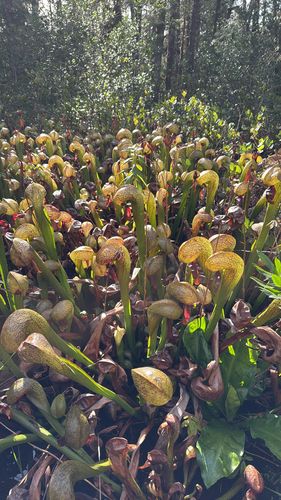
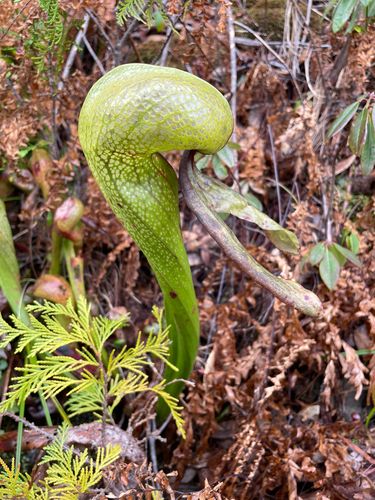
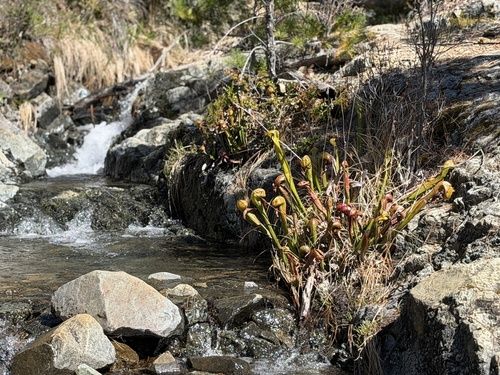
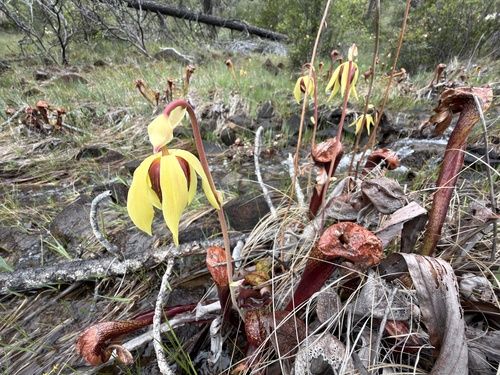
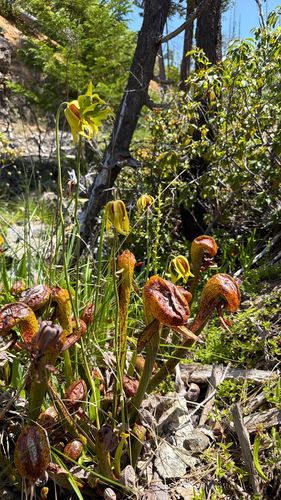
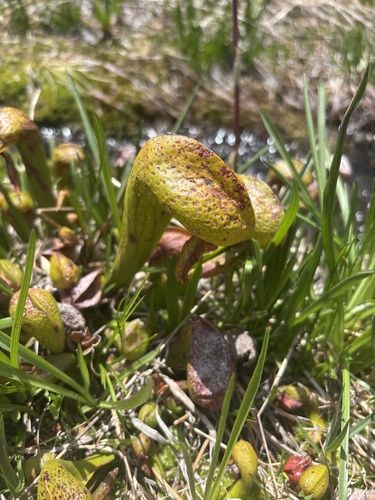
Etymology
- Darlingtonia: the genus is dedicated to William Darlington (1782-1863), a botanist from Philadelphia.
- californica: “from California”.
- The cobra: its coiled pitchers look like a rearing cobra with its hood spread. The forked appendage hanging in front of the opening recalls the snake's tongue.
- The former name Chrysamphora, given to it by Edward Greene in 1891, means “golden amphora” in Greek.
History of the discovery
- 1841: the assistant botanist William D. Brackenridge discovers it during the Wilkes Expedition, the great exploring expedition of the United States Navy. It was growing in a marsh beside a tributary of the Sacramento River, south of Mount Shasta.
- 1853: John Torrey describes it and creates the genus Darlingtonia.
- 1891: Edward Greene renames it Chrysamphora. This name is not accepted, and Darlingtonia is officially “conserved”.
Description (how to recognise it)
- Habit: a plant that forms colonies by means of stolons (creeping stems that produce new plants), on a horizontal rhizome.
- Pitchers:
- upright, 40 to 60 cm tall, up to 1 m;
- twisted on themselves by 90 to 270°, in a spiral;
- yellowish green, often flushed with red;
- they end in a rounded head, covered with translucent white spots;
- they stay green all year round.
- The opening: round, facing the ground, hidden under the head. It is not covered by a hood.
- The “snake's tongue”: a flattened, fishtail-shaped appendage with two spreading lobes, hanging in front of the opening. It is yellowish green to reddish. The neck is about 1 cm long.
- No phyllodes.
- Flowers: one flower per scape, an extraordinary flower:
- scape 50 cm to 1 m tall, slightly or much taller than the pitchers, bearing about 9 yellowish bracts 1 to 3.5 cm long;
- flower without scent, nodding;
- yellowish green sepals, 3 to 6 cm long, longer than the petals;
- reddish brown petals with darker veins, about 3.5 cm long. They touch and form a curtain around the stamens and pistil. Each one is notched: the notches of two neighbouring petals meet and form 5 holes in the corolla;
- 15 stamens;
- the style ends in 5 thin radiating arms, covered with pollen-receiving cells.
- Fruits: capsules shaped like an inverted cone, 3.5 to 4.5 cm long, which open from the bottom upwards.
- Seeds: about 1,000 per capsule, 2 to 3 mm long, covered with long papillae that allow them to float.
- Chromosomes: 2n = 30 (base number x = 15, against x = 13 in Sarracenia).
The yearly cycle
- The flowers form in autumn and spend the winter as buds, protected by the bracts.
- They open from mid-April to July.
- The fruits ripen from late summer to autumn, and the seeds keep dispersing all winter, often carried away by water.
Distribution
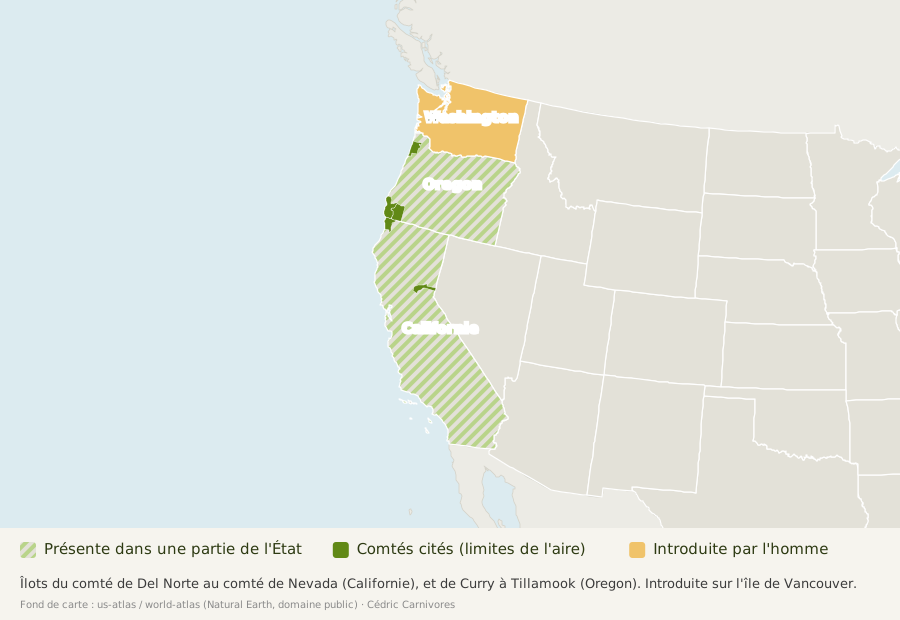
- California: in separate patches, from Del Norte County in the north-west to Nevada County in the south-east, in the Sierra Nevada. It has been introduced in Humboldt and Mendocino counties.
- Oregon: on the coast and in the inland mountains of Curry and Josephine counties, and north to Tillamook County.
- Introduced on Vancouver Island (British Columbia, Canada) and in southern Washington State.
Habitat
- Boggy streams, seeps and bogs;
- almost always on serpentine rock (ultramafic rock), very poor soils that are toxic to most plants, or on poor siliceous sand;
- always where water flows all year round. It is even found in seeps beside roadside ditches.
It forms fairly large colonies on slopes and mountain meadows, in the coastal lowlands, and in shallow streams. Altitude: from sea level to 2,600 m.
Ecology
- Roots kept cool: its roots are very large and spreading. They tolerate heat badly and decline as soon as the temperature rises a little above 10 °C. The cold water flowing through its habitats keeps them cool.
- It fills its pitchers itself: it does not collect rainwater, since its opening faces the ground. It regulates the water level in its pitchers with water drawn up by its roots.
- The trap:
- insects are attracted by nectar;
- once inside through the opening, they see light through the false windows of the head, head towards it and wear themselves out looking for the exit, well hidden underneath;
- they end up falling into the fluid.
- One study showed that removing the “tongue” does not change the amount of prey caught: so its role is not what was thought.
- Digestion: it was long believed to produce no digestive enzymes. Recent studies show that it secretes at least one, which breaks down proteins.
- Pollination: long a mystery. In 2011, a study in five populations in northern California observed a solitary bee, Andrena nigrihirta, visiting and pollinating the flowers. Visits are rare, and all the populations produced fewer seeds than they could for lack of pollen. Self-pollination also seems to play a part. Thrips and several spiders also visit the flowers.
- After fire: the plant can regrow from its roots.
Threats and protection
- Listing: “least concern” for the IUCN (2000); “vulnerable” for NatureServe. It remains uncommon in the wild.
- Threats: road building, drainage, logging, livestock farming, droughts, and unscrupulous collectors.
- Moved plants: Darlingtonia, and even carnivorous plants from the eastern United States, have been planted at sites in northern California and the north-west.
Did you know?
- Its petals form a curtain pierced with five holes: a unique case among carnivorous plants.
- Its seeds float: stream water carries them away all winter.
- Superb in the wild, it is very difficult to grow outside its cool climate.
Sources
- Flora of North America, vol. 8, p. 349-350, genus Darlingtonia and Darlingtonia californica (T. L. Mellichamp), floranorthamerica.org/Darlingtonia_californica: etymology, conserved name, Chrysamphora, full description of the flower, flowering, habitat, altitude, counties, introductions, yearly cycle, floating seeds, 1841 discovery, threats.
- Wikipedia (English), Darlingtonia californica: names, serpentine, roots, water level, false windows, role of the appendage, enzyme, statuses.
- Meindl & Mesler 2011, Madroño 58: 22: pollination by Andrena nigrihirta.
- DeBuhr, L. E. (1973). Distribution and Reproductive Biology of Darlingtonia californica. Thesis, Claremont Graduate School (cited by the Flora).