Dionaea muscipula J. Ellis
Species sheet, 29/10/2026, based on the Flora of North America. Points marked “(not confirmed)” rest on a single, unreliable source only.
At a glance
| Scientific name | Dionaea muscipula John Ellis, St. James's Chronicle or the British Evening Post no. 1172, 1768 |
| Genus | Dionaea Solander ex J. Ellis; a single species |
| Family | Droseraceae (with Drosera and Aldrovanda) |
| Common names | Venus flytrap, meadow-clam, tippitiwitchet; in French dionée attrape-mouche |
| Distribution | Coastal plain of North and South Carolina, around Wilmington |
| Habitat | Damp sandy-peaty soils, sphagnum carpets, pond pine savannas, from 0 to 100 m |
| Flowering | Late May-June |
| Status | Vulnerable (IUCN); CITES Appendix II; stealing it has been a felony in North Carolina since 2014 |
Photos in the wild
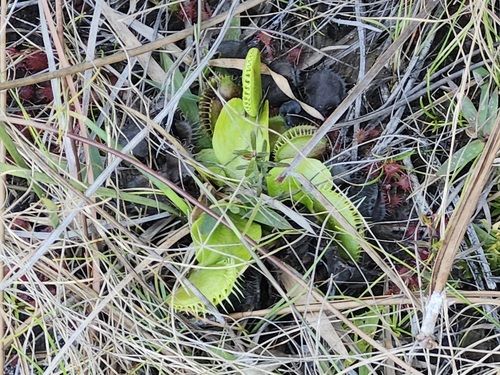
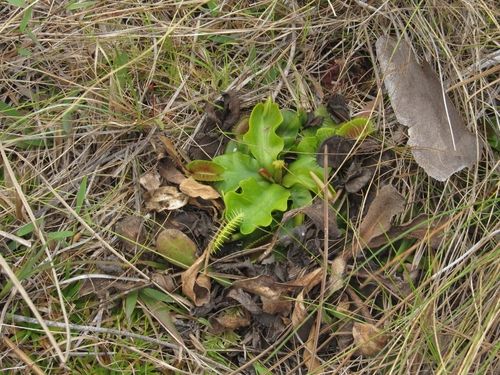
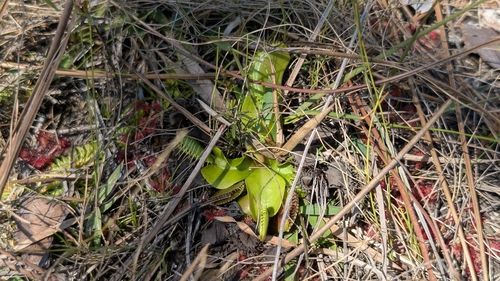
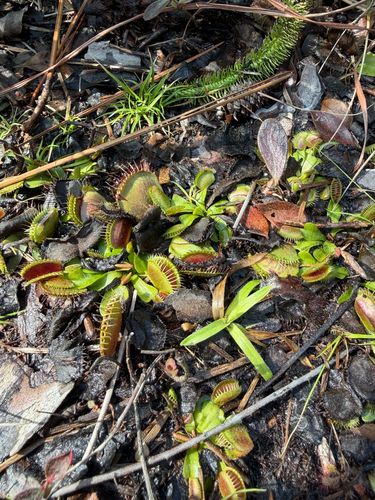
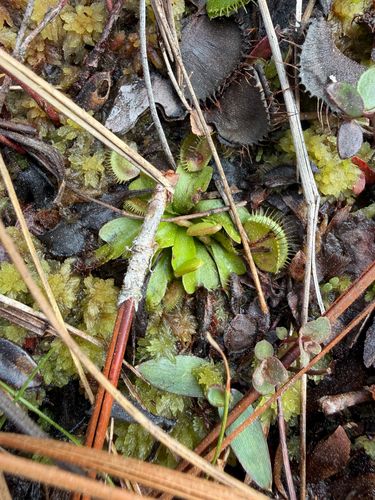
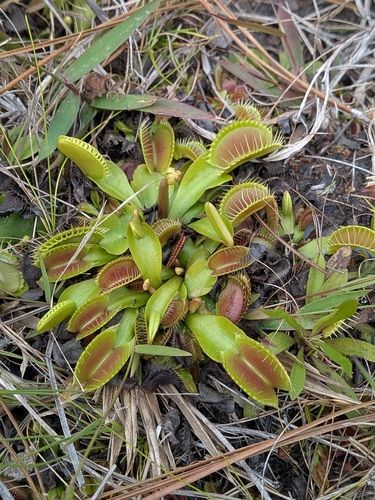
Etymology
- Dionaea: from Dione, in Greek mythology the mother of Aphrodite, goddess of love and beauty, whom the Romans called Venus. Hence the English name Venus flytrap.
- muscipula: a Latin word meaning a mousetrap, and also a flytrap. Dionaea muscipula therefore means roughly “Dione's trap” or “Aphrodite's trap”.
- The old popular names: meadow-clam, for its traps that open and close like shells; and tippitiwitchet, an old name from Carolina (origin, not confirmed).
History of the discovery
- 2 April 1759: the governor of the colony of North Carolina, Arthur Dobbs, is the first to describe it, in a letter to the botanist Peter Collinson. He speaks of a kind of “sensitive fly-catching plant, which closes on anything that touches it”. He gives a fuller description on 24 January 1760.
- 1768: the naturalist John Ellis names it Dionaea muscipula, following an idea of the botanist Daniel Solander. Unusually, the name is first published in a newspaper, the St. James's Chronicle, ahead of a letter to Linnaeus dated 23 September 1768. Ellis also proposes the English name Venus's Flytrap.
- 1875: Charles Darwin studies its movements at length in his book Insectivorous Plants.
Description (how to recognise it)
- Habit: a rosette of leaves, forming clumps in old plants. The plant is perennial and stays green all year: it does not form winter buds. It regrows from a rhizome shaped like a small bulb, wrapped in the fleshy bases of the leaves. Its roots are white and unbranched.
- Leaves:
- a winged petiole, 2 to 7 cm long (up to 10 cm), longer in shade;
- the trap: two kidney-shaped lobes, 1.2 to 2.5 cm long, hinged on the midrib, green or bright red inside;
- their edges bear stiff bristles 3 to 8 mm long, which stop prey from escaping;
- each lobe has 3 trigger hairs on its inner face.
- Flowers:
- scape 18 to 26 cm tall (15 to 43 cm), bearing the flowers in a cluster;
- white petals, 10 to 12 mm long, which wither in place;
- usually 15 stamens (10 to 20);
- feathery stigma.
- Fruits: small capsules 3 to 4 mm long that open irregularly, with 20 to 30 shiny black seeds, 1 to 1.5 mm long.
- Chromosomes: 2n = 32.
- A curiosity: the whole plant turns black when it dries.
How the trap works
- Two touches to close: the trigger hairs must be touched twice in a row, within about twenty seconds, for the trap to close. This double trigger prevents a raindrop or a bit of debris from closing it for nothing.
- Less than a second: the trap shuts in a fraction of a second. The bristles along the edge interlock like the bars of a cage.
- A light closure first: the two lobes meet while remaining convex. If nothing has been caught, the trap reopens the next day.
- Digestion: if the trap detects protein-rich prey, it closes completely, becomes slightly hollow, crushes the prey and secretes digestive enzymes. Digestion takes about ten days.
- Reopening: the trap then reopens by growing, reveals the empty carcass and can still be used for a while.
- Constant renewal: new leaves keep unfolding while the old ones die and turn black.
- These mechanisms have been the subject of a great deal of research.
Distribution
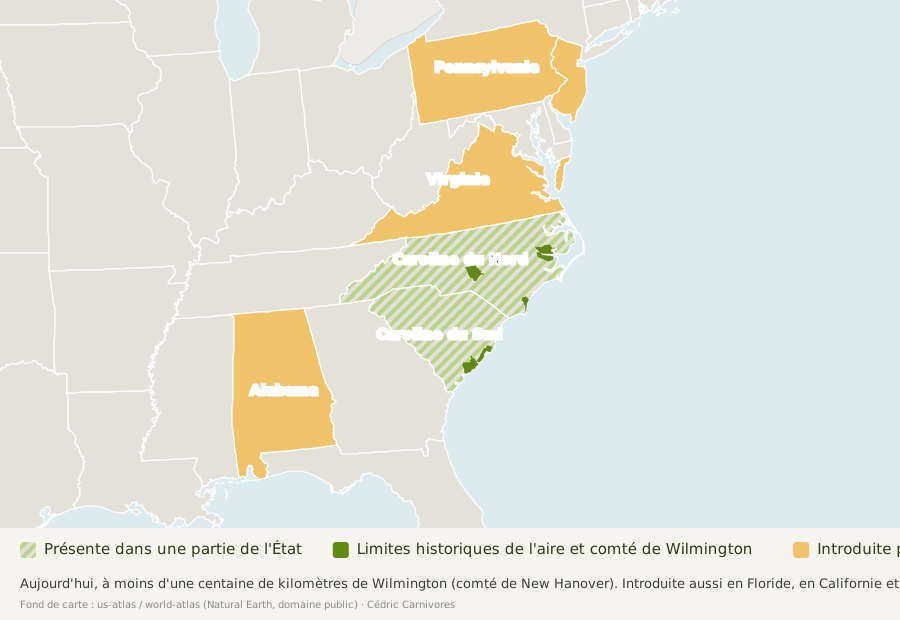
- Natural range: the outer coastal plain, from Beaufort County (North Carolina) to Charleston County (South Carolina), and inland to Moore County (North Carolina). Today, all known sites lie within about a hundred kilometres of Wilmington.
- A shrinking range: it has been greatly reduced by drainage, changes to habitats, the absence of fires and urban growth.
- Introduced in southern Alabama, northern California, eastern Pennsylvania and Caroline County in Virginia, without being truly naturalised. It is said to be naturalised in the Apalachicola area of Florida, in southern New Jersey and in Skagit County, Washington State.
A mysteriously small range: this may be explained by the poor dispersal of its seeds, its very poor soils, fairly high rainfall and regular fires.
Habitat
- Damp sandy-peaty soils and sphagnum carpets;
- pond pine savannas;
- roadsides, ditch banks, old borrow pits;
- above all the edges between pocosins (shrub thickets on peat) and pond pine savannas or sandhills.
It needs soils that are waterlogged but not flooded, and intense sunlight. Altitude: from sea level to 100 m.
Ecology
- A hotspot for carnivorous plants: in south-eastern North Carolina and neighbouring South Carolina, it grows with at least 16 other species of carnivorous plants. This is the greatest diversity of carnivorous plants in the world.
- Fragile: often abundant where it grows, it is very sensitive to shade and drought. It goes dormant during dry periods, or if its habitat does not burn roughly every five years.
- Prey: mainly walking animals: about one third ants, 30% spiders, 10% beetles and 10% grasshoppers, and less than 5% flying insects.
- It does not eat its pollinators: its flowers, held high on a scape, are pollinated by flying insects such as sweat bees (halictid bees), longhorn beetles and checkered beetles. These are almost never the same as its prey.
Notable forms
- The length of the petiole varies a great deal, under the influence of genes and environment.
- The inside of the traps can be bright red or greenish. Sunlight often brings out the red, but not always.
- In cultivation, plants that are entirely burgundy red have been found, as well as cultivars with bristles of varying lengths.
Its place in classification
It has sometimes been placed alone in its own family, the Dionaeaceae, because almost all its features differ from those of the sundews. DNA analyses nevertheless place it in the family Droseraceae. Its closest relative is Aldrovanda vesiculosa, an aquatic plant: they are the only two plants in the world with a snap trap, which is thought to have arisen only once in their common ancestor, from a sticky trap like that of the sundews.
Threats and protection
- Listing: “vulnerable” for the IUCN; CITES Appendix II.
- A collapse: a 2019 census counted about 164,000 plants in North Carolina and 4,900 in South Carolina, or about 302,000 in the wild. That is more than 93% fewer than the 1979 estimate of about 4.5 million.
- Poaching: since 2014, digging up wild Venus flytraps has been a felony in North Carolina. One man was sentenced to 17 months in prison for taking 970 of them.
- Other threats: habitat loss, fire suppression, rising sea levels.
- The U.S. Fish and Wildlife Service is considering listing it as a federally threatened species.
- Seed for cultivation: some roadside populations, of several thousand plants, are managed to harvest seed for nursery production.
Did you know?
- Its name was first published in a London newspaper, in 1768.
- It can “count”: two touches to close, then several more before it starts digesting.
- Around Wilmington, it shares its habitat with at least 16 other carnivorous plants: a world record.
- Despite its fame, it makes a poor houseplant on a windowsill.
Sources
- Flora of North America, vol. 6, p. 419, genus Dionaea and Dionaea muscipula (T. L. Mellichamp), floranorthamerica.org/Dionaea_muscipula: 1768 publication, etymology, English names, full description, flowering, habitats, altitude, historical range and counties, introductions, how the trap works, 16 other carnivorous plants, fire every five years, forms, classification (Cameron et al. 2002; Williams et al. 1994; Rivadavia et al. 2003).
- Wikipedia (English), Venus flytrap: Dobbs 1759-1760, Ellis and Linnaeus 1768, diet, pollinators, details of the trap, 2019 census, 2014 law, Aldrovanda.
- Darwin, C. (1875). Insectivorous Plants. London.
- Roberts, P. R. & Oosting, H. J. (1958). Responses of Venus fly trap to factors involved in its endemism. Ecological Monographs 28: 193-218 (cited by the Flora).