Drosera bequaertii Taton
Species sheet, updated on 30/10/2026.
At a glance
| Scientific name | Drosera bequaertii Auguste Taton, 1945 |
| Family | Droseraceae |
| Distribution | Angola and DR Congo |
| Status | Vulnerable (VU) on the IUCN Red List |
Etymology
- Drosera: see the genus sheet.
- bequaertii: probably in honour of the Belgian naturalist Joseph Bequaert, who explored the Congo (not confirmed).
Description (how to recognise it)
- Small perennial with a short stem 3 to 4 cm long (up to 7), densely hairy; leaves crowded and upright at the top, more spaced and bent downwards lower down, with an obovate to spatulate blade 4 to 12 mm long, hairy underneath; reddish-brown stipules, torn at the tip.
- Scapes 10 to 17 cm, well upright, with 2 to 8 flowers. D. compacta is generally considered a synonym, but the authors consider that further study would be needed.
Distribution
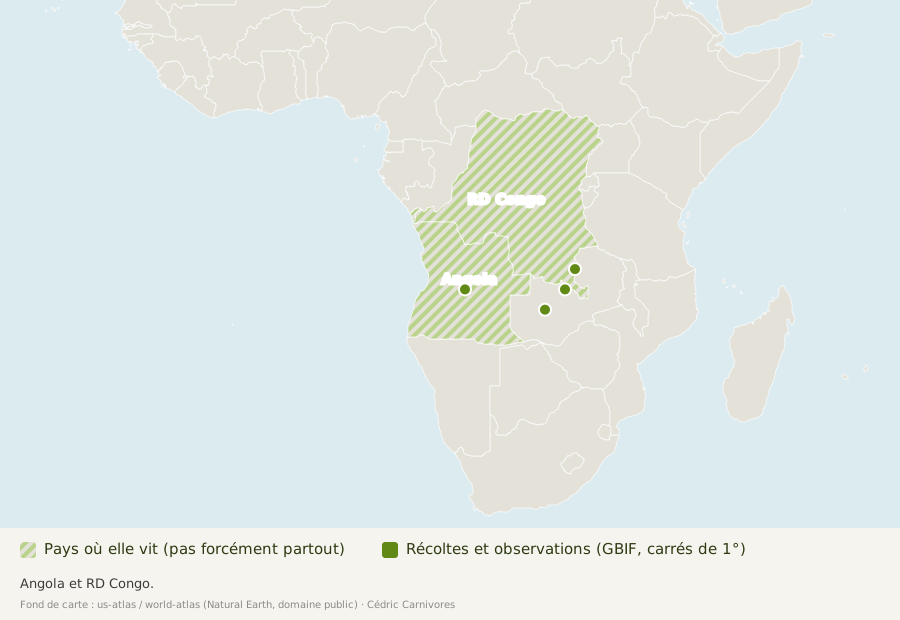
Central Africa: Angola and the Democratic Republic of the Congo. According to Kew's world checklist of plants (WCVP), it is native to the following regions: Angola, DR Congo and Zambia.
Habitat
Grassy wetlands of the high plateaus; Angola, DR Congo and Zambia; the type specimen was collected by J. Bequaert in the Congo in 1912; recent collections at around 1,000 to 1,130 m (Cameia National Park, Angola). According to the collections and observations published in GBIF, it grows mostly at around 1,150 m above sea level.
Sources
- Wikipedia (English), List of Drosera species: range.
- List of Drosera: authors, year.
- Kew, World Checklist of Vascular Plants (via GBIF): natural distribution.
- “Synopsis of the genus Drosera (Droseraceae) in Angola and the Democratic Republic of the Congo” (Plazi text, public domain, via GBIF): description, habitat, range, specimens.
- GBIF, Drosera bequaertii: author, original publication, IUCN Red List category, countries, altitude and localities of herbarium specimens and observations.