Drosera bicolor Lowrie & Carlquist
Species sheet, updated on 30/10/2026.
At a glance
| Scientific name | Drosera bicolor Allen Lowrie & Sherwin Carlquist, 1992 |
| Family | Droseraceae (subgenus Ergaleium, section Ergaleium: erect tuberous sundews) |
| Distribution | Upper Phillips River valley and south-east of Lake King (Western Australia) |
| Habitat | Deep siliceous sand, in heathland |
Etymology
- Drosera: see the genus sheet.
- bicolor: from the Latin, “two-coloured”: its white flowers bear a red spot at the base of the petals.
Description (how to recognise it)
- Tuberous perennial, upright, up to about 11 cm.
- Rosette of leaves at the base, as in D. peltata.
- White flowers marked with a red spot near the base of the petals, from September to October.
- According to FloraBase: Tuberous perennial. White flowers, in September.
Distribution
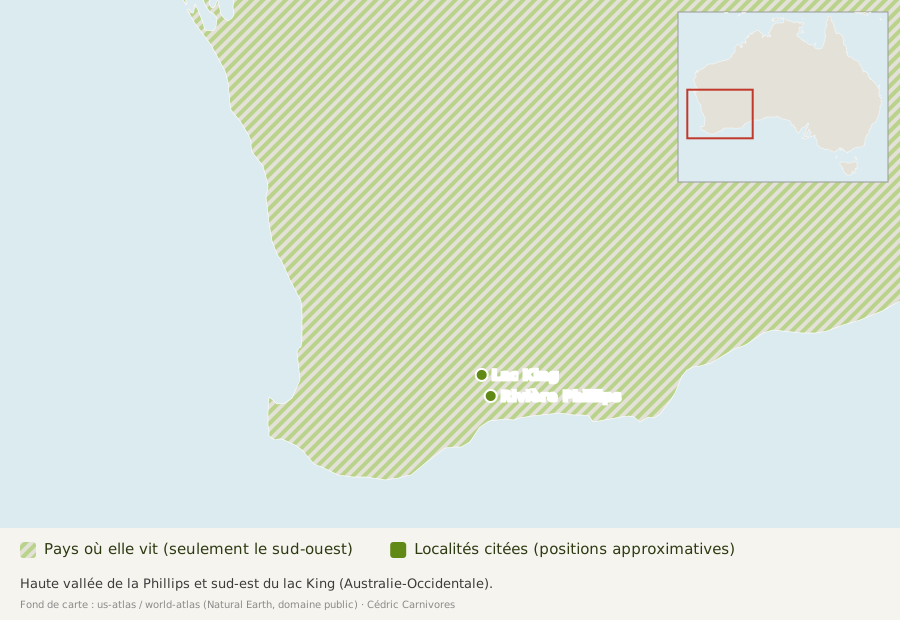
Endemic to Western Australia: upper valley of the Phillips River and south-east of Lake King.
Habitat
Deep siliceous sand, in heathland. According to FloraBase: White siliceous sand. Floodplains.
Did you know?
- Some consider it a mere variety of D. peltata; it is also close to D. salina.
Sources
- Wikipedia (English), Drosera bicolor: authors, description, flowering, range, habitat, relationships, section.
- FloraBase, Western Australian Herbarium, Drosera bicolor Lowrie & Carlquist: description (Amanda Spooner, 8 September 1999), flowering, soil and habitat, regions, status in Western Australia.
- GBIF, Drosera bicolor: author, original publication, countries and localities of herbarium specimens and observations.