Drosera caduca Lowrie
Species sheet, updated on 30/10/2026.
At a glance
| Scientific name | Drosera caduca Allen Lowrie, Nuytsia 11, 1996 |
| Family | Droseraceae (subgenus and section Lasiocephala: “petiolaris” sundews of northern Australia) |
| Distribution | From the Edkins Range to the south of Prince Regent National Park, and Augustus Island (Kimberley, Western Australia) |
| Habitat | White sands along creeks |
| Status | Least concern (LC) on the IUCN Red List |
Etymology
- Drosera: see the genus sheet.
- caduca: from the Latin caducus, “falling, deciduous”: its sticky traps disappear on the adult leaves.
History of the description
- 27 May 1993: the type specimen is collected on Augustus Island.
- 1996: described by Allen Lowrie.
Description (how to recognise it)
- Perennial plant forming a rosette; one or several rosettes grow from the rootstock.
- Only the young leaves bear sticky tentacles: the adult leaves no longer have any, a case unique in the genus.
- White flowers, from December to July.
Distribution
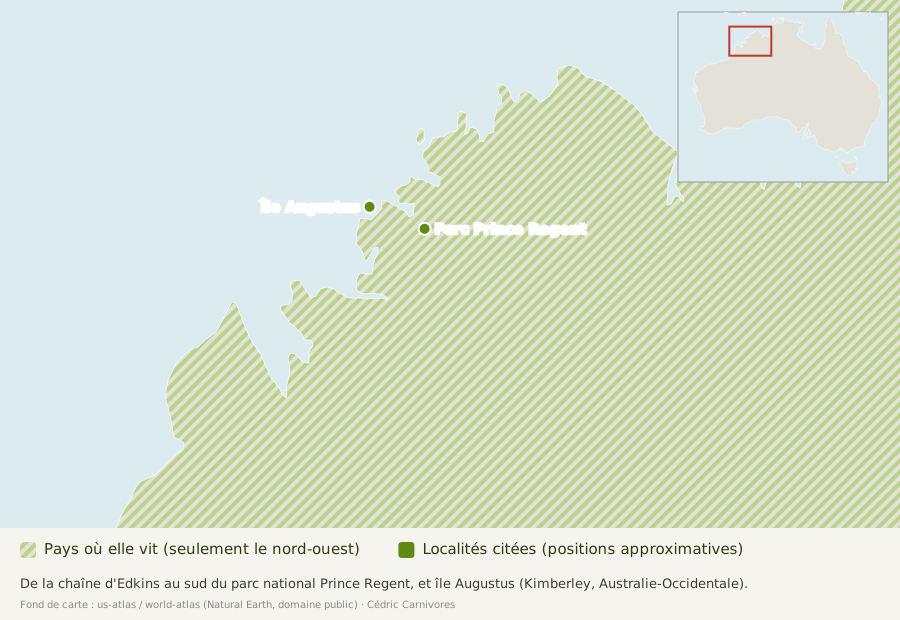
Endemic to Western Australia (Kimberley): from the Edkins Range to the south of Prince Regent National Park, and on Augustus Island.
Habitat
White sands along creeks. According to the collections and observations published in GBIF, it grows mostly at around 344 m above sea level.
Sources
- Wikipedia (English), Drosera caduca: author, etymology, type specimen, description, flowering, range, habitat, subgenus.
- GBIF, Drosera caduca: author, original publication, IUCN Red List category, countries, altitude and localities of herbarium specimens and observations.