Drosera coalara Lowrie & Conran
Species sheet, updated on 30/10/2026.
At a glance
| Scientific name | Drosera coalara Allen Lowrie & John Conran, 2013 |
| Family | Droseraceae |
| Distribution | Australia |
| Status | Least concern (LC) on the IUCN Red List |
Etymology
- Drosera: see the genus sheet.
- coalara: origin of the name not given in the sources consulted.
Description (how to recognise it)
- English Wikipedia places it in D. citrina, a pygmy sundew with lemon-yellow flowers; a 2020 study examined its links with D. citrina and D. nivea.
- Pygmy sundew (section Bryastrum), described by Lowrie (2014) as white-flowered; Krueger and Fleischmann (2020) found populations where white and yellow flowers grow mixed together, as in D. citrina and D. nivea.
- In their view, the three rather form a gradient: D. citrina (mostly yellow) in the south, D. nivea (mostly white) in the north, linked by D. coalara in the middle; pollinators do not seem to distinguish between the two colours.
Distribution
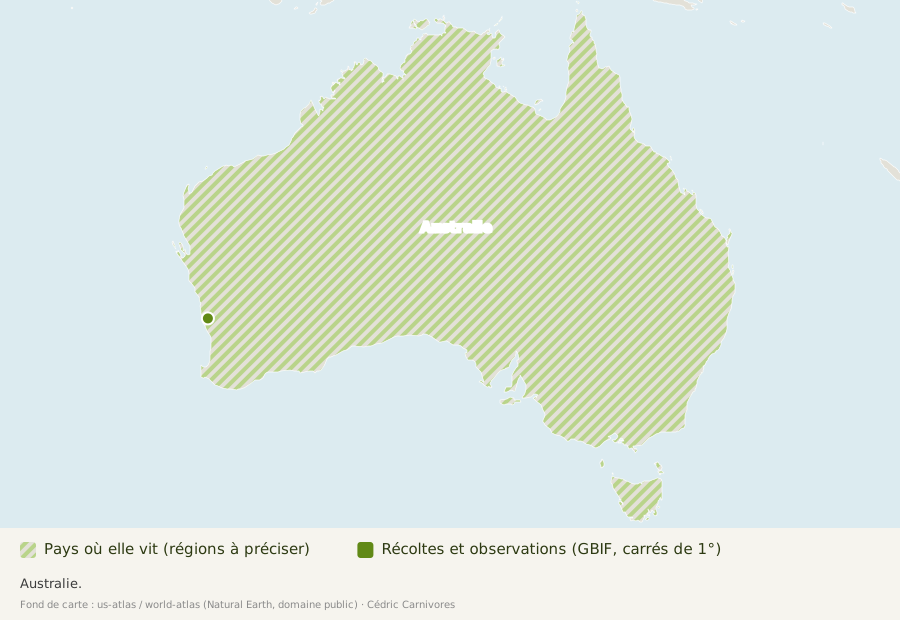
Endemic to Australia. According to Kew's world checklist of plants (WCVP), it is native to this single region only: Western Australia.
Habitat
According to Krueger and Fleischmann (2020), it grows in very varied heathlands, on deep yellow, beige or grey sands and even on almost pure laterite, on the sandplains of south-western Western Australia (between Coorow and Gingin); originally known only from the type locality (north-east of Badgingarra), it was found in 2019 at at least seven other sites, as far as Wannamal.
Sources
- Wikipedia (English), Drosera citrina: synonymy, 2020 study.
- Wikipedia (English), List of Drosera species: range.
- List of Drosera: authors, year.
- Kew, World Checklist of Vascular Plants (via GBIF): natural distribution.
- Krueger and Fleischmann, “When three become two: Drosera coalara links D. citrina with D. nivea”, 2020, Carnivorous Plant Newsletter (ICPS open archive): flower colour, range, habitat.
- GBIF, Drosera coalara: author, original publication, IUCN Red List category, countries and localities of herbarium specimens and observations.