Drosera fimbriata DeBuhr
Species sheet, updated on 30/10/2026.
At a glance
| Scientific name | Drosera fimbriata Larry Eugene DeBuhr, 1975 |
| Family | Droseraceae (subgenus Ergaleium, section Stolonifera) |
| Distribution | Around Manypeaks, near the Scott River and Denmark (Western Australia) |
| Habitat | Sands that are wet in winter, in heathland |
| Status | Priority 4 (rare taxa) on the Western Australian list |
Photos in the wild
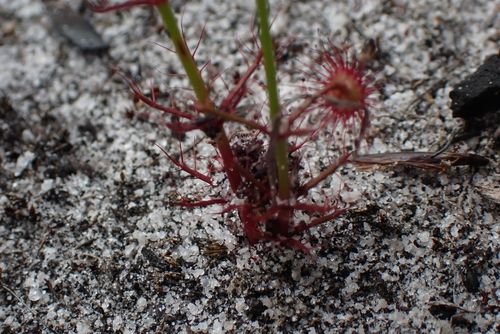
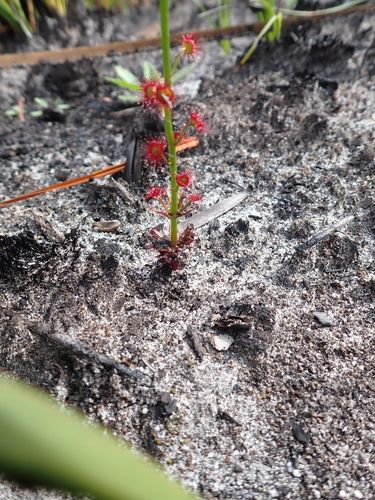
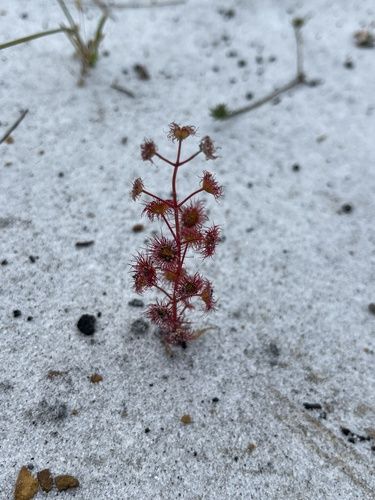
Etymology
- Drosera: see the genus sheet.
- fimbriata: from the Latin, “fringed”. In English: “Manypeaks sundew”.
Description (how to recognise it)
- Tuberous perennial, 10 to 15 cm tall.
- At the bottom of the stem, 2 or 3 whorls of non-carnivorous leaves; above them, 2 to 5 whorls of trap leaves.
- Flowering in October.
- According to FloraBase: erect tuberous perennial, 5 to 15 cm tall. White flowers, from September to October.
Distribution
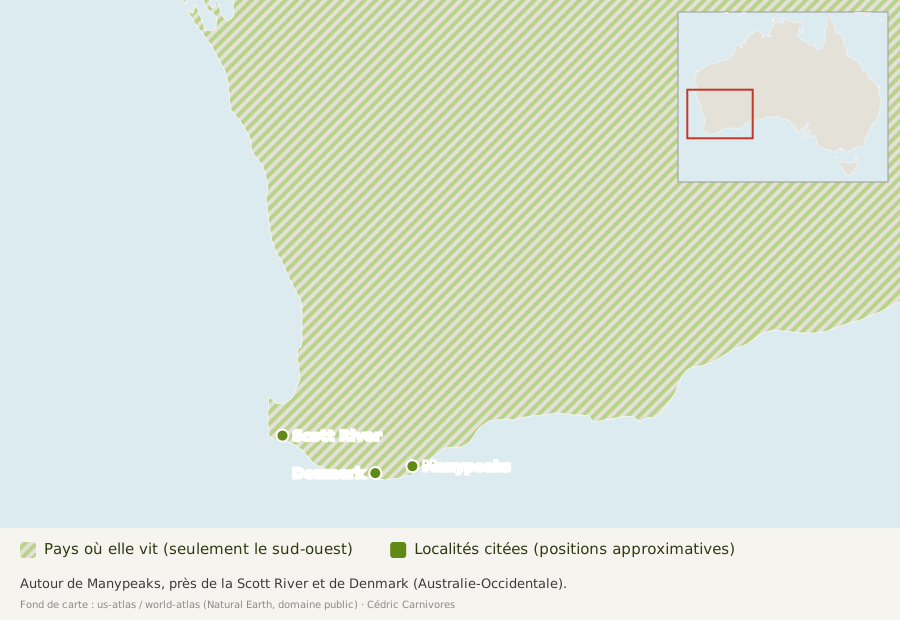
Endemic to Western Australia: mostly around Manypeaks, with other populations near the Scott River and Denmark.
Habitat
Sands that are wet in winter, in heathland. According to FloraBase: white sand, granite.
Sources
- Wikipedia (English), Drosera fimbriata: author, common name, description, flowering, range, habitat, status, section.
- FloraBase, Western Australian Herbarium, Drosera fimbriata DeBuhr: description (Grazyna Paczkowska, 3 April 1996), flowering, soil and habitat, regions, status in Western Australia.
- GBIF, Drosera fimbriata: author, original publication, countries and localities of the herbarium specimens and observations.