Drosera fulva Planch.
Species sheet, updated on 30/10/2026.
At a glance
| Scientific name | Drosera fulva Jules Émile Planchon, 1848 |
| Family | Droseraceae (subgenus Lasiocephala: the “petiolaris” sundews) |
| Distribution | Around Darwin, from Koolpinyah to Noonamah (Northern Territory) |
| Habitat | Damp sands of seasonal depressions, and seeps |
| Status | Common and not threatened according to Lowrie (1996) |
Photos in the wild
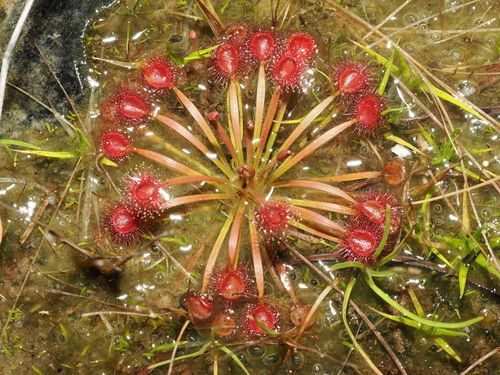
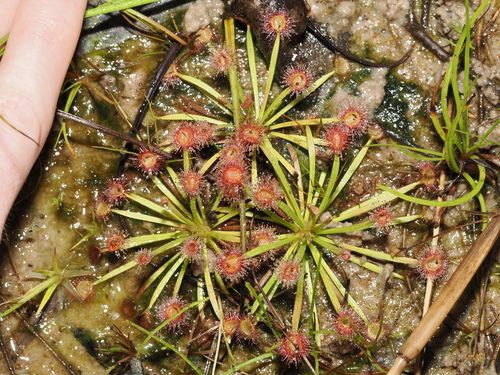
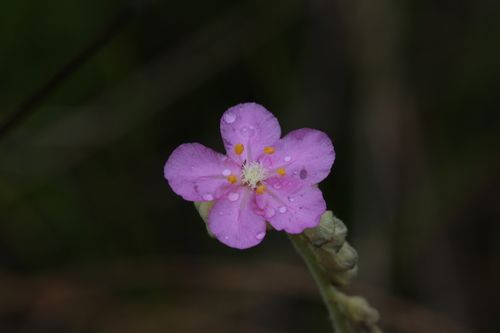
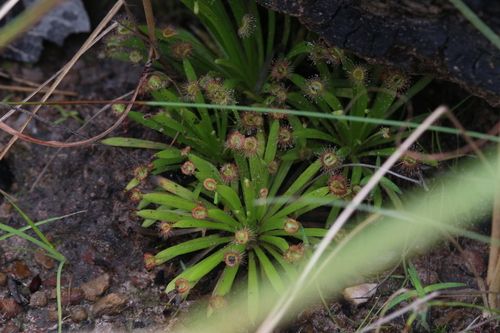
Etymology
- Drosera: see the genus sheet.
- fulva: from the Latin, “tawny, reddish-brown”.
History of the description
- Around 1838-1840: John W. Armstrong collects it at Port Essington.
- 1848: description by Planchon.
- Long merged into D. petiolaris, it was recognised again by Allen Lowrie.
Description (how to recognise it)
- Compact rosette of half-erect or prostrate leaves; round, red blades of 2 to 3 mm.
- Scapes of 25 to 45 cm, white flowers, sometimes pink, from February to May.
Distribution
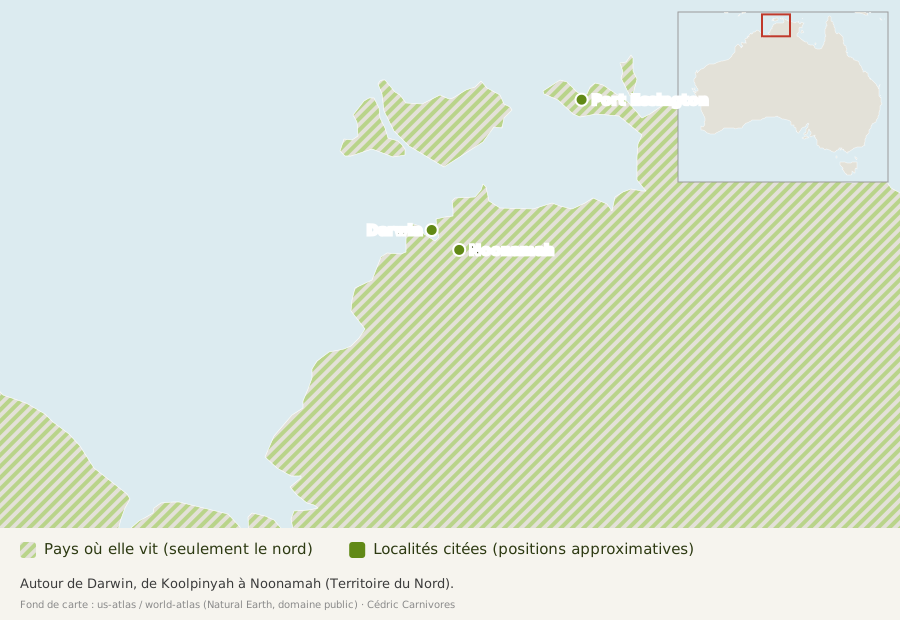
Endemic to the Northern Territory: around Darwin, from Koolpinyah to Noonamah; one collection from Port Essington, perhaps also on the Cobourg Peninsula.
Habitat
Damp sands of seasonal depressions, above flood level, or seeps.
Did you know?
- Close to D. brevicornis and D. dilatatopetiolaris.
Sources
- Wikipedia (English), Drosera fulva: author, history, description, flowering, range, habitat, status, relationships.
- GBIF, Drosera fulva: author, original publication, countries and localities of the herbarium specimens and observations.