Drosera grantsaui Rivadavia
Species sheet, updated on 30/10/2026.
At a glance
| Scientific name | Drosera grantsaui Fernando Rivadavia, 2003 |
| Family | Droseraceae |
| Distribution | Brazil |
| Status | Not yet assessed by the IUCN |
Etymology
- Drosera: see the genus sheet.
- grantsaui: named after a person called Grantsau.
Description (how to recognise it)
- According to Rivadavia (quoted by Hochberg and Rivadavia, 2003): a perennial sundew, reminiscent of D. scorpioides or a small D. chrysolepis; long confused with D. communis. Depending on the habitat, the stem is barely visible or reaches nearly 30 cm.
- Flowers white to pale lilac or pale pink; it flowers all year round, with no particular season.
Distribution
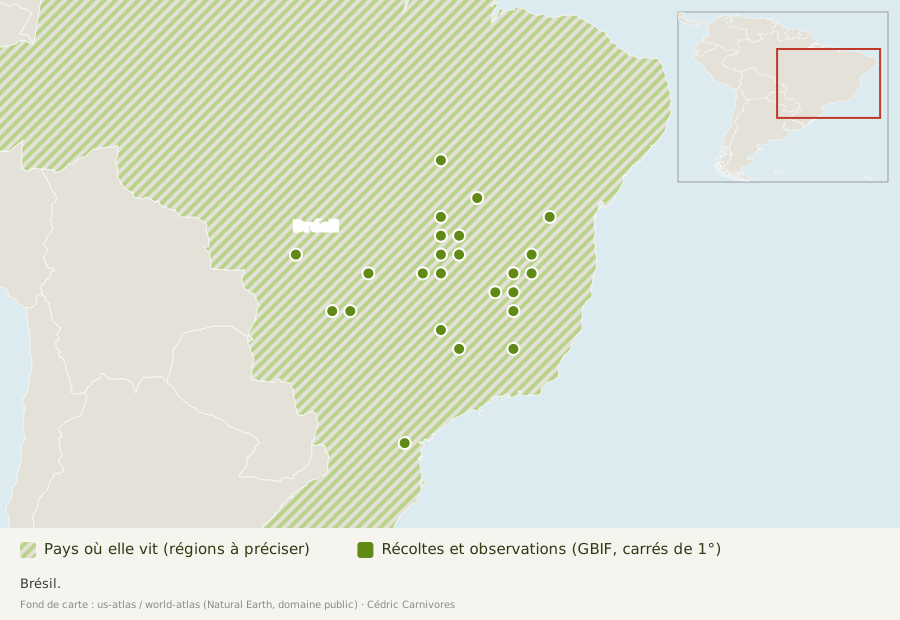
Endemic to Brazil. Regions where most of the herbarium specimens and observations published in GBIF come from (number of records): Minas Gerais (90), Goiás (32), Federal District (Brasília) (12), Paraná (12), Mato Grosso (9). According to Kew's world plant list (WCVP), it is native to the following regions: northeastern Brazil, northern Brazil, southeastern Brazil, southern Brazil, west-central Brazil and Paraguay. According to Flora do Brasil (the official list of Brazilian plants), it grows in Brazil in these states: Bahia, Federal District, Goiás, Minas Gerais, Mato Grosso do Sul, Mato Grosso, Paraná, São Paulo and Tocantins. Major biomes: Cerrado and Atlantic Forest.
Habitat
According to Flora do Brasil: terrestrial plant, in campos rupestres (rocky mountain grasslands) and cerrado (savanna). Rivadavia, who discovered it in 1991 in Emas National Park, describes it as widespread and common in eastern and west-central Brazil (Paraná, São Paulo, Goiás, Mato Grosso, Minas Gerais, Federal District, Tocantins, Bahia), mainly on high sandstone plateaus with open vegetation, at about 550 to 1,550 m; it lives in places that are wet all year round (seeps, stream banks), on sphagnum, on peaty humus, more rarely on wet sandy-rocky or lateritic soil, often with other Drosera, Genlisea and Utricularia (Hochberg and Rivadavia, 2003). Based on the collections and observations published in GBIF, it grows mostly at 350 to 1,377 m altitude.
Sources
- Wikipedia (English), List of Drosera species: range.
- List of Drosera: authors, year.
- Kew, World Checklist of Vascular Plants (via GBIF): natural distribution.
- Flora e Funga do Brasil, official list (via GBIF): states, biomes, endemism, life form and vegetation types in Brazil.
- Hochberg and Rivadavia, Carnivorous Plant Newsletter 32, 2003 (archive.org): discovery, range, habitat, flowering.
- GBIF, Drosera grantsaui: author, original publication, countries, altitude and localities of herbarium specimens and observations.