Drosera gunniana (Planch.) de Salas
Species sheet, updated on 30/10/2026.
At a glance
| Scientific name | Drosera gunniana Jules Émile Planchon; Miguel de Salas, 2018 |
| Family | Droseraceae |
| Distribution | Australia |
| Status | Not yet assessed by the IUCN |
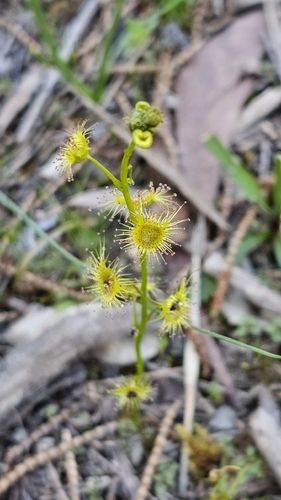
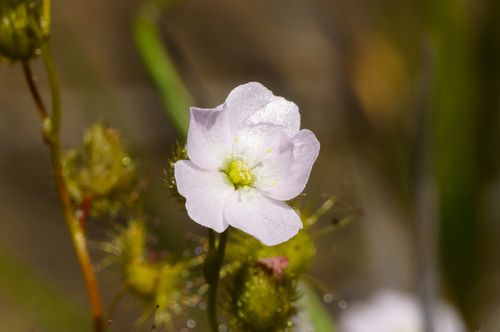
Photos in the wild
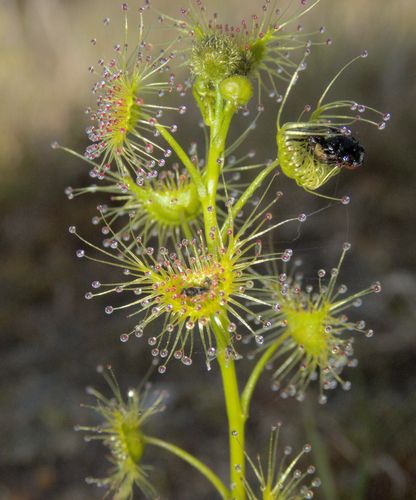
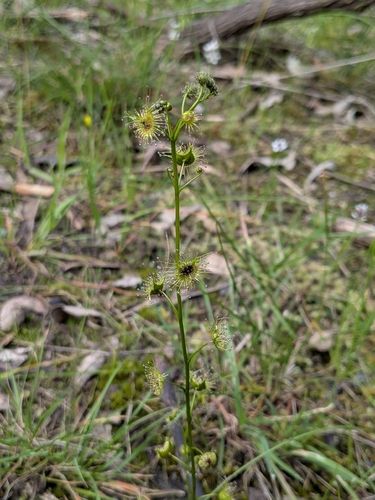
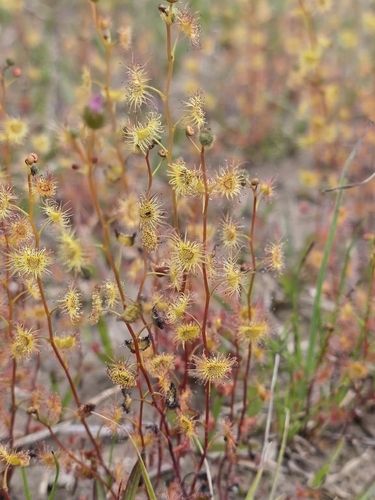
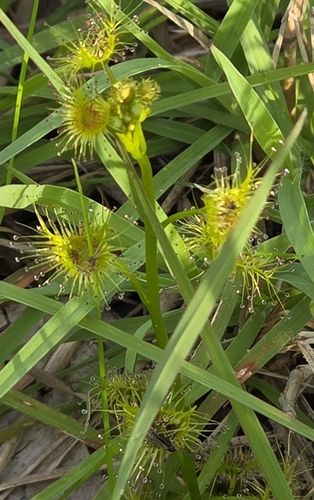
Etymology
- Drosera: see the genus sheet.
- gunniana: probably in honour of the Tasmanian botanist Ronald Gunn (not confirmed).
Description (how to recognise it)
- According to de Salas (2018), who raised it to species rank: a tuberous sundew (pink or red tuber), up to 30 cm, growing in loose colonies; erect stem, most often a single main stem; basal rosette usually present at flowering, with half-moon-shaped, non-peltate leaves.
- Stem leaves peltate, crescent-shaped with auricles, 5 to 6 mm; sepals green or blackish, with a fringed margin; petals pink or white, 5 to 8 mm. It belongs to the D. peltata complex; de Salas distinguishes it in particular from D. hookeri, which has several stems.
Distribution
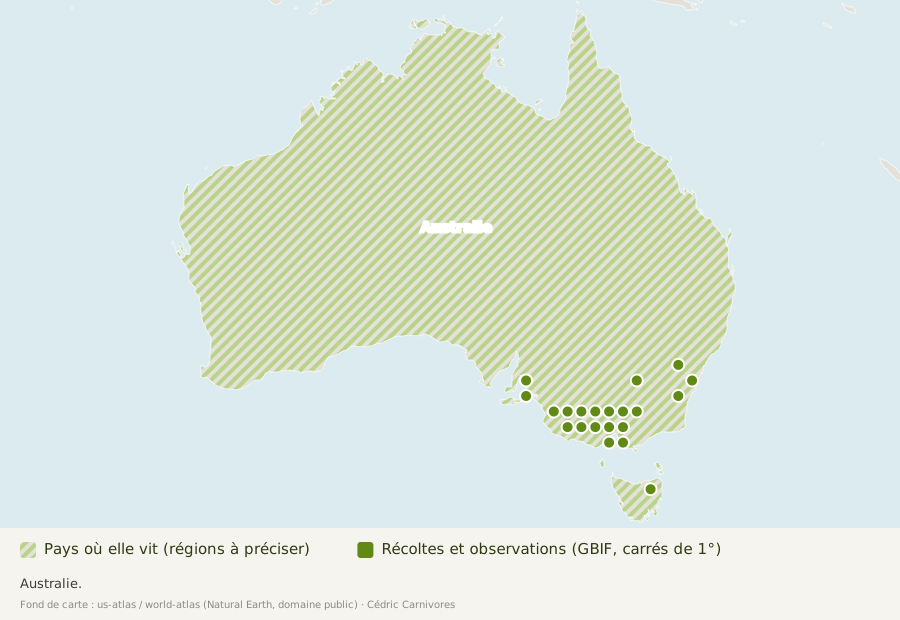
Endemic to Australia. Regions where most of the herbarium specimens and observations published in GBIF come from (number of records): Victoria (734), South Australia (295), New South Wales (111).
Habitat
De Salas (2018) records it in open woodland, grassy woodland and open grassy places, even in lawns, in New South Wales, Victoria, South Australia and Tasmania, at low and middle altitudes; in flower from September to November, dormant in summer.
Sources
- Wikipedia (English), List of Drosera species: range.
- List of Drosera: authors, year.
- de Salas, Muelleria 36, 2018 (archive.org): new rank, description, habitat.
- GBIF, Drosera gunniana: author, original publication, countries and localities of herbarium specimens and observations.