Drosera hartmeyerorum Schlauer
Species sheet, updated on 30/10/2026.
At a glance
| Scientific name | Drosera hartmeyerorum Jan Schlauer, 2001 |
| Family | Droseraceae (subgenus Drosera, section Arachnopus) |
| Distribution | Northern Western Australia |
| Habitat | Warm, wet, nutrient-poor sands or peats |
| Status | Least concern (LC) on the IUCN Red List |
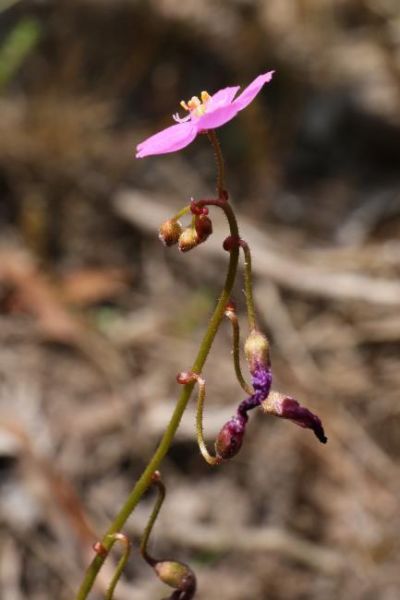
Photos in the wild
Etymology
- Drosera: see the genus sheet.
- hartmeyerorum: in honour of Siegfried and Irmgard Hartmeyer, who discovered it in 1995.
History of the description
- 1995: discovered by Siegfried and Irmgard Hartmeyer.
- First seen as a subspecies of D. indica, it was described as a species in 2001.
Description (how to recognise it)
- Annual plant that grows in summer, with long, sprawling leaves that readily curl around captured insects.
- Small, round yellow glands at the base of the leaves: they set it apart from all the others, but their role is unknown.
Distribution
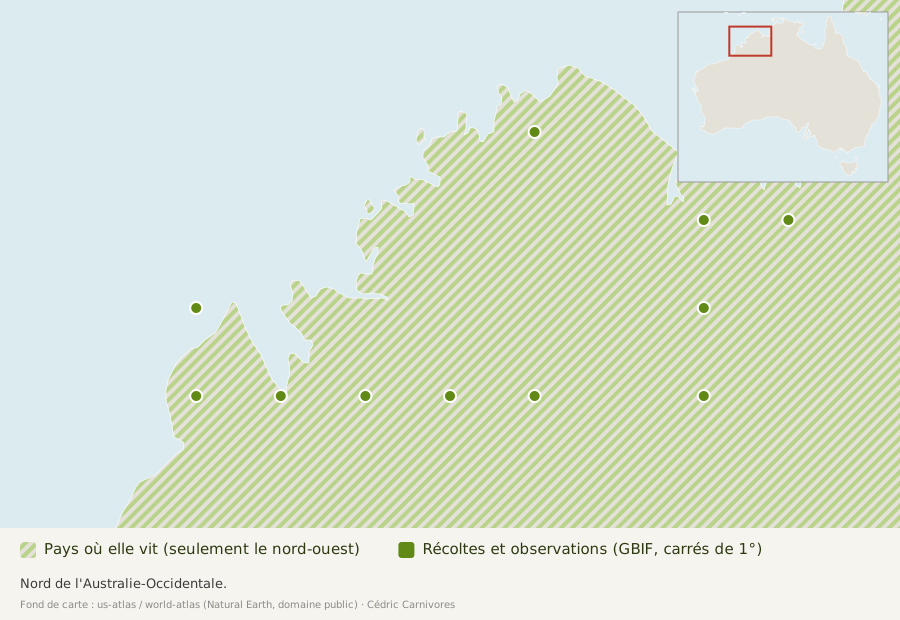
Northern Western Australia.
Habitat
Warm, wet, sandy or peaty places, with very humid air and poor soil. Based on the collections and observations published in GBIF, it grows mostly at 165 to 291 m altitude.
Did you know?
- Its closest relative is D. indica.
Sources
- Wikipedia (English), Drosera hartmeyerorum: author, discovery, description, yellow glands, range, habitat, relationships, section.
- GBIF, Drosera hartmeyerorum: author, original publication, IUCN Red List category, countries, altitude and localities of herbarium specimens and observations.