Drosera katangensis Taton
Species sheet, updated on 30/10/2026.
At a glance
| Scientific name | Drosera katangensis Auguste Taton, 1945 |
| Family | Droseraceae |
| Distribution | Haut-Katanga (DR Congo) |
| Habitat | Grassy marshes |
| Status | Critically endangered (IUCN) |
Etymology
- Drosera: see the genus sheet.
- katangensis: “from Katanga”.
History of the description
- Known from a single collection made in 1912; never seen again since.
Description (how to recognise it)
- Perennial plant of waterlogged soils.
- Upright stem up to 15 cm, densely glandular; alternate, widely spaced leaves with an oblong-spatulate blade 5 to 15 mm long, hairy underneath; scape up to 20 cm, very hairy, with at most 8 flowers.
- Still poorly known: it shares features with D. flexicaulis, D. elongata and D. bequaertii.
Distribution
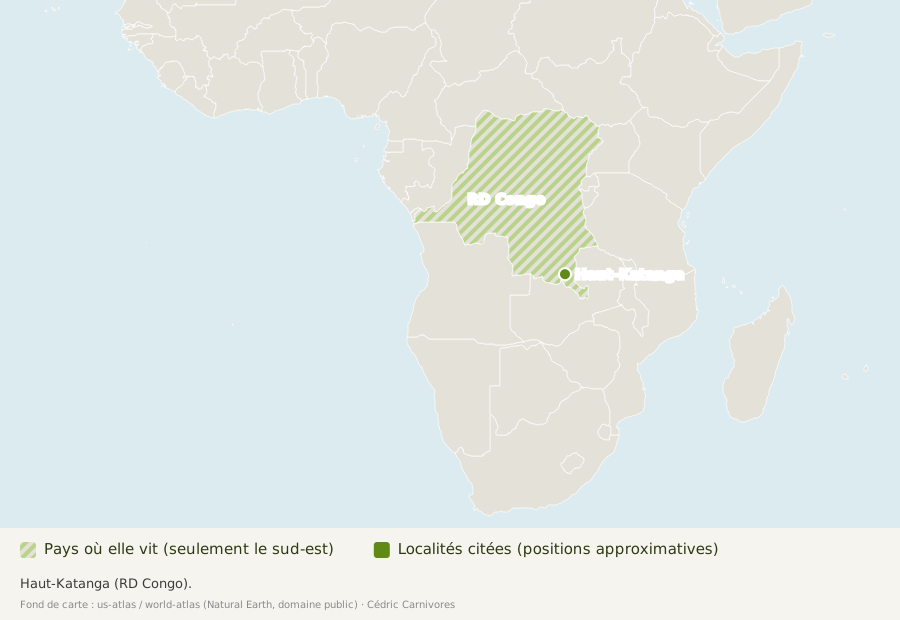
Endemic to DR Congo: Haut-Katanga.
Habitat
Grassy marshes. Wet plains; known only from the former province of Katanga (DR Congo): Manika Plateau (type specimen, 1912), Kundelungu Plateau at about 1 685 m and Kibara Plateau; probably also in neighbouring regions.
Threats and protection
Logging, mining concessions and agriculture.
Sources
- Wikipedia (English), Drosera katangensis: author, 1912 collection, range, habitat, status, threats.
- “Synopsis of the genus Drosera (Droseraceae) in Angola and the Democratic Republic of the Congo” (Plazi text, public domain, via GBIF): description, habitat, range, specimens.
- GBIF, Drosera katangensis: author, original publication, countries and localities of herbarium specimens and observations.