Drosera kenneallyi Lowrie
Species sheet, updated on 30/10/2026.
At a glance
| Scientific name | Drosera kenneallyi Allen Lowrie, Nuytsia, 1996 |
| Family | Droseraceae (subgenus Lasiocephala: “petiolate” sundews of northern Australia) |
| Distribution | Mitchell Plateau, Kimberley (Western Australia) |
| Habitat | Sandy loams at the edge of the airstrip swamp |
| Status | Not yet assessed by the IUCN |
Etymology
- Drosera: see the genus sheet.
- kenneallyi: in honour of Kevin F. Kenneally, who first collected it in 1982.
History of the description
- 1982: first collection by Kevin Kenneally.
- 1993: Allen Lowrie collects it during a Landscope expedition and brings it into cultivation.
- 1996: description.
Description (how to recognise it)
- Compact rosette pressed flat against the ground, with small red blades 2 to 3 mm long.
- Scapes 12.5 to 20.5 cm, white flowers from November to December.
Distribution
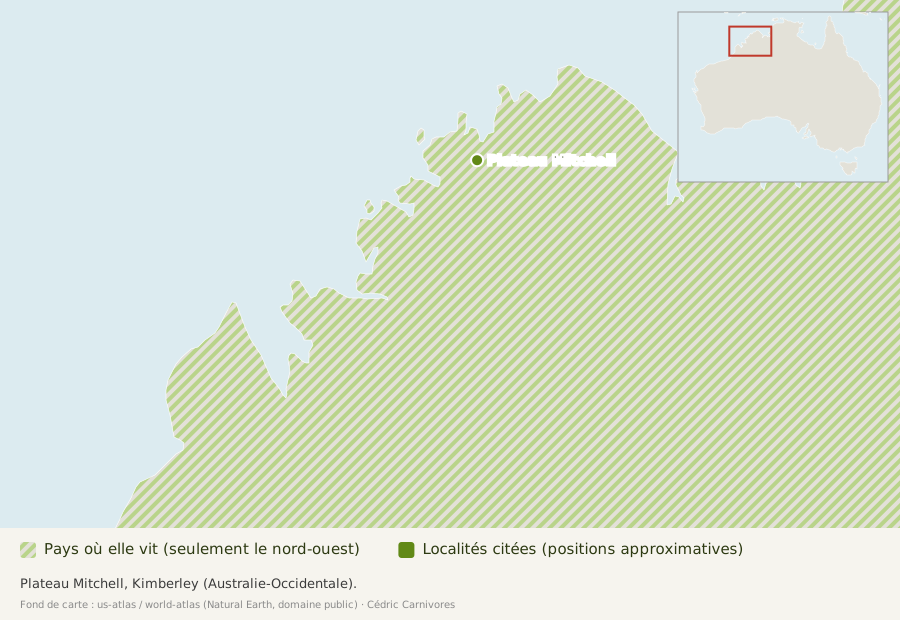
Endemic to the Kimberley: Mitchell Plateau, common within a radius of about 5 km around the airstrip.
Habitat
Sandy loams at the edge of the airstrip swamp. According to the collections and observations published in GBIF, it grows mainly at about 276 m above sea level.
Ecology
It copes with seasonal flooding by raising or lowering its petioles to keep its leaves above the water.
Did you know?
- Its closest relative is D. falconeri, which has larger leaves.
Sources
- Wikipedia (English), Drosera kenneallyi: author, etymology, history, description, flowering, range, habitat, flooding, relationships.
- GBIF, Drosera kenneallyi: author, original publication, countries, altitude and localities of herbarium specimens and observations.