Drosera occidentalis Morrison
Species sheet, updated on 30/10/2026.
At a glance
| Scientific name | Drosera occidentalis Alexander Morrison, 1912 |
| Family | Droseraceae (subgenus Ergaleium, section Bryastrum: pygmy sundews) |
| Distribution | Wetlands from north of Perth to south of Busselton (Western Australia) |
| Habitat | Wetlands |
| Status | Least concern (LC) on the IUCN Red List |
Etymology
- Drosera: see the genus sheet.
- occidentalis: from the Latin, “western”. English common name: “western sundew”.
Description (how to recognise it)
- Tiny sundew about 2.5 cm across, with trap blades sometimes only 1 mm long.
- White or pink flowers, from late spring to early summer.
- According to FloraBase: perennial rosette plant with fibrous roots, up to 2.5 cm tall. Pink to white flowers, from October to December or January.
Distribution
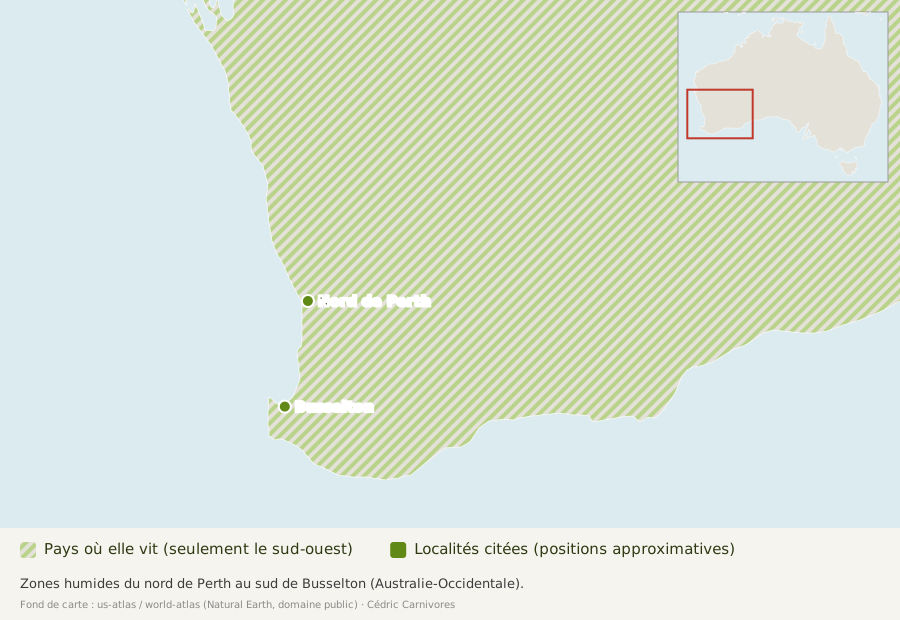
Endemic to Western Australia: wetlands from north of Perth to south of Busselton.
Habitat
According to the collections and observations published in GBIF, it grows mostly from 16 to 350 m above sea level.
Sources
- Wikipedia (English), Drosera occidentalis: author, description, flowering, range, habitat.
- Wikipedia (English), List of Drosera species: common name.
- FloraBase, Western Australian Herbarium, Drosera occidentalis Morrison: description (Grazyna Paczkowska, 10 April 1996), flowering, soil and habitat, regions, status in Western Australia.
- GBIF, Drosera occidentalis: author, original publication, IUCN Red List category, countries, altitude and localities of herbarium specimens and observations.