Drosera pedicellaris Lowrie
Species sheet, updated on 30/10/2026.
At a glance
| Scientific name | Drosera pedicellaris Allen Lowrie, 2002 |
| Family | Droseraceae (subgenus Ergaleium, section Bryastrum: pygmy sundews) |
| Distribution | Three small areas: Three Springs, Pindar and Badgingarra (Western Australia) |
| Habitat | White sands of open heathland, from 80 to 300 m |
| Status | Vulnerable (IUCN) |
Etymology
- Drosera: see the genus sheet.
- pedicellaris: from the Latin, “with pedicels”: its flowers have distinctly long pedicels.
History of the description
- 1997: discovery.
- 2002: description.
Description (how to recognise it)
- Pygmy sundew forming a rosette pressed flat to the ground, 1 to 1.8 cm across, with up to about twenty leaves.
- It reproduces by gemmae produced in autumn.
- Scapes up to 5.5 cm, with up to 20 white flowers with orange pollen, in October-November.
Distribution
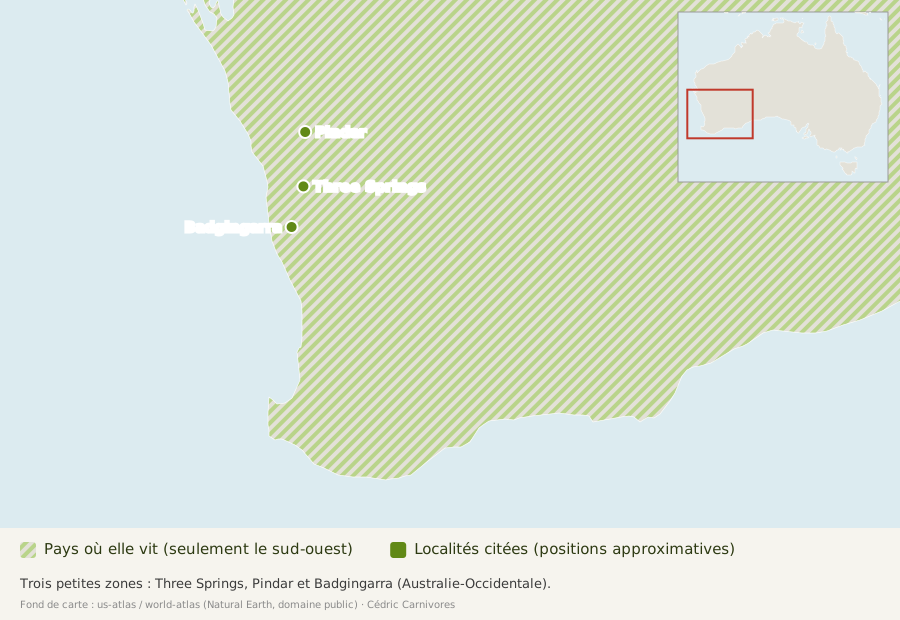
Endemic to Western Australia: only three small areas, near Three Springs and Pindar (east of Geraldton) and north of the Badgingarra reserve.
Habitat
White sands of open heathland, from 80 to 300 m.
Threats and protection
Clearing for farming of the land around the unprotected sites, and fires, even in the reserves. Two of the three sites are nature reserves.
Sources
- Wikipedia (English), Drosera pedicellaris: author, etymology, discovery, description, gemmae, flowering, range, habitat, status, threats.
- GBIF, Drosera pedicellaris: author, original publication, countries and localities of herbarium specimens and observations.