Drosera petiolaris R. Br. ex DC.
Species sheet, updated on 30/10/2026.
At a glance
| Scientific name | Drosera petiolaris Robert Brown ex Augustin Pyramus de Candolle, Prodromus 1, 1824 |
| Family | Droseraceae (subgenus Lasiocephala: “petiolaris” sundews) |
| Distribution | Northern Australia (Western Australia, Northern Territory, Queensland) and New Guinea |
| Status | Least concern (LC) on the IUCN Red List |
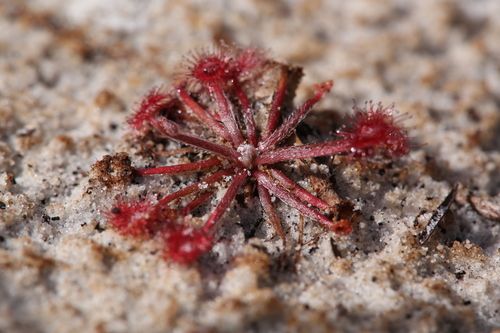
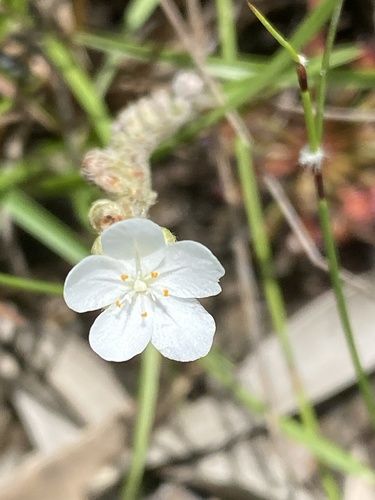
Photos in the wild
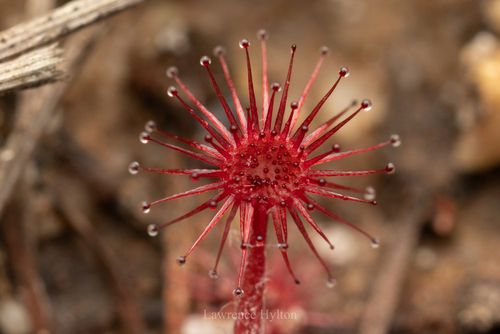
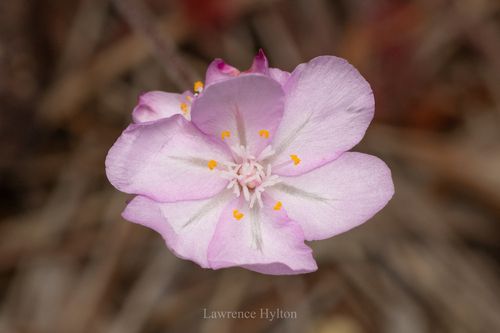
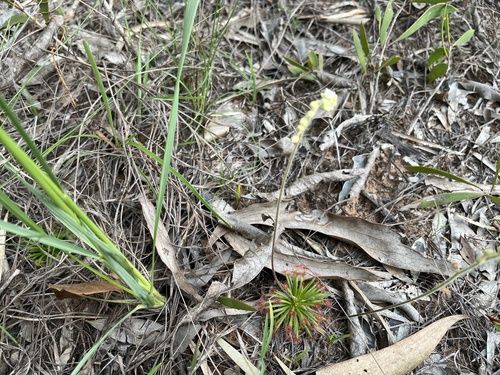
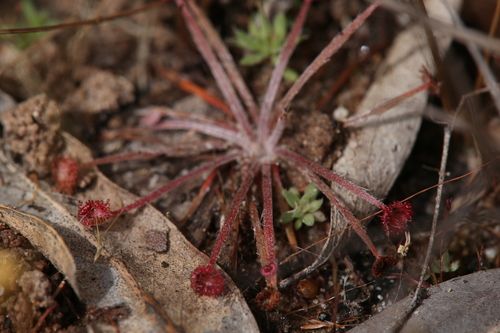
Etymology
- Drosera: see the genus sheet.
- petiolaris: from the Latin, “with a petiole”: its traps are borne at the end of long petioles. Aboriginal name: “larmi” according to English Wikipedia (not confirmed).
History of the description
- The type specimen was collected on the banks of the Endeavour River (Queensland) by Joseph Banks and Daniel Solander, during James Cook's first voyage.
- 1824: described by de Candolle, based on notes by Robert Brown.
Description (how to recognise it)
- Compact rosette from which long, narrow petioles grow, bearing at their tip the trap blades with long glands.
- According to Diels (1906): short stem very densely covered with the remains of old petioles and stipules; petiole 15 to 25 mm (sometimes 50 mm), sometimes widened and almost hairless, sometimes thin, thick and covered with a grey woolly felt; concave, round blade about 2.5 mm across.
- 1 or 2 scapes of 5 to 30 cm (most often 12 cm), sometimes woolly, bearing 10 to 35 flowers; sepals with tawny wool on the outside; purple petals about 7 mm; styles divided several times.
Distribution

Northern Australia (northern Western Australia, Northern Territory, Queensland) and New Guinea: the largest range in its subgenus, and the only species found outside Australia.
Habitat
Diels (1906) cites collections from the mouth of the Fly River (New Guinea) and from all over northern Australia: between the De Grey River and Lagrange Bay, Broome, Beagle Bay, Prince Regent River, Melville Island, Port Essington, Goulburn Island; in flower in August. According to the collections and observations published in GBIF, it grows mostly from 9 to 460 m above sea level.
Did you know?
- It gives its name to the petiolaris complex, which includes almost all of the subgenus Lasiocephala.
Sources
- Wikipedia (English), Drosera petiolaris: authors, type specimen, description, range, complex.
- Wikipedia (English), List of Drosera species: vernacular name.
- Diels, Das Pflanzenreich IV.112: Droseraceae, 1906 (archive.org): description, localities and habitats of the specimens (translated from Latin and German).
- GBIF, Drosera petiolaris: author, original publication, IUCN Red List category, countries, altitude and localities of herbarium specimens and observations.