Drosera pilosa Exell & Laundon
Species sheet, updated on 30/10/2026.
At a glance
| Scientific name | Drosera pilosa Arthur Wallis Exell & Jack Laundon, 1956 |
| Family | Droseraceae |
| Distribution | Cameroon, Guinea, Kenya and Tanzania |
| Status | Least concern (LC) on the IUCN Red List |
Etymology
- Drosera: see the genus sheet.
- pilosa: from the Latin, “hairy”.
Description (how to recognise it)
- Stemless perennial, in a rosette; elliptic to obovate blade 4 to 13 mm, hairy underneath; lateral, ascending, hairy scapes 2 to 16 cm, with 2 to 6 flowers.
- Very close to D. burkeana, but with a hairy peduncle, pedicels and sepals (hence its name).
Distribution
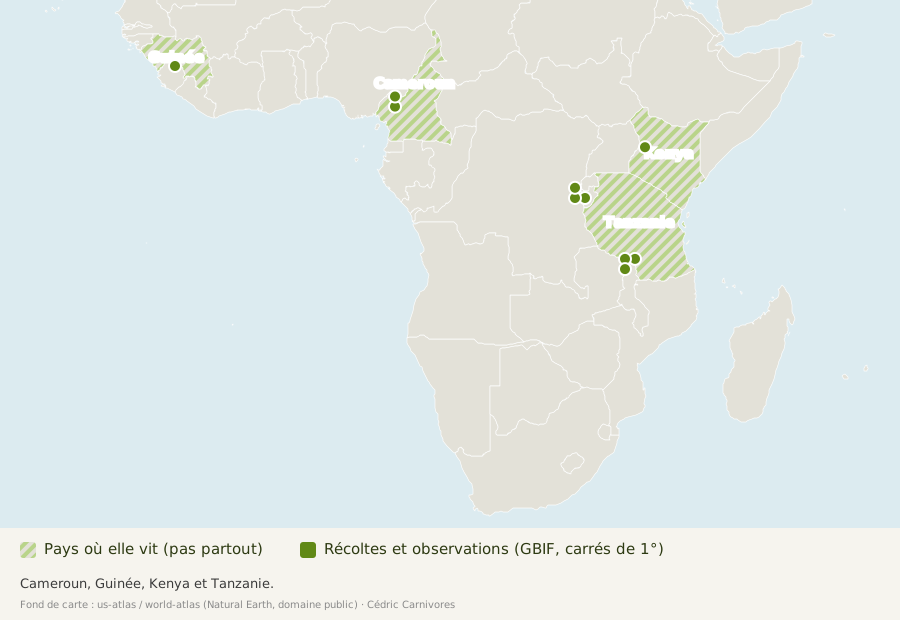
Tropical Africa: Cameroon, Guinea, Kenya and Tanzania. Regions where most of the herbarium specimens and observations published in GBIF come from (number of records): Cuando Cubango (4), Muramvya (4). According to Kew's world checklist of plants (WCVP), it is native to the following regions: Angola, Burundi, Cameroon, DR Congo, Guinea, Kenya, Rwanda, Sierra Leone and Tanzania.
Habitat
Mountain species of tropical Africa: Angola, Burundi, Cameroon, DR Congo, Guinea, Kenya, Malawi, Rwanda, Sierra Leone and Tanzania (type specimen north of Lake Malawi, 1885); collections at around 1 360 to 2 200 m. According to the collections and observations published in GBIF, it grows mostly from 1 219 to 2 700 m above sea level.
Sources
- Wikipedia (English), List of Drosera species: range.
- List of Drosera: authors, year.
- Kew, World Checklist of Vascular Plants (via GBIF): natural distribution.
- “Synopsis of the genus Drosera (Droseraceae) in Angola and the Democratic Republic of the Congo” (Plazi text, public domain, via GBIF): description, habitat, range, specimens.
- GBIF, Drosera pilosa: author, original publication, IUCN Red List category, countries, altitude and localities of herbarium specimens and observations.